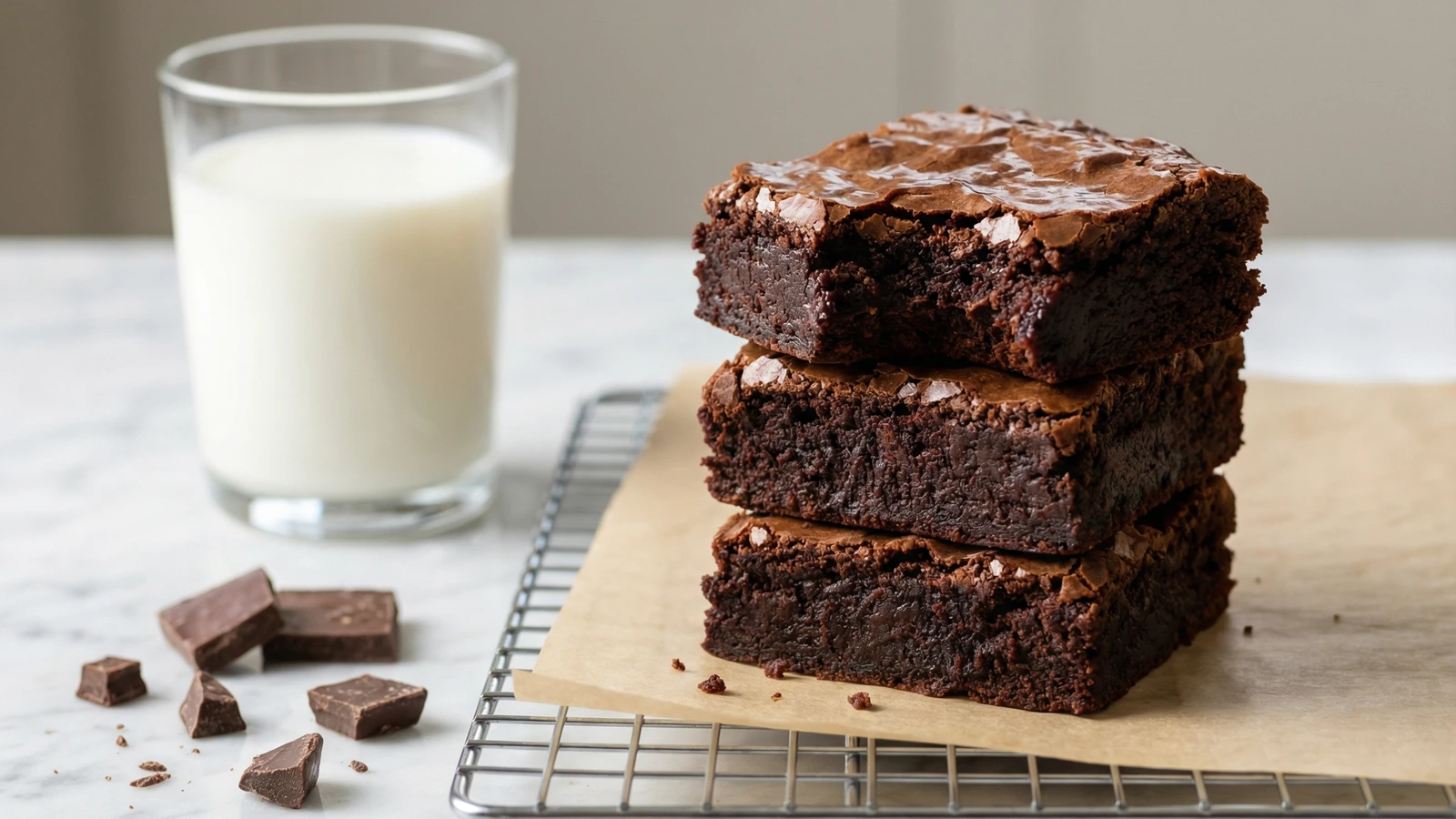
Intensely chocolate squares with that coveted shiny, crackled crust and a dense, almost truffle-like interior. This is the brownie that converts cake-brownie people.
Pastries & Cookies
American
Make Ahead
Potluck
Comfort Food
20 min
Active Time
25 min cook•45 min total
Yield16 brownies
The brownie occupies a peculiar place in American baking. It appeared sometime in the late 1800s, possibly at Chicago's Palmer House Hotel, possibly in a New England kitchen, possibly by accident when someone forgot the leavening. The origin matters less than the result: a confection that belongs to neither cookie nor cake, existing in its own category of dense chocolate satisfaction.
What separates a fudgy brownie from its cakey cousin comes down to ratios. More fat, less flour, no chemical leavening. The chocolate does all the structural work here, setting up as it cools into something closer to ganache than batter. That shiny, crackled top everyone chases? It forms when dissolved sugar rises to the surface and crystallizes as the brownies cool. Beating the eggs and sugar together creates the meringue-like structure that makes this possible.
I've tested hundreds of brownie recipes over the years. This one wins because it respects what a brownie wants to be: intensely chocolate, slightly underdone in the center, dense enough to require a glass of cold milk. The method matters as much as the ingredients. Melt your chocolate gently. Beat your eggs until they're pale and ribboned. Pull the pan from the oven while the center still wobbles. Trust the carryover heat to finish the job.
The technique, the tradition, and the story behind every dish.
•Double boiler or heatproof bowl set over saucepan
•Hand mixer or sturdy whisk
•Wire cooling rack
•Parchment paper
Instructions
1
Prepare your pan
Position a rack in the center of your oven and heat to 350°F. Line an 8-inch square metal pan with parchment paper, leaving a 2-inch overhang on two opposite sides. These handles make lifting the cooled brownies effortless. Lightly grease the parchment with butter or cooking spray.
Metal pans conduct heat better than glass. If using glass, reduce your oven temperature by 25 degrees to prevent overbrowning at the edges.
2
Melt butter and chocolate
Set a heatproof bowl over a pot of barely simmering water. The bowl shouldn't touch the water. Add the butter and both chocolates. Stir occasionally with a rubber spatula until everything melts into a glossy, uniform mixture. This takes 4 to 5 minutes. The chocolate should feel warm, not hot, when you touch the bowl. Remove from heat and let cool for 5 minutes.
Chocolate seizes when it meets steam or water droplets. Keep your bowl and spatula bone dry.
3
Beat eggs and sugar
While the chocolate cools, combine the eggs and sugar in a large bowl. Beat with a hand mixer or whisk vigorously for 3 to 4 minutes until the mixture turns pale yellow, doubles in volume, and falls from the whisk in thick ribbons that hold their shape for a moment before dissolving. This step creates the shiny top. Don't shortcut it.
Room temperature eggs whip to greater volume than cold eggs. If you forgot to set them out, submerge the whole eggs in warm water for 5 minutes.
4
Combine wet ingredients
Pour the melted chocolate mixture into the beaten eggs in a slow, steady stream, folding gently with a spatula as you pour. Add the vanilla and salt. Continue folding until no streaks remain. The batter will look like silk chocolate mousse, glossy and smooth.
5
Add dry ingredients
Sift the flour and cocoa powder directly over the batter. Fold with the spatula using broad, gentle strokes, scraping the bottom of the bowl with each pass. Stop the moment the flour disappears. Overmixing develops gluten and produces tough brownies. A few tiny streaks won't hurt anything.
6
Bake until just set
Scrape the batter into your prepared pan, spreading it evenly into the corners. Bake for 22 to 25 minutes. The brownies are ready when the top looks set and matte at the edges but still slightly glossy in the center. A toothpick inserted 2 inches from the edge should come out with moist crumbs clinging to it, not wet batter. The center will jiggle slightly when you shake the pan. This is correct. It will firm as it cools.
Every oven lies. Start checking at 20 minutes. Underbaked brownies can be returned to the oven. Overbaked brownies become cake.
7
Cool completely
Let the brownies cool in the pan on a wire rack for at least 2 hours. I know this is difficult. The cooling period allows the chocolate to set into that dense, fudgy texture you're after. Cutting too soon yields gooey, shapeless squares that taste fine but disappoint the eye. Once completely cool, use the parchment handles to lift the entire slab onto a cutting board.
8
Cut and serve
Use a sharp knife to cut into 16 squares, wiping the blade clean between cuts. This produces those clean, sharp edges. For extra fudgy centers, refrigerate the cooled slab for 30 minutes before cutting. The brownies will slice like cold butter, each piece a perfect block of chocolate intensity.
Chef Tips
•The chocolate quality determines everything. Use chocolate you'd happily eat straight from the bar. Grocery store baking chips won't deliver the complexity you want.
•For extra depth, add 1 tablespoon of instant espresso powder to the melted chocolate. It won't taste like coffee. It amplifies the chocolate.
•Store brownies at room temperature, tightly wrapped, for up to 4 days. They actually improve on day two as the flavors meld.
•These freeze beautifully. Wrap individual squares in plastic, then foil, and freeze for up to 3 months. Thaw at room temperature for an hour, or eat them cold from the freezer if you enjoy that dense, almost candy-like texture.
•For brownie sundaes, warm squares in a 300°F oven for 5 minutes before topping with ice cream. The edges crisp slightly while the center goes molten.
Advance Preparation
•Batter can be made, poured into the prepared pan, covered, and refrigerated for up to 24 hours before baking. Add 3 to 4 minutes to the baking time since you're starting from cold.
•Baked brownies keep at room temperature for 4 days or refrigerated for a week. Bring to room temperature before serving for the best texture.
•Cut brownies freeze for up to 3 months. Wrap each square individually for easy access.
Frequently Asked Questions
Nutrition Information
1 brownie (about 33g)
Calories
250 calories
Total Fat
11 g
Saturated Fat
6 g
Trans Fat
0 g
Unsaturated Fat
5 g
Cholesterol
45 mg
Sodium
120 mg
Total Carbohydrates
21 g
Dietary Fiber
1 g
Sugars
14 g
Protein
2 g
Where cooking meets culture.
Culinary guides, cultural storytelling, and the editorial depth that makes cooking meaningful.