
Chef Lupita
Almendrados Conventuales Poblanos
Puebla's convent almond cookies, made from blanched almonds, sugar syrup, egg yolks, canela, and patient hands, the kind of sweet that belongs beside coffee in talavera, not in a plastic bakery box.
A cooking platform built around craft, culture, and the stories behind what we eat.
Created by
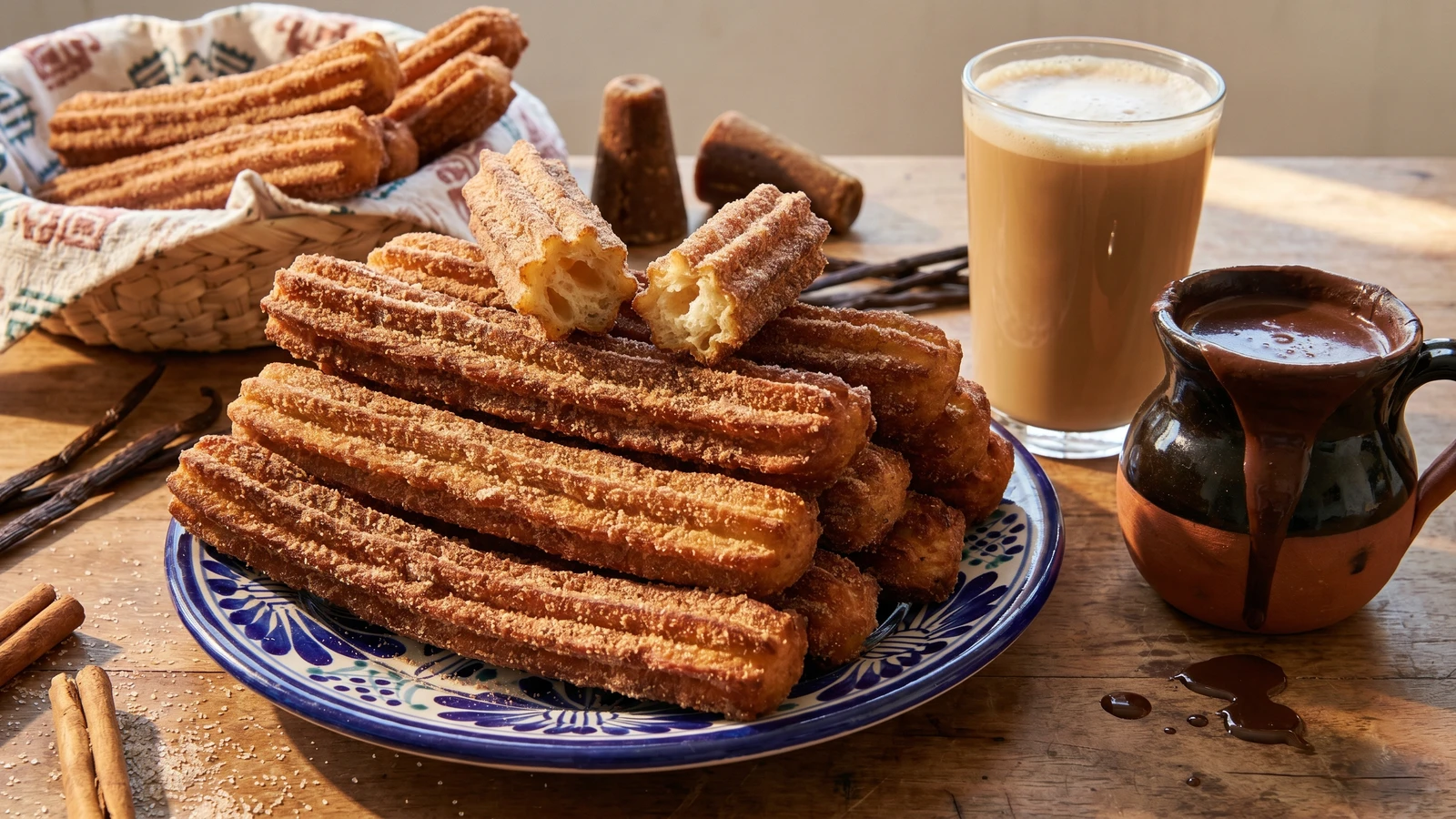
Veracruz's coffee-town churros, piped into long ridges, fried until crisp outside and tender within, then rolled in canela sugar and served with thick chocolate from the highland table.
Veracruz first. Coatepec sits in the mountains near Xalapa, where the air smells of coffee, wet stone, and pan dulce in the afternoon. These churros belong to that café rhythm: a plate on the table, a tall café lechero nearby, and chocolate thick enough to coat the spoon.
The dough is a cooked paste, flour worked into hot water, butter, salt, and a little sugar until it pulls away from the pot. Then the eggs go in one by one. That is what gives the churro its tender center. The star tip is not decoration. Those ridges make more surface for the oil to crisp. La cocina no es decoración, es trabajo.
Veracruz gives you the perfume: canela, piloncillo, coffee, and vanilla from Papantla to the north. Do not use fake vanilla here. In La Merced, the vanilla vendors can smell the difference before you open the bottle, and so can anyone who grew up near a good bakery.
My mother did not write many sweet recipes in her notebook, but next to churros she wrote one sentence: 'El aceite debe estar vivo, no furioso.' The oil should be alive, not furious. Too cool and the churros drink oil. Too hot and the outside darkens before the center cooks. Saber cocinar es saber vivir.
Churros arrived in Mexico through Spanish colonial cooking, but port cities like Veracruz helped turn them into café food because wheat flour, sugar, cacao, and later coffee moved through the Gulf trade routes. Coatepec became one of Veracruz's important coffee regions in the 19th century, and its cafés built a local habit of pairing fried pastries with café lechero or thick chocolate. Papantla vanilla, cultivated in northern Veracruz since Totonac times, is one of the regional ingredients that gives this version its place on the map.
Quantity
1 cup
Quantity
1/2 cup
Quantity
6 tablespoons
Quantity
1 tablespoon
Quantity
1/2 teaspoon
Quantity
1 1/4 cups
sifted
Quantity
3
at room temperature
Quantity
1 teaspoon
Quantity
2 quarts
Quantity
3/4 cup
Quantity
2 teaspoons
Quantity
3 cups
Quantity
6 ounces
chopped
Quantity
1 1/2 tablespoons
Quantity
1 small
Quantity
1 tablespoon
Quantity
1 pinch
| Ingredient | Quantity |
|---|---|
| water | 1 cup |
| whole milk | 1/2 cup |
| unsalted butter | 6 tablespoons |
| granulated sugar | 1 tablespoon |
| fine sea salt | 1/2 teaspoon |
| all-purpose floursifted | 1 1/4 cups |
| large eggsat room temperature | 3 |
| pure Papantla vanilla extract | 1 teaspoon |
| neutral frying oil, such as safflower or canola | 2 quarts |
| granulated sugar, for coating | 3/4 cup |
| ground Mexican canela, for coating | 2 teaspoons |
| whole milk, for chocolate | 3 cups |
| Mexican table chocolatechopped | 6 ounces |
| grated piloncillo | 1 1/2 tablespoons |
| Mexican canela stick | 1 small |
| masa harina | 1 tablespoon |
| fine sea salt | 1 pinch |
In a small clay cazuela or heavy saucepan, warm 3 cups whole milk with the chopped Mexican table chocolate, piloncillo, canela stick, masa harina, and a pinch of salt. Whisk over medium-low heat until the chocolate melts and the masa thickens the drink slightly, 8 to 10 minutes. Keep it warm at the back of the stove. It should pour slowly, not sit like pudding.
Combine the water, 1/2 cup milk, butter, 1 tablespoon sugar, and 1/2 teaspoon salt in a medium saucepan. Bring it to a firm simmer. Add the sifted flour all at once and stir hard with a wooden spoon until the dough gathers into one mass and leaves a thin film on the bottom of the pot, about 2 minutes. That film tells you the flour has cooked enough.
Move the dough to a mixing bowl and let it cool for 5 minutes. Beat in the eggs one at a time, mixing fully after each addition. The dough will look broken at first. Keep going. When it is ready, it will be glossy, thick, and slow to fall from the spoon. Beat in the Papantla vanilla at the end.
Heat the oil in a heavy pot to 365F. Mix the coating sugar and ground canela in a shallow dish. Fit a sturdy piping bag with a large closed-star tip, at least 1/2 inch wide, and fill it halfway with dough. Do not overfill the bag. You need control, not bravado.
Pipe 5- to 6-inch strips of dough directly into the oil, cutting each strip with scissors. Fry only 4 or 5 at a time so the oil stays lively. Turn them as they cook, 4 to 5 minutes total, until the ridges are deep golden and firm. The sound should be an even bubbling, not violent popping and not silence.
Lift the churros out with a spider or slotted spoon and drain on a wire rack for 30 seconds. While still hot, roll them in the canela sugar so it clings to the ridges. If you wait until they cool, the sugar falls off and you will blame the recipe. No me vengas con atajos.
Remove the canela stick from the chocolate and whisk once more. Serve the churros warm on a talavera plate with the thick chocolate in small cups for dipping. Add café lechero if you want the Coatepec table complete. Cada estado, su propia cocina.
1 serving (about 80g)
Culinary guides, cultural storytelling, and the editorial depth that makes cooking meaningful.
Discover Culinary ExplorerChef Lupita
Puebla's convent almond cookies, made from blanched almonds, sugar syrup, egg yolks, canela, and patient hands, the kind of sweet that belongs beside coffee in talavera, not in a plastic bakery box.

Chef Lupita
Ciudad de Mexico's panaderia banderillas are long sticks of hojaldre pressed with sugar, baked until amber, and finished with a hard glaze for coffee at the kitchen table.

Chef Lupita
Mérida's pale egg-yolk-and-vanilla kisses, tiny cookies built on eight yolks and a perfume of orange blossom, sandwiched with guava paste and dusted heavy with powdered sugar.

Chef Lupita
Hidalgo's bisquet de nata carries Pachuca's mining history into the breakfast table: a Cornish-style bread softened by Mexican nata, split warm and eaten with café de olla.