Culinary Explorer

A cooking platform built around craft, culture, and the stories behind what we eat.
Discover Culinary Explorer
Chocos Fritos de Huelva

Chocos Fritos de Huelva

Created by

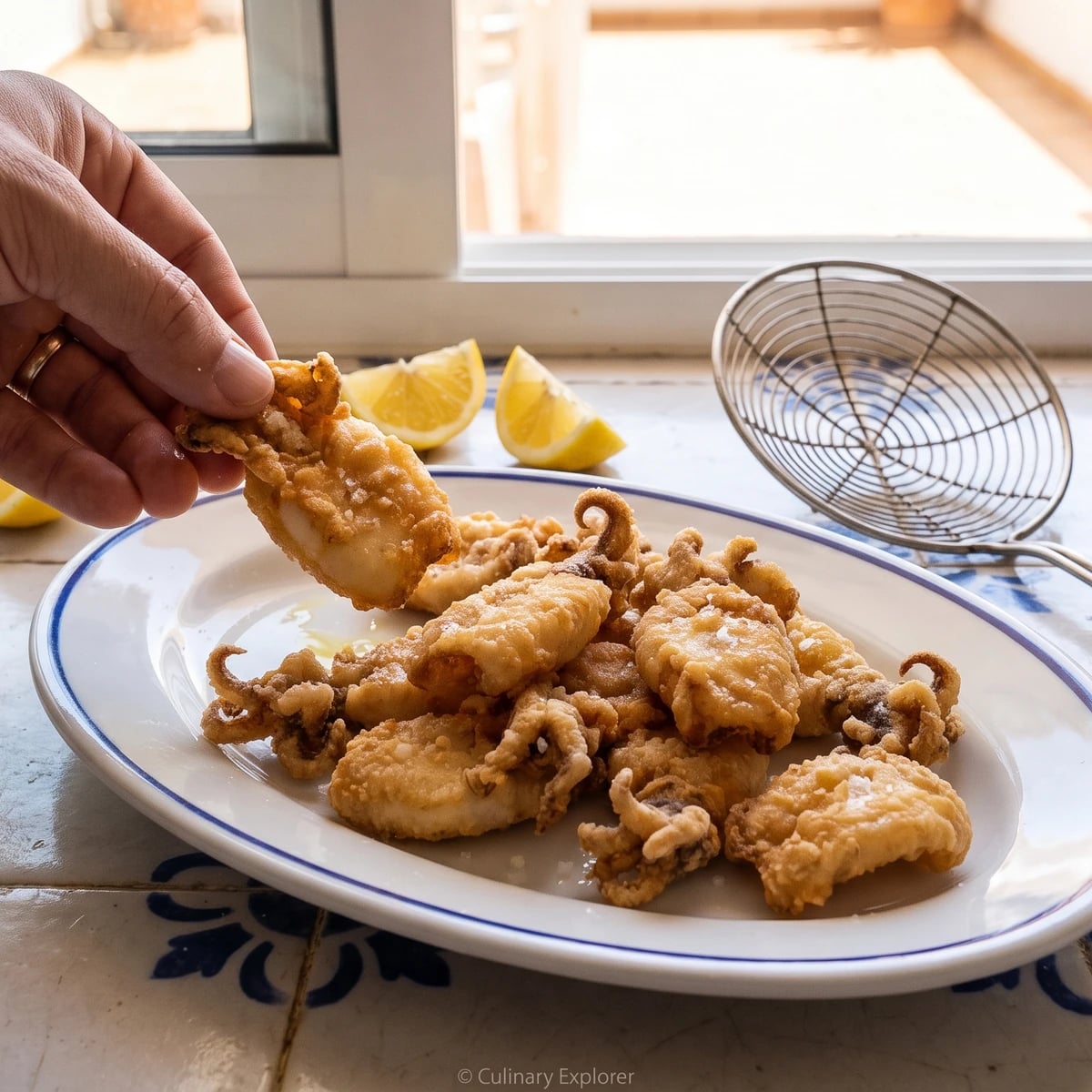
Chocos fritos are Huelva's fried cuttlefish, plain and exact: clean choco, dry it well, flour it lightly, and fry it hard and short so the sea stays tender.

Appetizers & Snacks
Spanish
Outdoor Dining
Dinner Party
Quick Meal
20 min
Active Time
8 min cook28 min total
Yield4 servings

Chocos fritos are Huelva's, from the Atlantic edge of Andalucía, where the cuttlefish is not a garnish or a clever little bite but the whole point. Small chocos can be fried whole once cleaned; a larger choco is cut into thick strips. Flour, salt, hot oil. That's the dish.

The method that decides it is drying and heat. Wet choco makes the flour clump and the oil drop, then you get a pale, leathery thing that tastes more of fryer than sea. Pat it dry until the paper comes away almost clean, coat it in harina para freír, the coarse Andalusian frying flour, shake off more than you think, and fry it in small batches at 180°C. Short. One to two minutes is enough.

If you can't find choco where you are, use cleaned cuttlefish first, then squid at a pinch. Squid cooks faster and tastes a little sweeter, so cut it thicker and pull it the moment the flour turns pale gold. No hace falta haber pisado España. You do need good seafood, dry hands, and oil that is properly hot. Siempre sale, si lo sigues.

Chocos fritos belong to Huelva and the Costa de la Luz, where cuttlefish from the Atlantic fish markets is part of everyday frying as much as anchovies or acedías. In Huelva, choco is so tied to local identity that people from the city are nicknamed choqueros, the cuttlefish people. The dish comes from the Andalusian fritura tradition: seafood cooked quickly in abundant olive oil with only flour between the fish and the heat.

The technique, the tradition, and the story behind every dish.

Discover Culinary Explorer

Ingredients

cleaned cuttlefish

Quantity

700g

small chocos left whole or larger choco cut into 2cm strips

fine sea salt

Quantity

8g

harina para freír or coarse wheat frying flour

Quantity

160g

fine semolina (optional)

Quantity

20g

mix with plain flour if you cannot find frying flour

olive oil or mild olive oil

Quantity

1 litre

for frying

lemon

Quantity

1

cut into wedges

Equipment Needed

  • Deep heavy frying pan or wide casserole
  • Kitchen thermometer
  • Spider or slotted spoon
  • Wire rack or paper-lined tray

Instructions

  1. 1

    Cut the choco

    Check that the cuttlefish is fully cleaned: no beak, no hard cartilage, no ink sac. Leave very small chocos whole if they are no longer than 7cm, or cut larger choco into strips about 2cm wide and 6cm long. Keep the pieces generous; thin strips overcook before the flour has time to colour.

  2. 2

    Dry it well

    Lay the choco on kitchen paper and pat it dry on every side, then leave it on fresh paper for 10 minutes. This is the step that decides the dish. If the surface is wet, the flour turns pasty and the oil cools; if it is dry, the coating stays thin and the choco fries before it toughens.

    If your fishmonger rinsed the cuttlefish heavily, dry it twice. A little patience here is worth more than any trick later.
  3. 3

    Salt and flour

    Sprinkle the choco evenly with the salt. Put the frying flour in a wide dish, adding the semolina only if you are using plain flour and need a coarser bite. Toss the choco through the flour, lift it in handfuls, and shake hard so only a thin dusty coat remains. Pésalo, no lo adivines, but don't bury it in flour.

  4. 4

    Heat the oil

    Pour the oil into a deep, heavy pan so it is at least 5cm deep and heat it to 180°C. If you have no thermometer, drop in a pinch of flour; it should fizz at once and float, not sink quietly and not darken in seconds. Set a rack or paper-lined tray beside the stove before you start, because the cooking is quick.

  5. 5

    Fry in batches

    Fry the choco in small batches, no more than a loose handful at a time, so the oil stays hot. Small whole chocos need about 90 seconds; thick strips need 1 to 2 minutes. Move them once with a spider or slotted spoon, then lift them out when the coating is pale gold and crisp at the edges. Do not wait for deep brown. By then the choco has paid for your hesitation.

  6. 6

    Drain and serve

    Drain briefly on the rack or paper, salt with a small pinch while still glossy, and serve at once with lemon wedges. Eat them hot, before the coating softens. Tal como se hace allí: plain, fast, and with no sauce hiding the cuttlefish.

Chef Tips

  • Buy cleaned cuttlefish if you can, but ask whether it has been soaked in a lot of water. Very wet choco spits in the oil and fries poorly. Dry it well and the dish becomes simple.
  • Harina para freír is the right flour for Andalusian frying: a little coarser than plain flour, so it gives a light dry crust without batter. If you cannot find it, mix plain flour with fine semolina.
  • Cuttlefish is the first choice. Squid works when you are far from Huelva, but it cooks faster and has less firm bite, so cut it thick and fry it even shorter.
  • Serve these straight from the pan. Fried choco waits for nobody. If you are feeding a table, fry in waves and let people eat while the next batch goes in.

Advance Preparation

  • The choco can be cleaned, cut, and kept covered in the refrigerator up to 12 hours ahead. Dry it only just before flouring.
  • Do not flour the choco ahead of time. The flour pulls moisture from the seafood and turns gluey before it reaches the oil.
  • Set the flour, salt, lemon, draining rack, and serving plate ready before heating the oil; once frying starts, the dish moves quickly.

Frequently Asked Questions

Nutrition Information

1 serving (about 200g)

Calories
420 calories
Total Fat
23 g
Saturated Fat
3 g
Trans Fat
0 g
Unsaturated Fat
19 g
Cholesterol
195 mg
Sodium
1440 mg
Total Carbohydrates
22 g
Dietary Fiber
1 g
Sugars
1 g
Protein
31 g

Note: Chef personas and recipes are created with AI assistance. Cook with care: follow safe food-handling practices, check doneness with a thermometer when needed, and adapt for allergies and your kitchen.

Where cooking meets culture.

Culinary guides, cultural storytelling, and the editorial depth that makes cooking meaningful.

Discover Culinary Explorer

More from Andalusian Fritura & Pescaíto Frito

Browse the full collection