
Chef Juliana
Beiju Chica de Santarém Novo
You don't need the right grandmother or a festival oven to learn the logic: grate mandioca fine, squeeze it damp, mix in coconut, and bake thin. Two ingredients, no packet, real crunch.
A cooking platform built around craft, culture, and the stories behind what we eat.
Created by
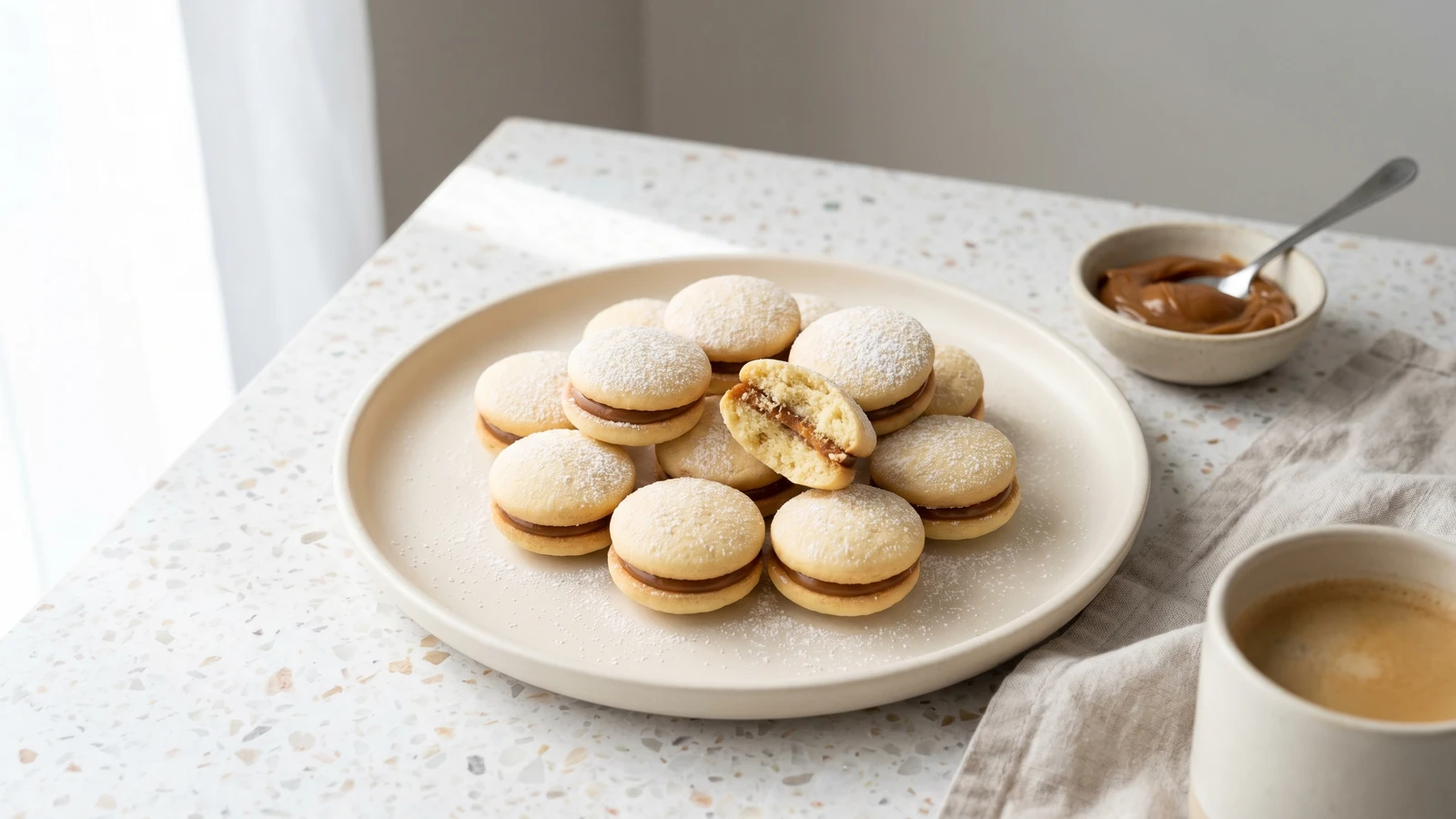
You don't need pastry courage for this. Two tender little cookies, a spoonful of doce de leite, and the patience to let the dough chill are enough to solve the sweet table.
You know that little voice, the one that looks at a tray of party sweets and says, isso não é pra mim. I know her. I had her in my own kitchen, standing there with flour on my shirt and the confidence of a wet match. Cozinhar não é dom, é um aprendizado. Cookies included.
Casadinho belongs to the sweet side of the Brazilian home table: birthdays, bridal showers, church bazaars, a cousin's afternoon coffee where somebody brings salgadinhos and somebody else brings the tray of sweets. It isn't the pê-efe, rice, beans, meat or egg, and something green, that holds the country up on a Tuesday. But it lives beside that same logic: comida de verdade made with recognizable things, in a home kitchen, by hands that don't need permission.
The method is small and exact. Cream the butter and sugar so the cookies bake tender instead of heavy. Chill the dough so it doesn't spread into sad little puddles. Cook or choose a firm doce de leite so the filling holds without oozing out the sides. A gente isn't decorating a museum piece. We're making receitas que funcionam.
By the end you'll have two little cookies married with doce de leite and dusted with sugar, sweet enough for a party and plain enough for coffee. Anota aí: the only fancy thing here is believing you couldn't do it.
Casadinho means little married one, a name used in Brazil for paired sweets joined by a filling, most commonly guava paste, brigadeiro, or doce de leite depending on the region and the party table. The cookie version is part of the broader Brazilian tradition of docinhos for celebrations, especially birthdays, weddings, and bridal showers, where small sweets are made ahead and served in paper cups or on trays. Doce de leite entered Brazilian home cooking through milk-and-sugar preservation, shared across Latin America with regional names and strong local habits rather than one single origin story.
Quantity
1/2 cup
softened
Quantity
1/2 cup, plus 2 tablespoons
for dough and dusting
Quantity
1 large
Quantity
1 teaspoon
Quantity
1 1/2 cups
spooned and leveled
Quantity
1/4 cup
Quantity
1/4 teaspoon
Quantity
3/4 cup
Quantity
1 tablespoon
only if needed to loosen the filling
| Ingredient | Quantity |
|---|---|
| unsalted buttersoftened | 1/2 cup |
| powdered sugarfor dough and dusting | 1/2 cup, plus 2 tablespoons |
| egg yolk | 1 large |
| vanilla extract | 1 teaspoon |
| all-purpose flourspooned and leveled | 1 1/2 cups |
| cornstarch | 1/4 cup |
| fine salt | 1/4 teaspoon |
| firm doce de leite | 3/4 cup |
| milk (optional)only if needed to loosen the filling | 1 tablespoon |
Put the softened butter and 1/2 cup powdered sugar in a bowl and beat with a wooden spoon or mixer until pale, soft, and fluffy, about 2 minutes by mixer or 4 minutes by hand. It should look lighter and spread easily against the side of the bowl. This traps a little air, which keeps the cookies tender instead of dense little coins.
Beat in the egg yolk and vanilla until the mixture looks smooth and glossy. Scrape the bowl once so no butter hides at the bottom. The yolk gives richness and helps the dough hold together without making the cookie tough.
Whisk the flour, cornstarch, and salt in a separate bowl, then add them to the butter mixture. Mix just until the dry flour disappears and the dough gathers into soft clumps. Stop there. Keep mixing and you wake up the flour too much, and the cookie loses that tender, melt-in-your-mouth bite.
Press the dough into a flat disk, wrap it, and chill for 20 minutes. It should feel firm but still rollable, like cool clay. Chilling gives the butter time to firm up, so the cookies keep their shape in the oven instead of spreading into one another.
Heat the oven to 350°F (180°C). Roll the dough between two sheets of parchment to about 1/4 inch thick, then cut small rounds, about 1 1/2 inches wide. Move them to a lined baking tray with a little space between each one. Same size matters because each cookie needs a partner, and casadinho is not the place for chaos.
Bake for 10 to 12 minutes, until the edges are just barely golden and the tops still look pale. Don't wait for deep color. These are tender cookies, not toast. Let them cool on the tray for 5 minutes, then move them gently to a rack so they firm up without breaking.
Stir the doce de leite until smooth. It should mound on a spoon and hold for a second before slowly settling. If it's stiff like cold clay, stir in milk 1 teaspoon at a time. If it's runny, warm it in a small pan over low heat for a few minutes, stirring, until it thickens and leaves a clear trail on the bottom of the pan. That's the ponto: thick enough to stay between the cookies, soft enough to bite.
Turn half the cooled cookies flat-side up. Add about 1 teaspoon doce de leite to each one, then press a second cookie on top until the filling reaches the edge but doesn't spill out. Dust with the remaining powdered sugar. Let them rest for at least 30 minutes before serving, because the filling softens the cookie just enough to make the bite come together.
1 serving (about 27g)
Culinary guides, cultural storytelling, and the editorial depth that makes cooking meaningful.
Discover Culinary ExplorerChef Juliana
You don't need the right grandmother or a festival oven to learn the logic: grate mandioca fine, squeeze it damp, mix in coconut, and bake thin. Two ingredients, no packet, real crunch.

Chef Juliana
You think tiny wrapped wedding sweets are for people with magic hands. They're not. They're sponge, filling, glaze, and patience, taught in plain steps until they behave.

Chef Juliana
You think this is bakery magic. It isn't. Scald sour cassava starch, beat in eggs, pipe rings, and let a hot oven crack them into crisp, hollow biscuits.

Chef Juliana
You don't need bakery courage for this. Polvilho, queijo Minas, milk, butter, and your hands make crisp little sticks for coffee, lunchboxes, or the snack that keeps dinner sane.