
Chef Juliana
Ambrosia Baiana
You think curdled milk means you ruined dessert. Good. Tonight you'll do it on purpose, with lemon, yolks, cravo, and sugar, until the pot turns into golden gruminhos.
A cooking platform built around craft, culture, and the stories behind what we eat.
Created by
You don't need candy hands or birthday confidence. Blend, bake gently, chill properly, and you get brigadeiro you can slice, proof that dessert is learned the same way as rice.
You who look at a ring mold and think, isso não é pra mim, come here. I have ruined enough onions, cakes, and respectable pans to tell you this with a straight face: cozinhar não é dom, é um aprendizado. This one looks like party magic, but the work is embarrassingly ordinary. Blend, bake, chill. Anota aí.
At a Brazilian table, the pê-efe is the daily spine: arroz soltinho, feijão with caldo, meat or egg, something green. Dessert doesn't replace that plate; it sits after it, on birthdays and Sundays, the sweet proof that comida de verdade isn't joyless food. A gente eats rice and beans, then someone brings the cold chocolate ring from the fridge and suddenly the table gets quiet for half a minute.
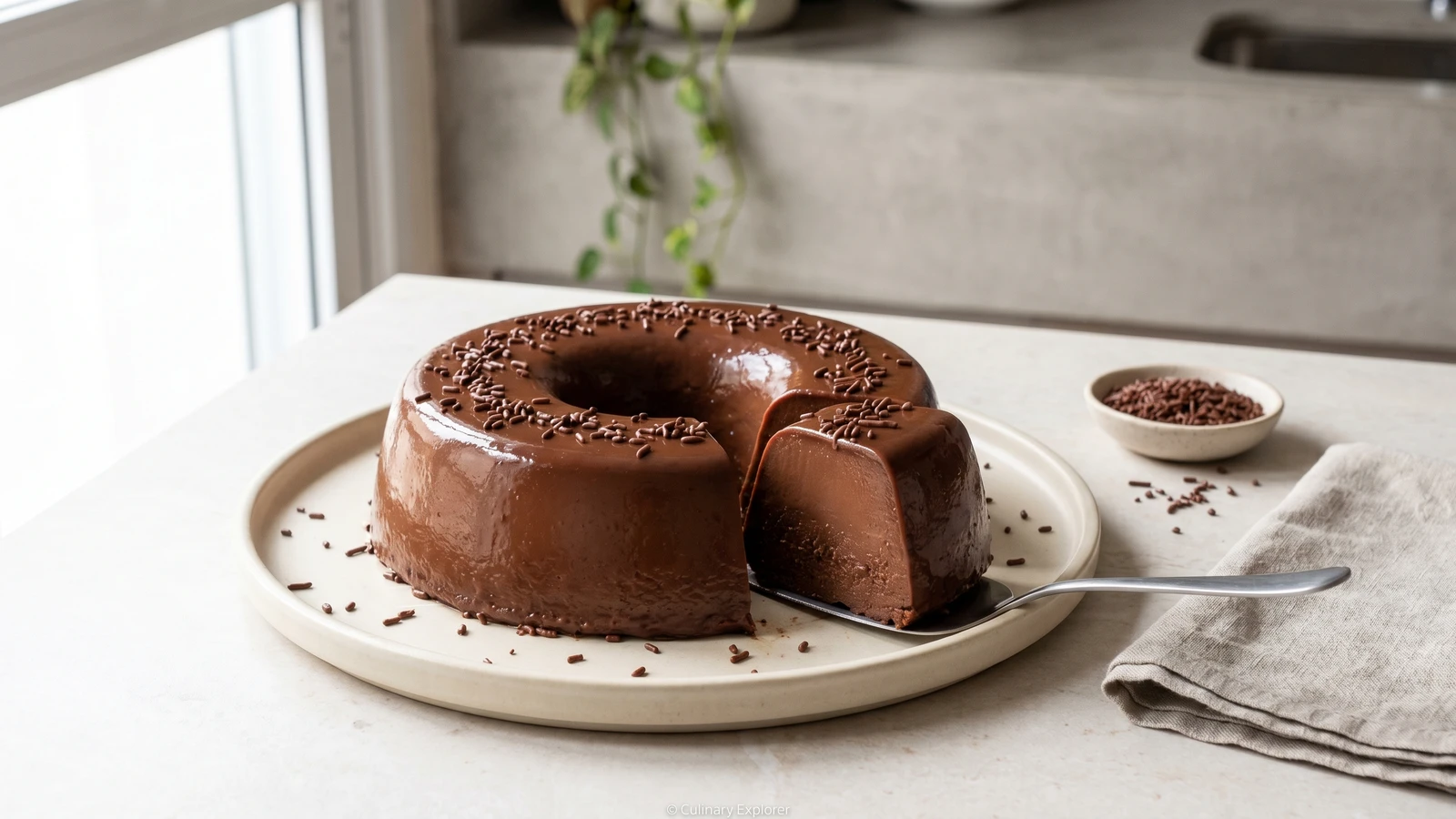
The method matters because eggs are honest but unforgiving. Beat them smooth with condensed milk, real cocoa, milk, cream, and butter, then bake the mixture in a water bath so the heat arrives gently instead of grabbing the eggs by the collar. Cover the mold so water doesn't drip in and the top stays smooth. Chill it until firm, because warm brigadeirão is not romantic, it's pudding with poor boundaries.
No packet, no chocolate drink mix pretending to be flavor. Use cocoa that tastes like chocolate, give it time to set, and you'll unmold a glossy, sliceable brigadeiro that looks like you knew what you were doing the whole time. Which, after this, you will.
Brigadeiro, the chocolate sweet made with condensed milk, cocoa, butter, and sprinkles, became tied to Brazil's 1945 presidential campaign of Brigadier Eduardo Gomes, when supporters sold the sweets to raise money and attention, though the exact origin is debated. Brigadeirão is the later home-kitchen enlargement of that sweet, shaped by the blender, the ring mold, and the national affection for pudim in the second half of the twentieth century. It belongs less to restaurant menus than to birthdays, Sunday lunches, and the refrigerator shelf everyone keeps opening just to check if it's firm yet.
Quantity
1 tablespoon
softened, for greasing the mold
Quantity
1 tablespoon
for coating the mold
Quantity
1 can (14 ounces/395 g)
Quantity
1 cup
Quantity
1 cup
Quantity
1/2 cup
sifted
Quantity
4
Quantity
2 tablespoons
melted and cooled slightly
Quantity
1/4 teaspoon
Quantity
enough to come halfway up the mold
for the water bath
Quantity
1/2 cup
for finishing
| Ingredient | Quantity |
|---|---|
| unsalted buttersoftened, for greasing the mold | 1 tablespoon |
| granulated sugarfor coating the mold | 1 tablespoon |
| sweetened condensed milk | 1 can (14 ounces/395 g) |
| whole milk | 1 cup |
| heavy cream or Brazilian creme de leite | 1 cup |
| unsweetened cocoa powdersifted | 1/2 cup |
| large eggs | 4 |
| unsalted buttermelted and cooled slightly | 2 tablespoons |
| fine salt | 1/4 teaspoon |
| hot waterfor the water bath | enough to come halfway up the mold |
| chocolate sprinklesfor finishing | 1/2 cup |
Heat the oven to 160°C (325°F). Rub the inside of a 20 cm (8 inch) ring mold with the softened butter, getting into the center tube and every curve, then dust it with the sugar and tap out the extra. The butter helps the pudding release, and the thin sugar coat gives the outside a small glossy grip instead of letting the chocolate cling to the pan like it pays rent there.
Put the condensed milk, whole milk, cream, sifted cocoa, eggs, melted butter, and salt in the blender. Blend for 30 to 45 seconds, just until the mixture is smooth, dark, and even. Stop there. Too much blending beats in air, and those bubbles bake into little holes instead of the clean, creamy slice a gente wants.
Pour the batter through a fine sieve into the prepared mold, pressing any cocoa specks through with a spoon. Tap the mold gently on the counter two or three times. The sieve catches egg bits and dry cocoa lumps, and the tapping brings big air bubbles to the surface before they become tunnels in the pudding.
Cover the mold tightly with aluminum foil. Set it inside a deep roasting pan, then pour hot water into the roasting pan until it comes halfway up the outside of the mold. Put the roasting pan in the oven carefully. The water bath softens the heat so the eggs set slowly and smoothly instead of tightening into a rubbery chocolate omelet, which nobody asked for.
Bake for 1 hour 15 minutes to 1 hour 25 minutes. Start checking at 1 hour 10 minutes. The edges should look set, the center should wobble gently like soft gelatin, and a thin knife inserted about 2 cm from the edge should come out mostly clean with a few moist chocolate streaks. Don't wait for the center to look stiff in the oven, because it keeps setting as it cools.
Lift the mold out of the water bath and remove the foil. Let it cool on the counter for 30 minutes, then cover and refrigerate for at least 4 hours, preferably overnight. This waiting is not decoration. Cold fat and set eggs give the brigadeirão the backbone it needs to unmold cleanly and slice instead of slump.
Run a thin knife around the outer edge and around the center tube. Dip just the bottom of the mold in warm water for 15 to 20 seconds, dry it, place a flat serving plate over the top, and flip with confidence. Lift the mold slowly. If it hesitates, warm the bottom again for a few seconds. Scatter the sprinkles over the top while the surface is still slightly tacky, so they stay where you put them.
Cut with a clean knife, wiping between slices if you want neat edges. Serve cold, in honest slices, not tiny nervous slivers. It should be firm enough to stand, creamy enough to bend under the fork, and chocolatey enough that nobody asks why you didn't roll brigadeiros instead.
1 serving (about 120g)
Culinary guides, cultural storytelling, and the editorial depth that makes cooking meaningful.
Discover Culinary ExplorerChef Juliana
You think curdled milk means you ruined dessert. Good. Tonight you'll do it on purpose, with lemon, yolks, cravo, and sugar, until the pot turns into golden gruminhos.

Chef Juliana
You are not ruining the milk. You're curdling it on purpose, slowly, until sugar, eggs, cinnamon, and patience turn cheap ingredients into dessert.

Chef Juliana
You think curdled milk means failure. Not here. Milk, yolks, sugar, and lemon cook into golden curds in amber whey, a Minas sweet where the ponto teaches the whole recipe.

Chef Juliana
You already trust rice for dinner. Trust it for dessert: cook it gently with milk, coconut, and canela until each grain turns soft, creamy, and impossible to blame on lack of talent.