Culinary Explorer

A cooking platform built around craft, culture, and the stories behind what we eat.
Discover Culinary Explorer
Carne con Chile Colorado Sonorense

Carne con Chile Colorado Sonorense

Created by

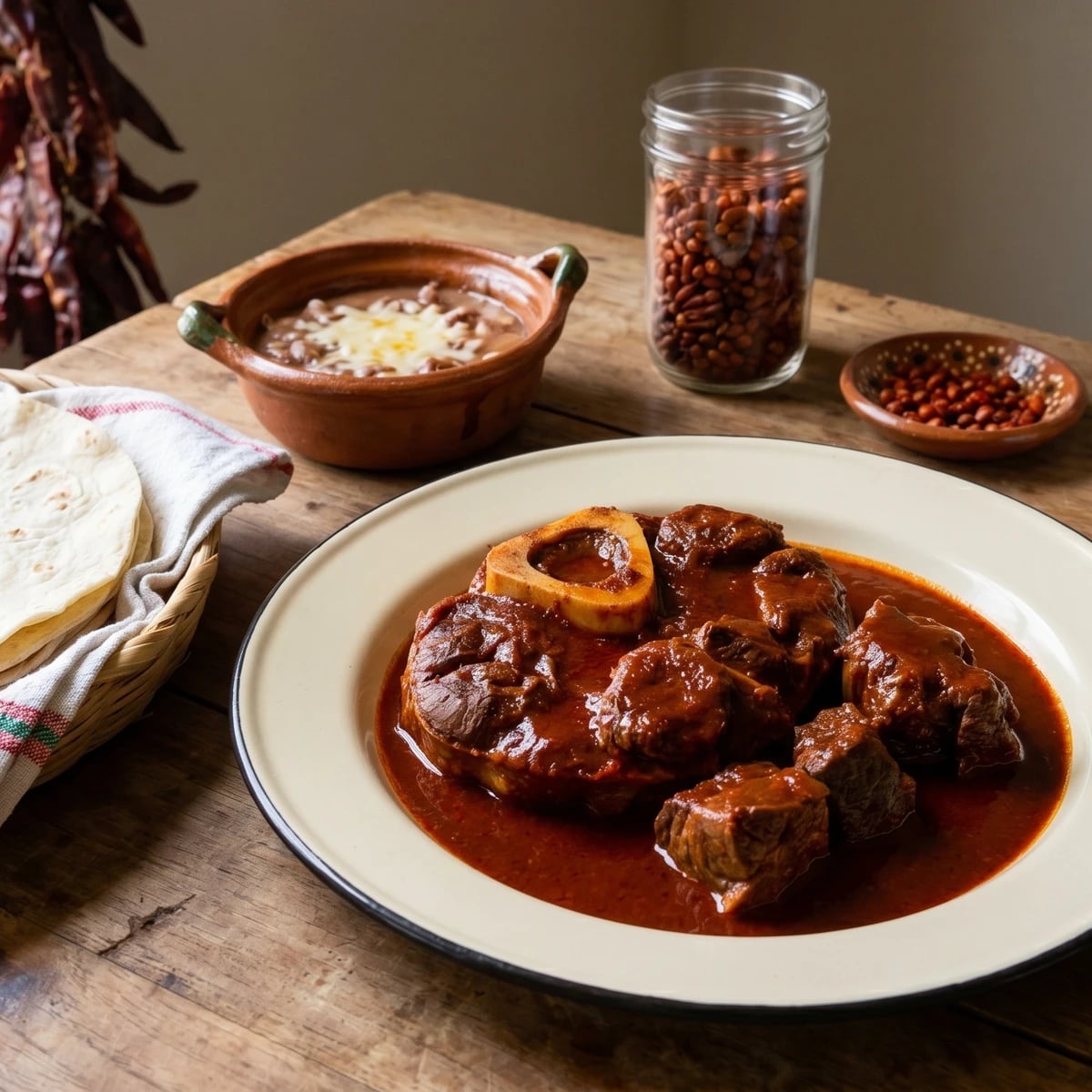
Sonora's chile colorado, beef shank slow-simmered in a sauce of toasted California, guajillo, and ancho chiles until the meat falls apart and the red sauce coats the spoon like velvet. Eaten with a flour tortilla sobaquera, never a fork.

Soups & Stews
Mexican
Comfort Food
Make Ahead
Weeknight
30 min
Active Time
3 hr cook3 hr 30 min total
Yield6 to 8 servings

This is a Sonoran dish. Not from Mexico City, not from Jalisco, not from anywhere south of the Sierra Madre Occidental. Carne con chile colorado is noroeste cooking, the food of the cattle ranches and wheat fields of Sonora, and that geography decides everything about it: the beef instead of pork, the wheat tortilla instead of corn, the chile California that gives the stew its name and its red.

Chile California is what most of the rest of Mexico calls chile colorado. It is the dried form of the Anaheim chile, mild, fruity, and the color of clay tile. In Sonora, this chile is the workhorse. You buy it in long red strings at the Mercado Municipal in Hermosillo, you toast it on a dry comal, and you build the sauce around it. The guajillo gives backbone. The ancho gives a touch of sweetness. The California gives the dish its identity. Take it out and you have a different stew from a different place.

The meat is shank. Chambarete, with the bone and the marrow still in. You brown it hard, you simmer it slowly with the broth, and then you marry it with the chile paste fried in lard until the sauce darkens and clings to the meat. La manteca es el sabor. The Sonoran cooks I learned this from in El Recodo and Ures do not apologize for the lard, do not apologize for the wheat tortilla, do not apologize for serving this with a stack of frijoles puercos and a Tecate. This is their food. Cada estado, su propia cocina.

My mother did not cook Sonoran. She was from Jalisco. But there was a page in her notebook from a friend in Magdalena de Kino, written in blue ink, with one underlined instruction: 'No me vengas con atajos con los chiles.' Toast them, soak them, fry the paste in lard. Asi se hace y punto.

Carne con chile colorado is the workhorse stew of Sonoran ranch and rural household cooking, shaped by the state's two defining colonial-era industries: cattle, introduced by Jesuit missions in the 17th century, and wheat, planted along the Rio Yaqui and Rio Mayo by those same missions because corn struggled in the arid northwest. The chile California, known regionally as chile colorado or chile seco del norte, is the sun-dried form of the Anaheim variety and is the dominant dried chile of northwestern Mexican cooking, distinguishing the cuisine of Sonora and Chihuahua from the chile pasilla and mulato traditions of central and southern Mexico. The pairing of slow-braised beef with a fried red chile sauce, eaten with a flour tortilla sobaquera, became codified in the 19th century in the rancheria kitchens of the Sonoran sierra, where wood-fired braziers and large enameled ollas remain standard equipment in many homes today.

The technique, the tradition, and the story behind every dish.

Discover Culinary Explorer

Ingredients

bone-in beef shank (chambarete)

Quantity

3 pounds

cut into 2-inch pieces

manteca de cerdo (pork lard)

Quantity

2 tablespoons

white onion

Quantity

1 medium

half roughly chopped, half left whole

garlic cloves

Quantity

6

4 peeled, 2 left whole in their skins

bay leaves

Quantity

2

kosher salt

Quantity

1 tablespoon, plus more to taste

dried chile California (chile colorado)

Quantity

6

stemmed and seeded

dried chile guajillo

Quantity

4

stemmed and seeded

dried chile ancho

Quantity

3

stemmed and seeded

cumin seeds

Quantity

1 teaspoon

dried Mexican oregano (oregano del monte if available)

Quantity

1 teaspoon

whole cloves

Quantity

2

all-purpose flour

Quantity

1 tablespoon

additional manteca de cerdo (for frying the chile paste)

Quantity

2 tablespoons

warm flour tortillas sobaqueras (optional)

Quantity

for serving

frijoles puercos or frijoles maneados (optional)

Quantity

for serving

lime wedges (optional)

Quantity

for serving

dried chiltepín (optional)

Quantity

for the table

Equipment Needed

  • Heavy 6-quart cazuela or Dutch oven
  • Cast iron comal or heavy skillet for toasting
  • High-powered blender
  • Fine-mesh strainer
  • Wooden spoon for stirring the chile paste

Instructions

  1. 1

    Brown the shank

    Pat the beef shank dry. Salt it generously. Melt the first 2 tablespoons of lard in a heavy cazuela or Dutch oven over medium-high heat. Brown the shank pieces in batches, about 4 minutes per side, until each face has a deep mahogany crust. Do not crowd the pot. Crowded meat steams and never browns, and a chile colorado without browned beef tastes thin no matter what you do to the sauce.

    Leave the marrow bones in. The marrow melts into the broth over the long cook and gives the dish the body that makes a Sonoran chile colorado taste like a Sonoran chile colorado.
  2. 2

    Build the broth

    Return all the browned shank to the pot along with any juices on the plate. Add the chopped onion half, the 4 peeled garlic cloves, the bay leaves, and enough cold water to cover the meat by two inches. Bring to a gentle simmer. Skim the gray foam that rises in the first fifteen minutes. Lower the heat until the broth shows lazy bubbles every few seconds. Cover partially. Cook two and a half hours, until the meat pulls apart with a fork but still holds together on the bone.

  3. 3

    Toast the chiles

    While the meat simmers, heat a dry comal over medium. Toast the California, guajillo, and ancho chiles separately, pressing them flat with a spatula for 20 to 30 seconds per side. They should puff and turn fragrant, never blacken. The chile California is the one that gives this stew its name and its color. Do not skip it. The kitchen will smell like the inside of a chile vendor's stall in the Mercado Municipal de Hermosillo. That smell is the oils waking up.

    Burned chile is bitter chile. If one goes black in spots, throw it out and toast another. There is no fixing it later.
  4. 4

    Toast the spices and aromatics

    On the same comal, toast the cumin seeds and cloves for about 30 seconds, until fragrant. Tip them into a small bowl. Toast the whole onion half and the two unpeeled garlic cloves directly on the comal, turning them, until they are blistered and softened in spots, about 6 to 8 minutes. Peel the garlic. The roasting on a dry comal is how Sonoran cooks pull sweetness and depth out of ingredients without adding more fat to the pot.

  5. 5

    Soak and blend the chile paste

    Place the toasted chiles in a heatproof bowl and cover with hot tap water. Hot, not boiling. Boiling water cooks the skins and turns the sauce bitter. Soak for 20 minutes, until the chiles are pliable. Drain. Transfer to a blender with the toasted onion, the toasted garlic, the cumin and cloves, the oregano, and one and a half cups of the beef broth from the pot. Blend on high for a full two minutes, until the puree is completely smooth. Strain through a fine-mesh sieve, pressing on the solids. Discard the skins.

  6. 6

    Fry the chile paste

    In a heavy skillet, melt the additional 2 tablespoons of lard over medium heat. Sprinkle in the flour and whisk for 30 seconds, until it smells like toasted bread. Pour in the strained chile puree all at once. It will sputter. Stir constantly for 6 to 8 minutes, until the paste darkens to the color of brick and the fat starts to bead at the edges. La manteca es el sabor. This is the step that separates a serious chile colorado from a sauce that tastes like soaked chile water.

  7. 7

    Marry the sauce and the meat

    Stir the fried chile paste into the simmering pot of beef. Adjust with more broth if it is too thick or simmer it down if it is too thin. The sauce should coat the back of a spoon and cling to the meat like red velvet. That is where the dish gets its name. Simmer uncovered for 20 to 30 more minutes so the sauce and the meat marry. Taste for salt now. The sauce should be assertive: deep, slightly sweet from the ancho, with the California chile carrying the color and the guajillo carrying the backbone.

  8. 8

    Serve at the table

    Spoon the carne con chile colorado into shallow clay bowls or onto enameled tin plates with a piece of shank and plenty of sauce. Set the warm tortillas sobaqueras in a cloth-lined basket. Put the dried chiltepín in a small dish on the table for those who want to crush a few over their bowl. In Sonora, you eat this with the tortilla, not the spoon. You tear a piece, scoop, and you do not stop until the bowl is wiped clean. Recetas probadas y garantizadas.

Chef Tips

  • Use beef shank with the bone and the marrow. Boneless stew meat will give you a thin, flat chile colorado. The marrow is what makes the broth taste like a Sonoran kitchen and not a cafeteria.
  • Chile California is sometimes sold under the name chile colorado or chile seco del norte. They are the same chile. If your market only carries guajillo, you can lean harder on the guajillo, but you will lose the rounder, milder fruitiness that makes this Sonoran. A substitution is a compromise, not an upgrade.
  • The flour tortilla sobaquera is not a Tex-Mex mistake. It is a Sonoran specialty, hand-stretched until it is thin enough to read through and as wide as a forearm. If you can buy them from a Sonoran tortilleria, do it. If you cannot, get the largest, thinnest flour tortillas you can find. Corn tortillas are wrong here.
  • Add a few crushed chiltepín to your bowl at the table if you want heat. Chile colorado itself is not a hot stew. It is a deep, earthy stew. The chiltepín is the Sonoran way to bring the burn.

Advance Preparation

  • Carne con chile colorado is better the second day. Make it in the morning, refrigerate, and reheat gently. The chile and the beef marry overnight and the sauce thickens to exactly the consistency you want.
  • The chile paste alone, fried and cooled, keeps refrigerated for one week and freezes for three months. Many Sonoran cooks make a double batch and freeze half for weeknight enchiladas, chilaquiles, or a fast pot of chile colorado on a busy day.

Frequently Asked Questions

Nutrition Information

1 serving (about 180g)

Calories
300 calories
Total Fat
14 g
Saturated Fat
7 g
Trans Fat
0 g
Unsaturated Fat
7 g
Cholesterol
145 mg
Sodium
690 mg
Total Carbohydrates
11 g
Dietary Fiber
4 g
Sugars
3 g
Protein
30 g

Note: Chef personas and recipes are created with AI assistance. Cook with care: follow safe food-handling practices, check doneness with a thermometer when needed, and adapt for allergies and your kitchen.

Where cooking meets culture.

Culinary guides, cultural storytelling, and the editorial depth that makes cooking meaningful.

Discover Culinary Explorer

More from Noroeste Soups & Stews

Browse the full collection