
Chef Lupita
Aguascalientes Beef Tongue Pozole (Pozole de Lengua)
Aguascalientes' Bajio pozole de lengua, built with cacahuazintle hominy, tender beef tongue, chile ancho and guajillo, with xoconostle brightness and table garnishes.
A cooking platform built around craft, culture, and the stories behind what we eat.
Created by
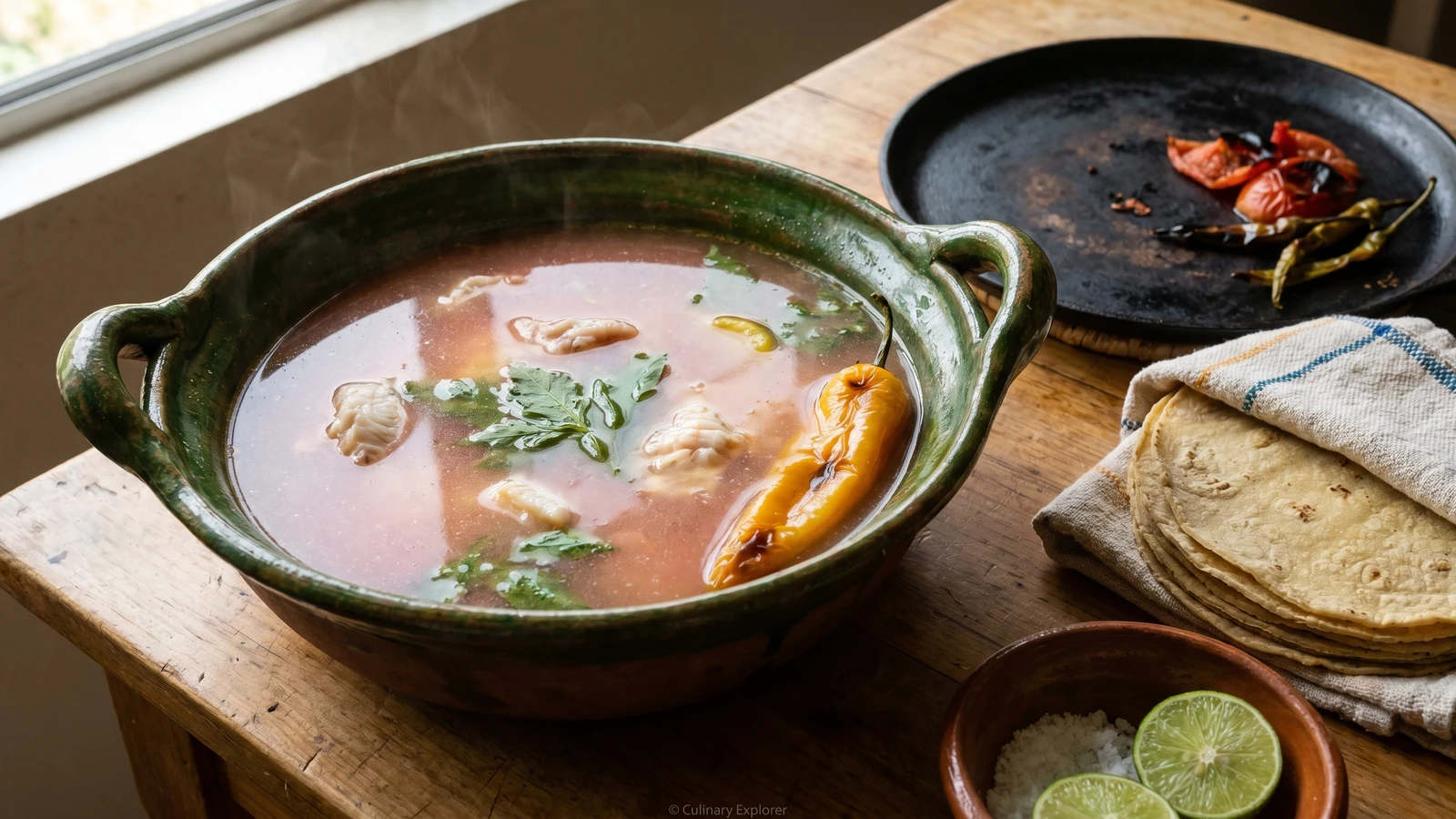
Michoacán's lake-basin caldo, built with delicate pescado blanco, roasted tomato, epazote, and a whole chile perón, gives you Pátzcuaro's clean freshwater cooking in under an hour.
Michoacán, the lake basin of Pátzcuaro, this is where the caldo lives. Around Janitzio, Pacanda, Tzintzuntzan, and the shoreline towns, pescado blanco is not just fish. It is the taste of the lake, the thing the market women protect with their eyes when you ask where it came from.
The fish is kurucha urapiti, pescado blanco, small and silver, with flesh so delicate you do not bully it. The broth is light tomato, not a red chile stew. Epazote goes in near the end. Chile perón goes in whole, blistered on the comal, so it perfumes the pot without turning the soup into a contest. Not all Mexican food is chile first. This is a 32-state cuisine.
Do not confuse this with caldo michi from Lake Chapala. That is Jalisco and it has its own pride. Pátzcuaro's version is cleaner, more restrained, built around the fish and the herb. The women who perfected it know the timing because they have watched this fish fall apart when someone lets the pot boil. The lesson is simple: build the broth first, add the fish last, and keep your hands calm.
My mother was Jalisciense, so this was not her everyday soup. I learned it on the lake, from a señora who told me, without smiling, that if the fish was bad the recipe was already dead. She was right. Si no conoces el mercado, no conoces la cocina.
The Purépecha name kurucha urapiti, commonly translated as white fish, refers to the small silvery lake fish of the Pátzcuaro basin, principally Chirostoma estor, which fed Purépecha communities before the Spanish conquest. In the 20th century, as Pátzcuaro and Janitzio became symbols of Michoacán travel and Noche de Muertos, pescado blanco moved from local market food to a state emblem served in lakeshore fondas. This caldo is sometimes confused with Jalisco's caldo michi from Lake Chapala, but chile perón, epazote, and the Pátzcuaro fish place it firmly in Michoacán.
Quantity
1 1/2 pounds, about 4 small whole fish
scaled and gutted with heads left on when available
Quantity
1 1/2 teaspoons, divided, plus more to taste
Quantity
1 pound
halved
Quantity
1/2 medium
cut into a thick wedge
Quantity
3
unpeeled
Quantity
1 large
left whole
Quantity
1 tablespoon
Quantity
6 cups
use stock if cooking fillets instead of whole fish
Quantity
3 sprigs
Quantity
2
halved
Quantity
for serving
warmed
| Ingredient | Quantity |
|---|---|
| Pátzcuaro pescado blancoscaled and gutted with heads left on when available | 1 1/2 pounds, about 4 small whole fish |
| kosher salt | 1 1/2 teaspoons, divided, plus more to taste |
| ripe Roma tomatoes (jitomate guaje)halved | 1 pound |
| white onioncut into a thick wedge | 1/2 medium |
| garlic clovesunpeeled | 3 |
| chile perón amarillo or naranjaleft whole | 1 large |
| manteca de cerdo | 1 tablespoon |
| water or light fish stockuse stock if cooking fillets instead of whole fish | 6 cups |
| fresh epazote | 3 sprigs |
| limes (optional)halved | 2 |
| hand-pressed corn tortillas (optional)warmed | for serving |
Rinse the cleaned fish quickly under cold water and pat it dry. Make two shallow slashes on each side if using whole fish, then season with 1 teaspoon salt. Keep it cold while you build the broth. The salt firms the flesh so it does not break apart in the pot. Do not bathe it in lime. This is caldo, not ceviche.
Heat a dry comal over medium. Put the tomatoes cut side down, the onion wedge, the unpeeled garlic, and the whole chile perón on the comal. Turn everything as it chars in spots. The tomatoes should soften and slump, the onion should brown at the edges, the garlic should feel soft inside its skin, and the chile perón should blister without collapsing. Set the chile aside. Peel the garlic.
Blend the roasted tomatoes, onion, peeled garlic, and 1 cup of the water until smooth. Strain it if the tomato skins are thick. For this Pátzcuaro caldo, the broth should stay light enough that the fish remains the main thing. Do not make a heavy salsa and call it soup.
Melt the manteca de cerdo in a lead-free clay cazuela or heavy pot over medium heat. Pour in the tomato puree. It should hiss when it hits the fat. Cook for 6 to 8 minutes, stirring often, until the raw tomato smell is gone and the color turns a soft orange-red. La manteca es el sabor, even when the spoonful is small.
Add the remaining 5 cups water or light fish stock, the remaining 1/2 teaspoon salt, and the blistered chile perón. Cut one shallow slit down the side of the chile before it goes in so its flavor enters the broth without spilling all the seeds. Simmer gently for 10 minutes. Taste for salt. The broth should taste clean, tomato-light, and ready for fish.
Lower the heat until the broth barely moves. Slide in the fish and the epazote sprigs. Cover partially and poach 5 to 8 minutes, depending on thickness. Whole small fish are ready when the flesh turns opaque near the backbone and pulls away cleanly. Fillets are ready when they flake but still look moist. If you need a thermometer, the thickest part should reach 145F. Do not boil pescado blanco. It is delicate, and a rolling pot will tear it apart.
Turn off the heat and let the pot rest for 3 minutes. Lift the fish into wide bowls first, then ladle the broth over it with the chile perón and epazote visible. Serve with lime halves and warm corn tortillas. Warn people about the bones if you used whole fish. That is not a flaw. That is lake fish. Cada estado, su propia cocina.
1 serving (about 600g)
Culinary guides, cultural storytelling, and the editorial depth that makes cooking meaningful.
Discover Culinary ExplorerChef Lupita
Aguascalientes' Bajio pozole de lengua, built with cacahuazintle hominy, tender beef tongue, chile ancho and guajillo, with xoconostle brightness and table garnishes.

Chef Lupita
Veracruz's Gulf coast rice from Alvarado, built with seafood stock, tomato, chile chipotle, epazote, shrimp, fish, jaiba, and pulpo, served loose and brothy in a clay cazuela.

Chef Lupita
Costa Chica's wet salt-beef stew, built from chile costeño, guajillo, tomato, manteca, yuca, plantain, and masa dumplings, the ranching pot of Cuajinicuilapa and Pinotepa.

Chef Lupita
Michoacán's P'urhépecha atápakua is a masa-thickened sauce and stew at once, built with pork, chile guajillo, and hierbabuena added only at the end.