
Chef Lupita
Arroz a la Oaxaqueña
Oaxaca's red rice, stained with tomato and fried in lard, steamed with carrots, ejotes, black beans, and epazote. The side that anchors a Oaxacan family meal and earns its place beside the main.
A cooking platform built around craft, culture, and the stories behind what we eat.

Created by
Oaxaca's baked vegetable custard, lined with hierba santa and bound with eggs and crema. The kind of side dish a senora in the Valles Centrales builds when the mercado has been generous and the table needs something honest.
This is a Oaxacan dish. Hierba santa is what makes it Oaxacan, not the vegetables, not the eggs. The leaf, called hoja santa in some places and acuyo on the Veracruz side of the border, grows wild in the milpas of southern Mexico and tastes like nothing else: anise, sassafras, a faint shadow of black pepper. You cannot substitute it. If you cannot find it, make a different dish today.
In the markets of Oaxaca, the women who sell hierba santa stack the leaves in piles the size of dinner plates, the dark green undersides facing up, the stems still beaded from the last rinse. They will tell you to use it for tamales, for mole amarillo, for the broth of a fish wrapped in the leaf and steamed. And they will tell you, if you ask, that the budín is what you make when the calabacitas are firm, the acelgas are crisp, and the flores de calabaza are bright orange and not yet wilting from the morning sun. Cada estado, su propia cocina. This one belongs to the Valles Centrales.
My mother did not make this. She was from Jalisco and Jalisco does not cook with hierba santa. I learned it from a woman named Doña Aurelia in Tlacolula on a Sunday afternoon in 2009, and her version had no flour and no breadcrumbs. Just vegetables, eggs, crema, queso, and the leaf that holds it all together. La cocina no es decoracion, es trabajo. The work here is in the chopping and in the patience of the baño maría. Get those right and the budín takes care of itself.
Hierba santa (Piper auritum) is native to Mesoamerica and was used in ceremonial and medicinal cooking long before Spanish contact, with archaeobotanical evidence placing it in pre-Columbian kitchens of the Valles Centrales of Oaxaca and the Gulf coast. The Spanish-influenced custard format (egg and dairy bound and baked) merged with the indigenous use of large aromatic leaves (hierba santa, banana, hoja de aguacate) as a wrapping and perfuming medium, producing budines that read as colonial-era hybrids: European technique cradled inside Mesoamerican aroma. The dish remains a Lenten favorite across Oaxaca, where the prohibition on meat during Cuaresma drives a deep tradition of vegetable, egg, and bean dishes that home cooks treat with the same seriousness as any meat-based fiesta plate.
Quantity
6 large
thick central stem trimmed away
Quantity
3 tablespoons, plus more for the cazuela
Quantity
1 medium
finely diced
Quantity
3
finely minced
Quantity
2 medium
peeled and cut into 1/4-inch dice
Quantity
3 medium
cut into 1/4-inch dice
Quantity
1 large bunch
stems separated and diced, leaves chopped
Quantity
2 cups
pistils removed, roughly torn
Quantity
1
roasted, peeled, seeded, and diced
Quantity
1 1/2 teaspoons, plus more to taste
Quantity
1/4 teaspoon
Quantity
6
Quantity
1 cup
Quantity
1/2 cup
Quantity
1 1/2 cups
crumbled or pulled into thin strands
Quantity
1/4 cup
for the top
Quantity
for serving
| Ingredient | Quantity |
|---|---|
| fresh hierba santa leavesthick central stem trimmed away | 6 large |
| manteca de cerdo (pork lard) | 3 tablespoons, plus more for the cazuela |
| white onionfinely diced | 1 medium |
| garlic clovesfinely minced | 3 |
| carrotspeeled and cut into 1/4-inch dice | 2 medium |
| calabacitas (Mexican squash) or zucchinicut into 1/4-inch dice | 3 medium |
| acelgas (Swiss chard)stems separated and diced, leaves chopped | 1 large bunch |
| flor de calabaza (squash blossoms)pistils removed, roughly torn | 2 cups |
| fresh chile poblanoroasted, peeled, seeded, and diced | 1 |
| kosher salt | 1 1/2 teaspoons, plus more to taste |
| freshly ground black pepper | 1/4 teaspoon |
| large eggs | 6 |
| Mexican crema | 1 cup |
| whole milk | 1/2 cup |
| queso fresco or queso de Oaxacacrumbled or pulled into thin strands | 1 1/2 cups |
| grated cotijafor the top | 1/4 cup |
| salsa de molcajete with chile pasilla oaxaqueño (optional) | for serving |
Heat the oven to 350F. Grease a 12-inch clay cazuela or a 9-by-13-inch baking dish generously with manteca. Line the bottom and the sides with three of the hierba santa leaves, dark side facing the dish, the way you would line a pan with banana leaf for tamales oaxaqueños. The leaves perfume the budín from below as it bakes. This is not garnish. This is the soul of the dish.
Melt 3 tablespoons of manteca in a wide skillet over medium heat. Add the diced onion and a pinch of salt. Cook for 5 to 6 minutes, until translucent and soft, never browned. Add the minced garlic and cook for 30 seconds more, just until fragrant. La manteca es el sabor. Olive oil will give you a different dish.
Add the diced carrots and the chopped acelga stems to the skillet. Cook for 6 to 7 minutes over medium heat, stirring occasionally, until the carrot is just tender at the edge of a knife but still has bite. The stems of the acelgas need this head start. The leaves do not.
Stir in the diced calabacitas and the diced chile poblano. Cook for 4 minutes more. The calabacitas should soften but hold their shape. Add the chopped acelga leaves and the torn flor de calabaza. Cook for 2 more minutes, just until the chard wilts and the squash blossoms collapse into the pan. Season with the salt and black pepper. Taste. The vegetable mix should be assertively seasoned. The custard will mellow it.
Spread the vegetable mixture on a sheet pan to cool for 10 minutes. Hot vegetables will scramble the eggs the moment they meet. This step is not optional. Use the cooling time to chop the remaining three hierba santa leaves into thin ribbons.
In a large bowl, whisk the eggs until uniform. Whisk in the crema and the milk until smooth. Stir in the cooled vegetables, the chopped hierba santa ribbons, and the queso fresco. Fold gently with a spatula. You want every spoonful to carry vegetables, cheese, and herb. Taste a small bit of the liquid for salt. Adjust now.
Pour the mixture into the lined cazuela. Smooth the top. Scatter the cotija evenly over the surface. Set the cazuela inside a larger roasting pan and pour boiling water into the outer pan to come halfway up the sides of the cazuela. The baño maría is what gives the budín its silky, set texture. Bake without a roast directly on top, with no plug-in convection if you can help it, for 45 to 55 minutes. The budín is ready when the center barely jiggles when you nudge the cazuela and the top is golden in places.
Lift the cazuela out of the water bath. Let it rest on a wooden board for 15 minutes before serving. The budín firms as it cools, and a piece cut hot off the oven will fall apart on the plate. Serve directly from the cazuela with a salsa de molcajete made with chile pasilla oaxaqueño, the smoky raisin-dark chile that grows in the Sierra Mixe. Asi se hace y punto.
1 serving (about 270g)
Culinary guides, cultural storytelling, and the editorial depth that makes cooking meaningful.
Discover Culinary ExplorerChef Lupita
Oaxaca's red rice, stained with tomato and fried in lard, steamed with carrots, ejotes, black beans, and epazote. The side that anchors a Oaxacan family meal and earns its place beside the main.
Chef Lupita
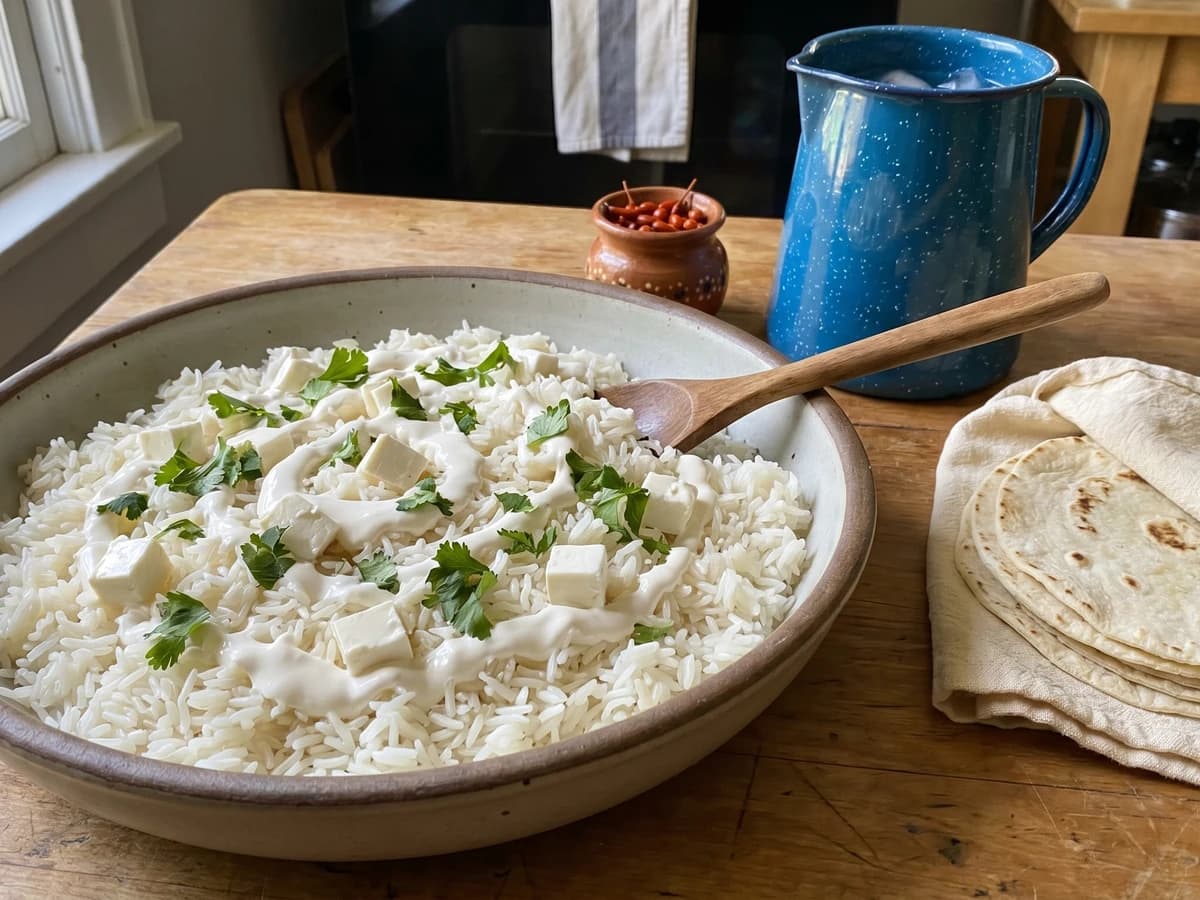
Sinaloa's home-cook white rice topped with cold cubes of cream cheese that soften into the warm grain, finished with crema and a sprinkle of chiltepin at the table. The trick that makes a side dish feel like a small luxury.
Chef Lupita
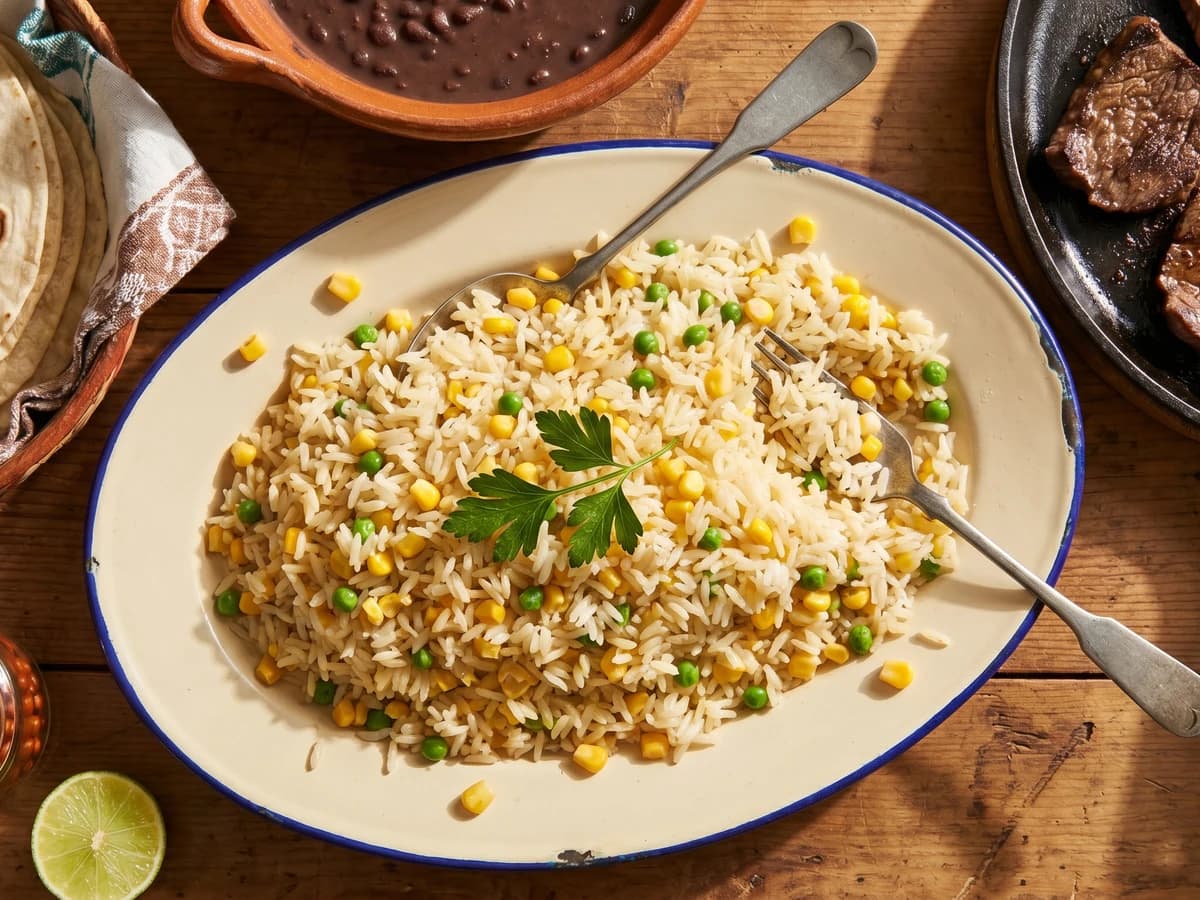
Sonora's white rice, toasted in butter and steamed with sweet corn and tender peas. The clean, quiet partner to a plate of carne asada, not the red rice of central Mexico.

Chef Lupita
Yucatán's white rice with sweet corn kernels, toasted in lard with garlic and onion. The quiet base that holds up against the peninsula's bold achiote-stained stews.