
Chef Lupita
Arroz a la Oaxaqueña
Oaxaca's red rice, stained with tomato and fried in lard, steamed with carrots, ejotes, black beans, and epazote. The side that anchors a Oaxacan family meal and earns its place beside the main.
A cooking platform built around craft, culture, and the stories behind what we eat.

Created by
Michoacán's fresh-corn uchepos sliced and baked with poblano rajas, crema, and cotija, a sweet corn tamal casserole that belongs to the Purépecha table.
This comes from Michoacán, from the Purépecha highlands around Pátzcuaro, Uruapan, and the market towns where fresh corn is not a side note. It is the center of the meal. Uchepos are tender fresh-corn tamales, made from young elotes, wrapped in their own husks, steamed until soft, then served with crema, salsa, or cheese. This budín takes those uchepos and layers them like a home casserole, with roasted chile poblano rajas and crema. A señora in Uruapan taught me this version for a holiday table, when she wanted the flavor of uchepos without unwrapping tamales one by one for twenty people.
The corn decides everything. You need fresh, milky kernels, not dry winter corn that tastes like cardboard. If the market corn is old, don't make uchepos today. Cook what the market is selling today. Pregúntale a las señoras del mercado. The masa should smell green and sweet when you grind it, and it should hold together because the corn has its own milk and starch. No flour. No boxed mix. This is not cornbread wearing a Mexican costume.
The rajas are poblano, roasted until the skin blisters, peeled, and cut into strips. The fat is manteca de cerdo in the fresh-corn masa because it gives tenderness without making the corn taste like butter cake. La manteca es el sabor. The finished budín should cut into soft squares, creamy at the edges, golden on top, with the sweetness of elote and the dark green bite of poblano. Cada estado, su propia cocina.
Uchepos are part of Michoacán's Purépecha corn tradition, distinct from the firmer dried-corn tamales eaten across much of Mexico. The word is commonly linked to the Purépecha language, and the dish remains strongest in the lake and highland regions around Pátzcuaro, Uruapan, and Morelia, where fresh corn is prepared as tamales during the rainy-season harvest. Layered budines of tamal, crema, chile, and cheese developed in home kitchens as a practical way to serve tamal flavors family-style for fiestas, baptisms, and holiday meals.
Quantity
12 large ears
young and milky, husks reserved for steaming
Quantity
6 tablespoons, plus more for the dish
softened
Quantity
1 teaspoon
for the fresh-corn masa
Quantity
1 teaspoon
only if the corn is not naturally sweet
Quantity
1/2 teaspoon
Quantity
1/2 cup
only as needed to loosen the fresh-corn masa
Quantity
6
Quantity
1 tablespoon
Quantity
1 medium
thinly sliced
Quantity
2
finely chopped
Quantity
1 teaspoon, divided
plus more to taste
Quantity
1 cup
Quantity
1/2 cup
Quantity
1 cup
crumbled
Quantity
1/2 cup
crumbled
Quantity
2 tablespoons
chopped
Quantity
for serving
Quantity
for serving
| Ingredient | Quantity |
|---|---|
| fresh sweet corn in husksyoung and milky, husks reserved for steaming | 12 large ears |
| pork lard (manteca de cerdo)softened | 6 tablespoons, plus more for the dish |
| kosher saltfor the fresh-corn masa | 1 teaspoon |
| sugar (optional)only if the corn is not naturally sweet | 1 teaspoon |
| baking powder | 1/2 teaspoon |
| whole milkonly as needed to loosen the fresh-corn masa | 1/2 cup |
| fresh chile poblano | 6 |
| pork lard (manteca de cerdo), for rajas | 1 tablespoon |
| white onionthinly sliced | 1 medium |
| garlic clovesfinely chopped | 2 |
| kosher salt, for rajas and cremaplus more to taste | 1 teaspoon, divided |
| Mexican crema | 1 cup |
| whole milk, for crema mixture | 1/2 cup |
| cotija cheesecrumbled | 1 cup |
| queso frescocrumbled | 1/2 cup |
| fresh epazote leaveschopped | 2 tablespoons |
| salsa de jitomate asado (optional) | for serving |
| warm corn tortillas (optional) | for serving |
Pull back the corn husks carefully and save the widest, cleanest leaves for wrapping. Strip off the silk. Cut the kernels from the cobs into a wide bowl, scraping the cobs with the back of the knife to catch the corn milk. That liquid matters. It is what makes uchepos taste like fresh elote, not dry masa.
Grind the kernels in a molino if you have one, or pulse them in a food processor until you have a coarse, wet paste. Do not turn it into soup. Beat the softened manteca de cerdo in a bowl until light, then mix in the ground corn, salt, baking powder, and sugar only if the corn needs help. Add milk a spoonful at a time only if the mixture is too stiff to spread. The masa should mound softly on a spoon and smell green and sweet.
Lay two corn husks slightly overlapping on the counter. Spoon about 1/3 cup fresh-corn masa into the center, fold the sides over, then fold up the bottom. The packet will be softer than a dried-corn tamal. Stand the uchepos open-end up in a steamer lined with extra husks. Steam over steady medium heat for 45 to 55 minutes, until the masa is set, tender, and pulls away from the husk in a soft sheet. Let them rest 15 minutes before unwrapping.
Roast the chile poblano directly over a gas flame or on a very hot comal, turning until the skins blister and blacken in patches. Put them in a covered bowl for 10 minutes, then peel off the skins with your fingers. Do not rinse them under water. You worked for that roasted flavor, don't wash it down the sink. Remove stems and seeds, then cut the flesh into strips.
Melt 1 tablespoon manteca de cerdo in a skillet over medium heat. Add the sliced white onion and cook until soft and lightly golden at the edges, about 8 minutes. Stir in the garlic for 30 seconds, then add the poblano rajas and 1/2 teaspoon salt. Cook 5 minutes more, until the chile strips are glossy and the onion has taken on their green flavor.
In a bowl, whisk the Mexican crema with 1/2 cup whole milk, 1/2 teaspoon salt, half of the cotija, the queso fresco, and the chopped epazote. Taste it. It should be salty enough to season the sweet corn. Cotija is not decoration here. It carries the milkiness and salt that make the budín cut clean instead of tasting flat.
Heat the oven to 375F. Grease a 9 by 13-inch clay cazuela or baking dish with manteca de cerdo. Unwrap the rested uchepos and slice them lengthwise into thick pieces. Lay half of them in the dish, spoon over half the crema mixture, then scatter over half the rajas. Repeat with the remaining uchepos, crema, and rajas. Finish with the remaining cotija across the top.
Bake 30 to 35 minutes, until the edges are bubbling, the top is golden in spots, and the center no longer looks loose when you shake the dish gently. Let it rest 15 minutes before cutting. This rest is not politeness. It lets the fresh-corn tamal layers settle so each square holds together.
Bring the cazuela to the table warm, with salsa de jitomate asado and corn tortillas alongside. Serve generous squares, not tiny restaurant portions. This is Michoacán food for a table, not a tasting spoon. Recetas probadas y garantizadas.
1 serving (about 325g)
Culinary guides, cultural storytelling, and the editorial depth that makes cooking meaningful.
Discover Culinary ExplorerChef Lupita
Oaxaca's red rice, stained with tomato and fried in lard, steamed with carrots, ejotes, black beans, and epazote. The side that anchors a Oaxacan family meal and earns its place beside the main.
Chef Lupita
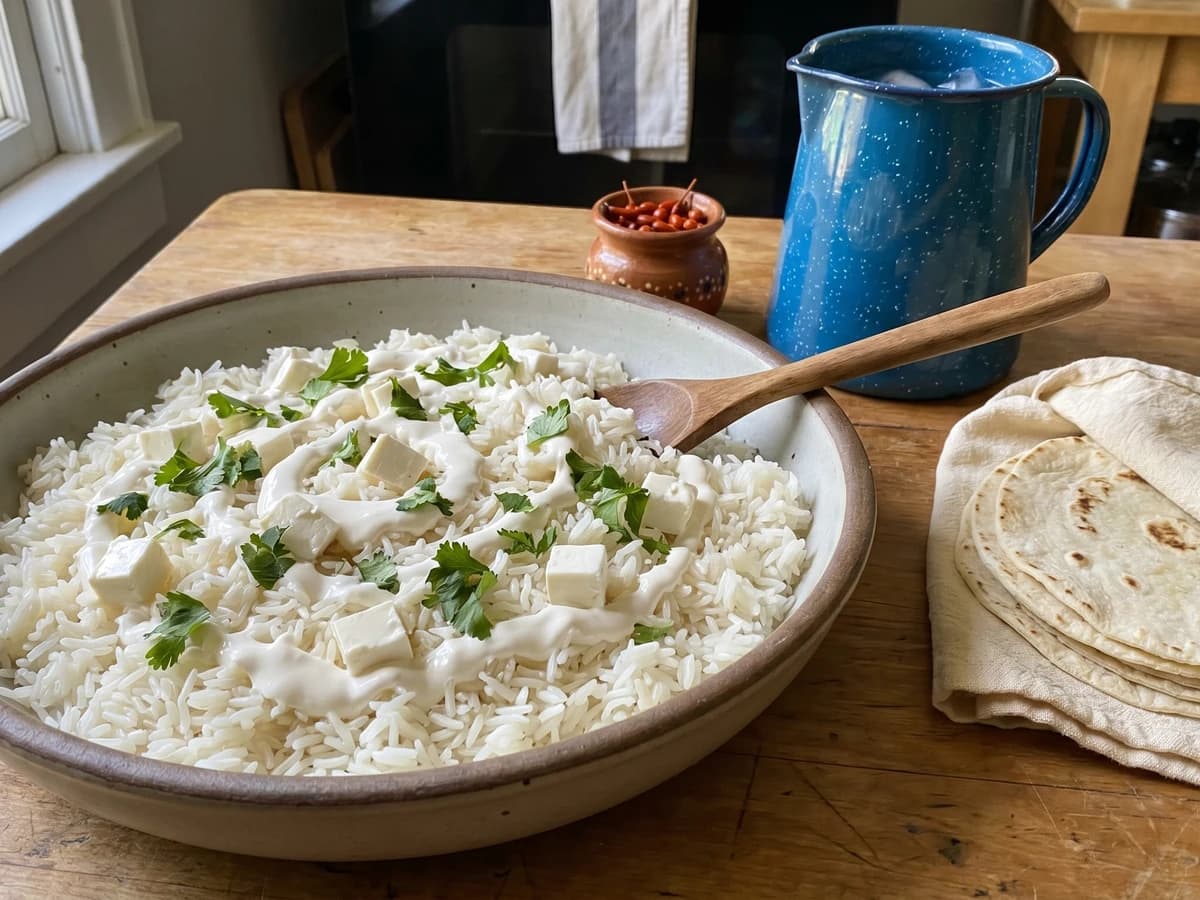
Sinaloa's home-cook white rice topped with cold cubes of cream cheese that soften into the warm grain, finished with crema and a sprinkle of chiltepin at the table. The trick that makes a side dish feel like a small luxury.
Chef Lupita
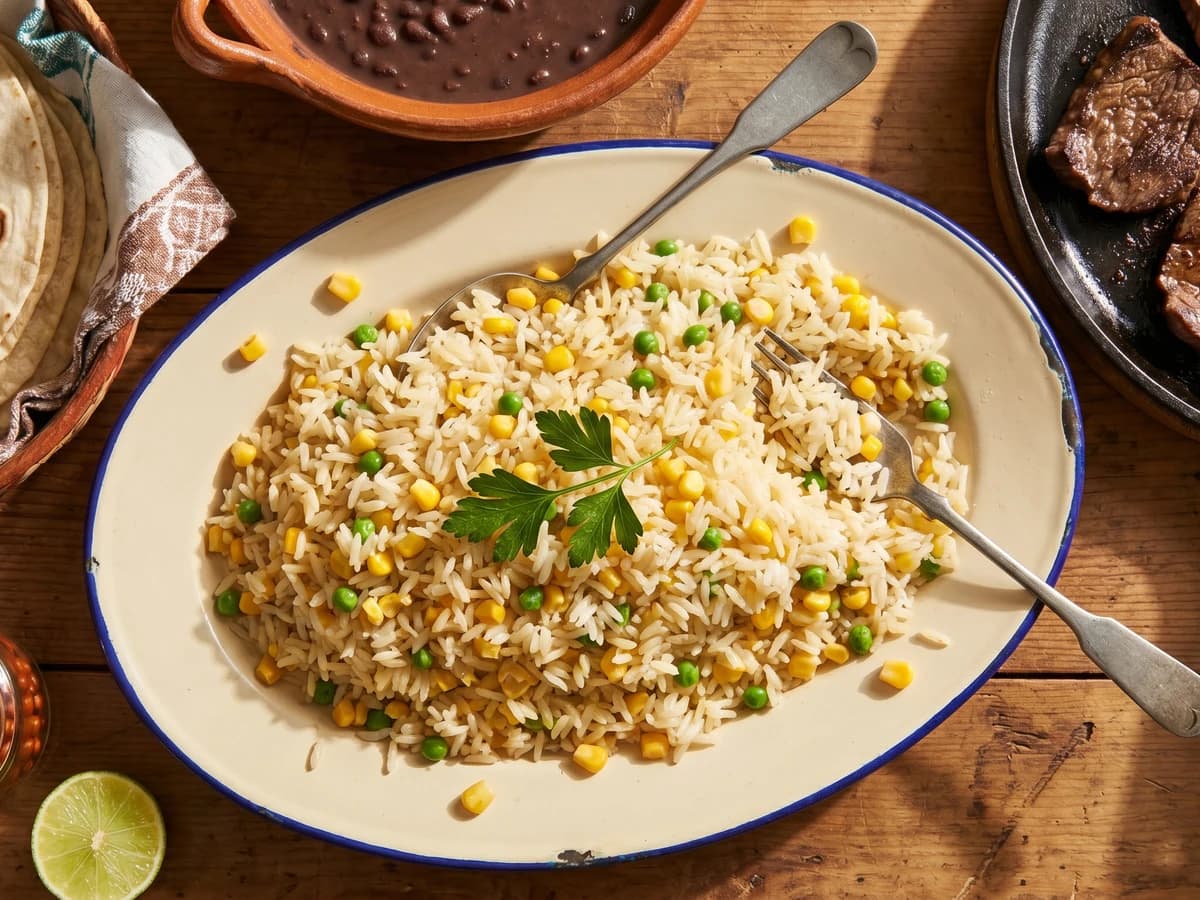
Sonora's white rice, toasted in butter and steamed with sweet corn and tender peas. The clean, quiet partner to a plate of carne asada, not the red rice of central Mexico.

Chef Lupita
Yucatán's white rice with sweet corn kernels, toasted in lard with garlic and onion. The quiet base that holds up against the peninsula's bold achiote-stained stews.