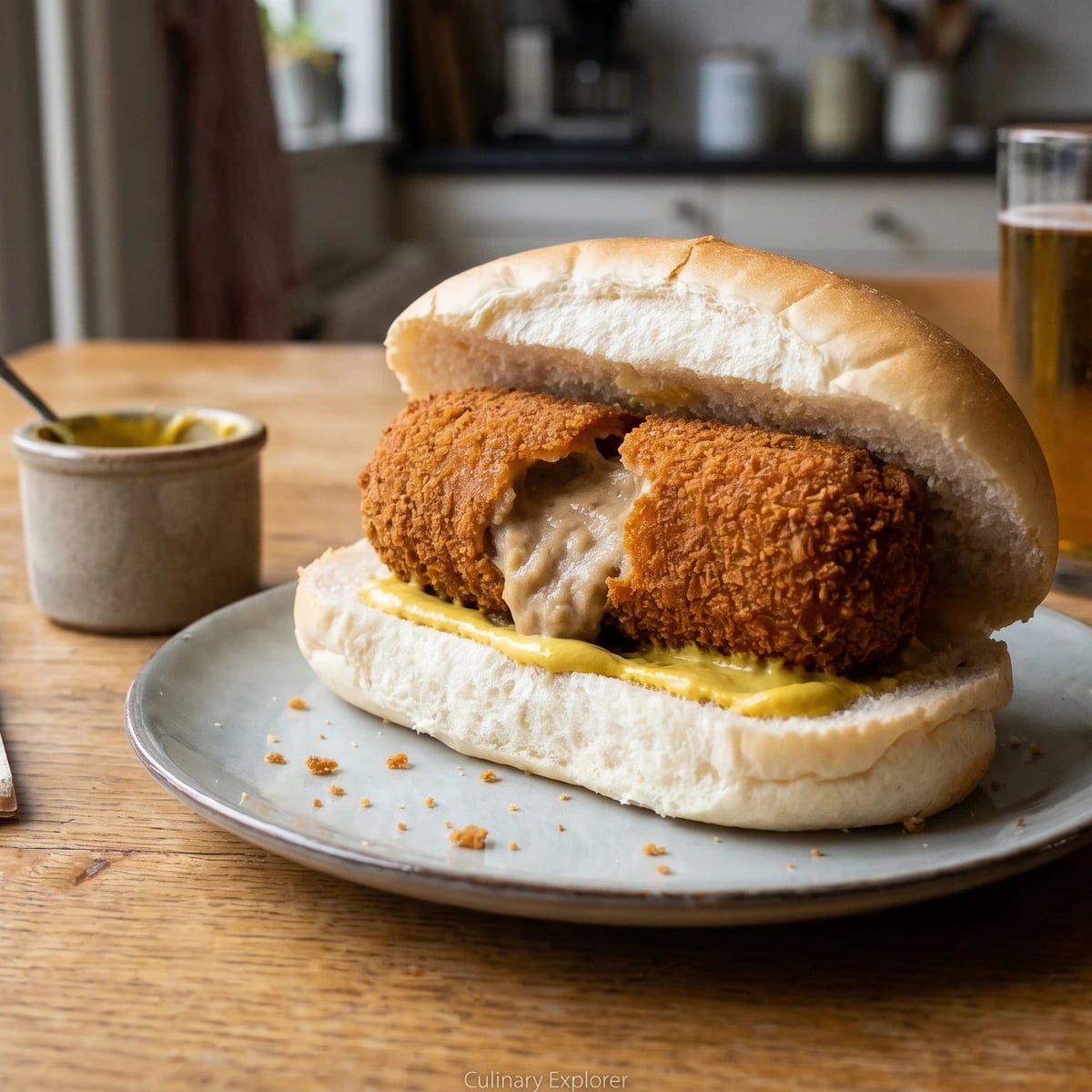
A soft white roll, a crisp ragout kroket, and mustard with a little temper: the country's unofficial official sandwich, born between thrift, French technique, and Amsterdam lunch counters.
Sandwiches & Wraps
Dutch
Quick Meal
Budget Friendly
35 min
Active Time
25 min cook•4 hr total
Yield6 sandwiches
The kroket is what happens when a very respectable French ragout loses its manners and becomes lunch. I say this with affection. In the Netherlands we have a genius for taking something that began in drawing rooms, wrapping it in breadcrumbs, and selling it from a wall hatch to a student with bicycle grease on his fingers.
The name already tells you the joke, if you listen in French first. Croquette comes from croquer, to crunch, and the Dutch kroket kept the sound and improved the social life. Once it was a small fried luxury of thick ragout, veal or beef, cooled until firm, breaded, and fried. Then the twentieth century put it in a soft white bolletje, a little round roll, with mustard sharp enough to wake the whole thing up. But let me tell you a secret: the bread is not an afterthought. It is the quiet softness that makes the crust sound louder.
A broodje kroket asks for discipline, not fuss. The ragout must be thick enough to set cold, or it will flee the crust the moment the oil gets serious. The breading must be double, because one coat is optimism and two coats are lunch. Hou het altijd simpel, always keep it simple: make the filling, chill it properly, fry until deeply golden, split the roll, add mustard, and crush the kroket just enough that the hot ragout meets the bread. Eat at once. This sandwich waits for no scholar.
The Dutch kroket descends from the French croquette, from croquer, to crunch, and appears in Dutch cookery from the nineteenth century as a refined fried ragout preparation before becoming an everyday snack. Amsterdam gave the broodje kroket much of its modern lunch-counter identity, especially through names like Kwekkeboom, founded in 1900, and Eetsalon Van Dobben, opened in 1945. Its rise after the Second World War mirrors a larger Dutch pattern: restaurant technique made portable, affordable, and ordinary without losing the pleasure of crisp crust and slow-cooked filling.
The technique, the tradition, and the story behind every dish.
Melt the butter in a heavy pan and soften the onion gently for five minutes without browning it. Stir in the flour and cook for two minutes, then add the cold stock a little at a time, beating until smooth before each new splash. Add the milk, then simmer until the sauce is thick, glossy, and pulls slowly from the spoon.
2
Season and chill
Fold in the shredded beef or veal, mustard, nutmeg, parsley, salt, and black pepper. The nutmeg is not decoration; it is the old Dutch whisper in the ragout. Spread the mixture in a shallow dish, press parchment on the surface, and refrigerate until fully cold and firm, at least three hours.
If the ragout is loose when cold, stop. Warm it again and cook it thicker. A kroket filling that won't stand before frying won't behave inside hot oil.
3
Shape the kroketten
Divide the cold ragout into six equal portions and roll each into a short cylinder about twelve centimetres long. Keep your hands lightly floured and work quickly; cold ragout is obedient, warm ragout remembers it is sauce.
4
Bread them twice
Roll each cylinder in flour, dip in beaten egg, and coat in breadcrumbs. Dip again in egg and breadcrumbs for a second coat, pressing gently so the crust is even and sealed at the ends. Lay the kroketten on a tray and chill for thirty minutes while the oil heats.
5
Fry until crisp
Heat the oil to 180C in a deep, heavy pan. Fry the kroketten in batches for three to four minutes, turning once, until the crust is deep golden brown and crisp. Drain on a rack rather than paper if you can; paper traps oil against the crust, and the whole point of croquer is the crunch.
6
Build the broodje
Split the soft white rolls and spread each with a tablespoon of mustard. Lay one hot kroket inside each roll and press down lightly so the crust cracks and the ragout settles into the bread. Serve immediately, with no lettuce, no tomato, no apology.
Chef Tips
•For a quick Dutch lunch, buy good frozen beef or veal kroketten from a Dutch butcher or a trusted brand and put your effort into the frying and the bread. History allows this shortcut; the snack bar made the broodje kroket famous, not the private kitchen.
•Use soft white rolls, not crusty bread. A hard roll fights the kroket, while a witte bol, a soft white bun, gives way and catches the ragout.
•Mustard matters. It should be sharp enough to cut the richness, not sweet enough to make the sandwich childish.
•Do not crowd the pan. Too many kroketten drop the oil temperature, and then the crust drinks oil before it crisps.
Advance Preparation
•The ragout can be made up to two days ahead and kept covered in the refrigerator.
•Breaded, uncooked kroketten can be frozen on a tray, then stored in a sealed container for up to one month. Fry from frozen at 175C, adding two to three minutes.
•Once fried, a kroket is best eaten at once. Reheating makes the filling hotter than the crust can politely contain.
Frequently Asked Questions
Nutrition Information
1 serving (about 275g)
Calories
700 calories
Total Fat
34 g
Saturated Fat
10 g
Trans Fat
1 g
Unsaturated Fat
23 g
Cholesterol
115 mg
Sodium
1300 mg
Total Carbohydrates
70 g
Dietary Fiber
4 g
Sugars
6 g
Protein
28 g
Where cooking meets culture.
Culinary guides, cultural storytelling, and the editorial depth that makes cooking meaningful.