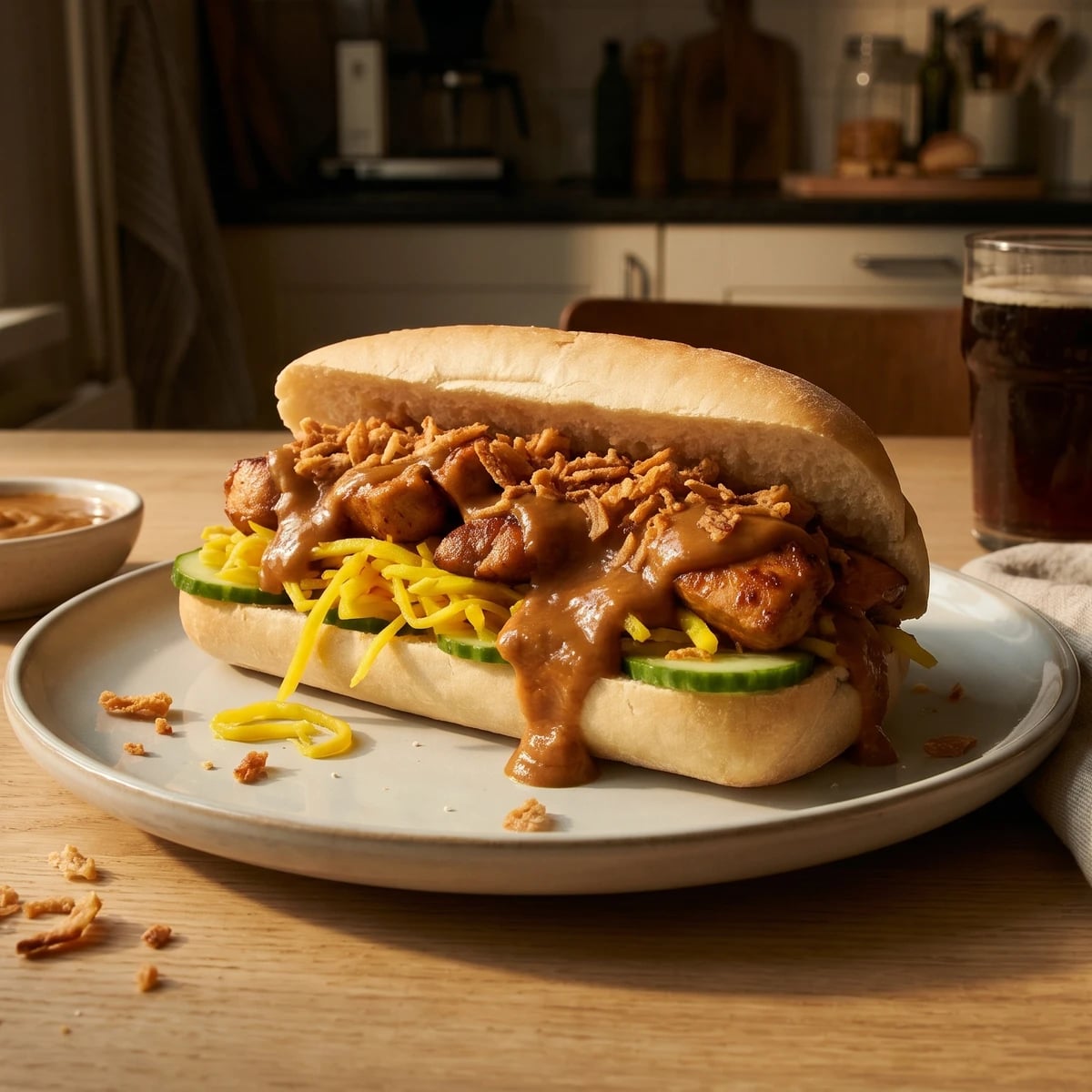
The colony brought home in a roll: grilled chicken saté under warm peanut sauce, sharpened with atjar, made Dutch by the lunch counter and kept honest by the saus.
Sandwiches & Wraps
Dutch
Quick Meal
Weeknight
20 min
Active Time
15 min cook•35 min total
Yield4 sandwiches
Some dishes arrive in the Netherlands by ship, and some by family. Broodje Indische kipsaté arrived by both. I first understood it not in an archive but at a kitchen table where the satésaus, the peanut sauce, was guarded more fiercely than the silver. The chicken could be ordinary, the roll could be from the corner baker, but the saus had to be right: dark, nutty, salty-sweet, with enough sambal to tap the table and wake it up.
The name already tells you the journey. Broodje means a small bread roll. Indische points not to India, but to the former Dutch East Indies, present-day Indonesia, and kipsaté is chicken satay, skewered meat whose name travelled through Malay and Indonesian kitchens before Dutch lunchrooms tucked it into bread. But let me tell you a secret: the sandwich is not a lesser version of saté. It is the Dutch weekday solution to an Indo-Dutch memory, portable, messy, and entirely serious.
The trick is to keep the chicken juicy and the sauce loose enough to soak the bread without drowning it. Peanut sauce thickens as it stands, like a scholar becoming stubborn in old age (for obvious reasons), so you thin it with warm water until it falls from the spoon in a ribbon. Then comes atjar, pickled vegetables, for acid, cucumber for coolness, and fried onions for crackle under the teeth. Hou het altijd simpel. A good roll, good sauce, hot chicken, sharp pickle. History and cookery, they cannot be separated, but lunch still has to be ready before everyone gets cross.
Saté entered Dutch everyday eating through the Indo-Dutch table, especially after Indonesian independence in 1949, when repatriated Dutch and Indo families brought home cooking, toko groceries, and rijsttafel habits into Dutch cities. Peanut sauce, often called satésaus or pindasaus in the Netherlands, became so familiar that by the late twentieth century it belonged as much to snack bars, lunchrooms, and chips shops as to family kitchens. The broodje Indische kipsaté shows that history in miniature: Indonesian skewered meat, Dutch bread culture, and the sharp-sweet atjar that keeps the richness in balance.
The technique, the tradition, and the story behind every dish.
Stir the chicken with the ketjap manis, oil, lime juice, garlic, coriander, cumin, and salt. Leave it for at least fifteen minutes, or up to a night in the refrigerator. Thigh meat is the honest choice here; breast dries out just when the sauce is becoming generous.
2
Make the saus
Put the peanut butter, coconut milk, ketjap manis, sambal, lime juice, and brown sugar in a small saucepan over low heat. Stir until smooth and glossy, then loosen with warm water, a spoonful at a time, until it falls in a thick ribbon. Do not boil it hard. Peanut sauce sulks when bullied.
3
Cook the chicken
Heat a grill pan or heavy frying pan until properly hot. Cook the chicken in a single layer for about five to seven minutes, turning once or twice, until browned at the edges and cooked through. If the pan crowds, cook in two batches; crowded chicken stews, and this sandwich wants the dark edges of the grill.
If you use wooden skewers for a more saté-like shape, soak them first and thread the chicken loosely. For a weekday broodje, strips in a pan are perfectly respectable.
4
Warm the rolls
Split the rolls and warm them briefly in the pan or oven, just until the cut sides feel soft and ready to drink in sauce. A hard roll fights the filling; a soft broodje does the Dutch thing and cooperates.
5
Build the broodjes
Lay cucumber slices inside each roll, add the hot chicken, spoon over plenty of peanut sauce, then finish with drained atjar and fried onions. Serve at once, with extra saus on the table, because someone will ask and that person is correct.
Chef Tips
•Use ketjap manis, the sweet Indonesian soy sauce, not ordinary soy sauce with sugar stirred in as an afterthought. The thickness and molasses note matter.
•Atjar tjampoer, mixed pickled vegetables, is not decoration. It cuts the peanut sauce and makes the sandwich lively enough to finish.
•Peanut sauce thickens as it cools. Keep a small cup of warm water beside the stove and thin it back to a spoonable ribbon before serving.
•For a sharper lunchroom version, add a few drops of sambal to the finished roll rather than making the whole pot of sauce hotter.
Advance Preparation
•The chicken can marinate overnight in the refrigerator; bring it out fifteen minutes before cooking so it hits the pan without a deep chill.
•The peanut sauce can be made two days ahead and refrigerated. Reheat gently with warm water until glossy and loose again.
•Assemble only just before eating. Bread, sauce, and pickle are a fine friendship, but not one that survives the refrigerator.
Frequently Asked Questions
Nutrition Information
1 serving (about 390g)
Calories
875 calories
Total Fat
48 g
Saturated Fat
17 g
Trans Fat
0 g
Unsaturated Fat
31 g
Cholesterol
140 mg
Sodium
1900 mg
Total Carbohydrates
69 g
Dietary Fiber
6 g
Sugars
25 g
Protein
48 g
Where cooking meets culture.
Culinary guides, cultural storytelling, and the editorial depth that makes cooking meaningful.