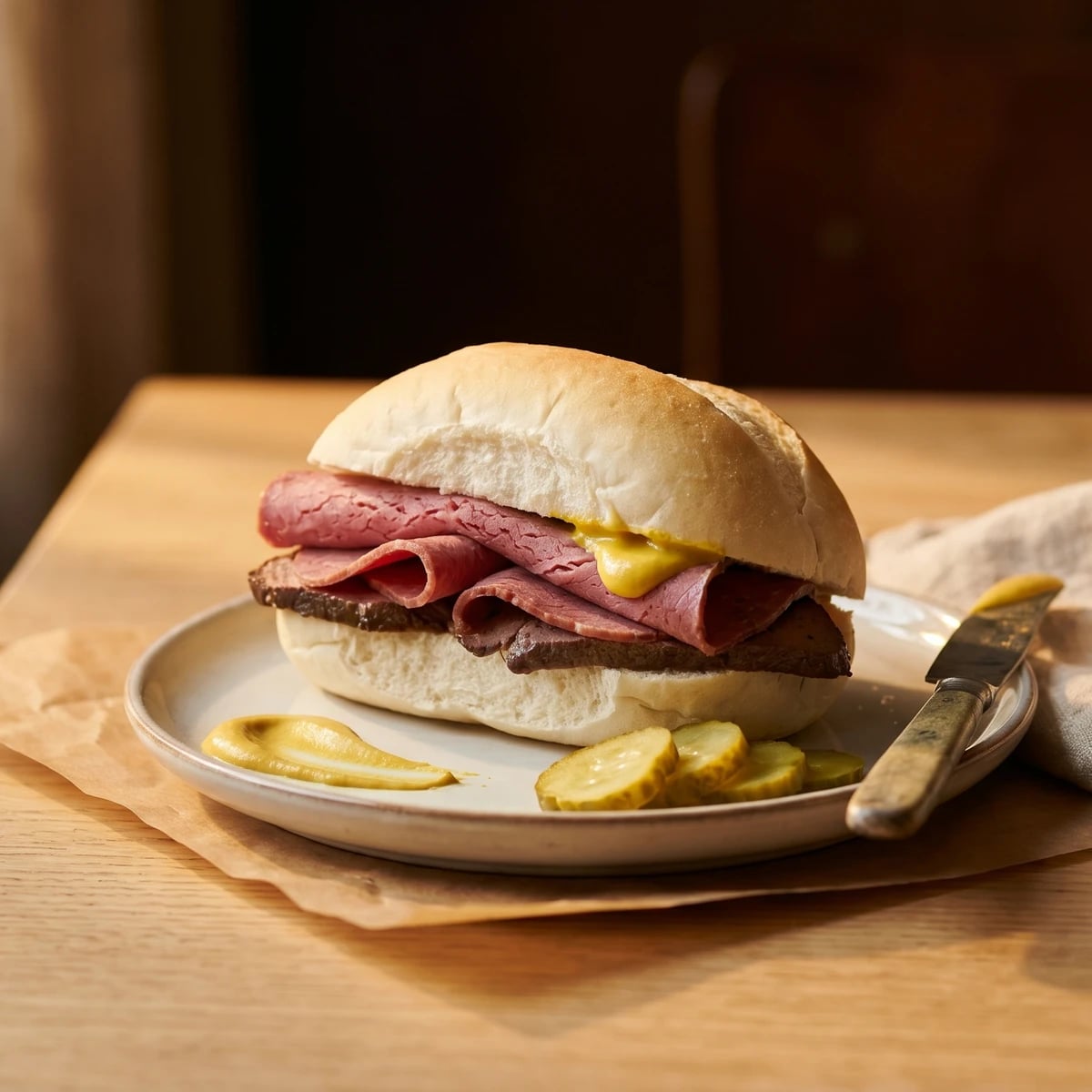
A white Amsterdam kadetje carrying half warm pekelvlees, half tender liver, the Jewish sandwich that survived the old Jodenbuurt and still asks only for mustard and a good appetite.
Sandwiches & Wraps
Dutch, Jewish
Quick Meal
Special Occasion
10 min
Active Time
8 min cook•18 min total
Yield4 sandwiches
The first time I ordered a broodje halfom in Amsterdam, I was handed a small white roll that looked far too modest for the history it was carrying. This is often how Dutch food behaves. It arrives quietly, wrapped in paper, and only later do you notice that the old Jewish quarter, the butcher's counter, the lunch crowd, and a whole stubborn city have come to the table with it.
The name already tells you, and for once I don't need Latin to be useful. Halfom is Amsterdam plain speech: half of one, half of the other. In this case the one is pekelvlees, brined beef, warm and rosy from the slicer; the other is cooked liver, dark, soft, and minerally. Together on a kadetje, a soft white roll, they make a sandwich that has no patience for decoration. Mustard, yes. A pickle beside it, if the mood is right. Anything more starts making speeches.
But let me tell you a secret. The sandwich is not heavy if you treat it gently. Boil the meat and the liver will turn chalky, the beef tight and sulking. Warm them instead in quiet stock, just long enough for the slices to relax and shine, then stack them generously while the bread is still soft. Hou het altijd simpel, always keep it simple. A dish without its story is half a meal, and this one is already called half. We shouldn't rob it twice.
Broodje halfom belongs to Amsterdam's Jewish delicatessen culture, especially the old Jodenbuurt, where Ashkenazi butchers and lunch counters sold warm meat sandwiches from the nineteenth century onward. Its pairing of pekelvlees, brined beef, with cooked liver reflects both Jewish butchery traditions and the Amsterdam habit of serving sustaining food on a soft white kadetje. After the Second World War shattered the old neighborhood, the sandwich survived at only a handful of counters and became closely associated with Sal Meijer, the postwar Amsterdam sandwich shop opened in 1957.
The technique, the tradition, and the story behind every dish.
Put the stock or water in a small saucepan with the bay leaf and peppercorns. Bring it just to a simmer, then lower the heat until it barely moves. You are not making soup here; you are making a warm bath for meat that has already done its work.
2
Warm the fillings
Lay the liver slices into the hot stock for about two minutes, then add the pekelvlees for the final minute. Lift everything out with tongs when the slices look glossy and flexible. Do not let the pan boil. Boiled liver tastes like a lecture no one asked for.
If your pekelvlees is sliced very thin, it needs only thirty seconds in the hot stock. The liver can take a little longer, but only a little.
3
Prepare the rolls
Split the kadetjes without cutting all the way through, so each roll opens like a little book. Spread the inside with a teaspoon of sharp mustard. The bread should be soft and yielding; a crusty roll fights the filling, and this sandwich has had enough history without a bread argument.
4
Stack half and half
Divide the warm liver and pekelvlees among the rolls in equal measure, folding the slices rather than laying them flat. Halfom means half and half, so keep the promise. Serve at once, with sweet-sour pickles beside the plate.
Chef Tips
•Buy pekelvlees from a Jewish deli, Dutch butcher, or a good shop that slices cooked brined beef fresh. Tinned corned beef is a different creature entirely and will make a different sandwich.
•If you must cook the liver yourself, use calf's liver if you can. Poach it gently in salted water with onion and bay until the centre reaches 70C, then chill it fully before slicing thin. For a kosher table, buy liver already prepared by a kosher butcher; home kashering has rules this quick recipe shouldn't pretend to replace.
•The mustard should be sharp enough to cut the richness. Sweet mustard makes the sandwich sleepy.
•Serve immediately. A broodje halfom waits badly: the bread softens, the liver dulls, and the little Amsterdam miracle becomes merely lunch.
Advance Preparation
•The liver and pekelvlees can be sliced and kept refrigerated for one day, covered well.
•Warm the fillings only once and assemble just before serving; the sandwich is at its best while the meat is glossy and the bread still soft.
Frequently Asked Questions
Nutrition Information
1 serving (about 230g)
Calories
395 calories
Total Fat
8 g
Saturated Fat
3 g
Trans Fat
0 g
Unsaturated Fat
5 g
Cholesterol
300 mg
Sodium
1700 mg
Total Carbohydrates
33 g
Dietary Fiber
2 g
Sugars
5 g
Protein
43 g
Where cooking meets culture.
Culinary guides, cultural storytelling, and the editorial depth that makes cooking meaningful.