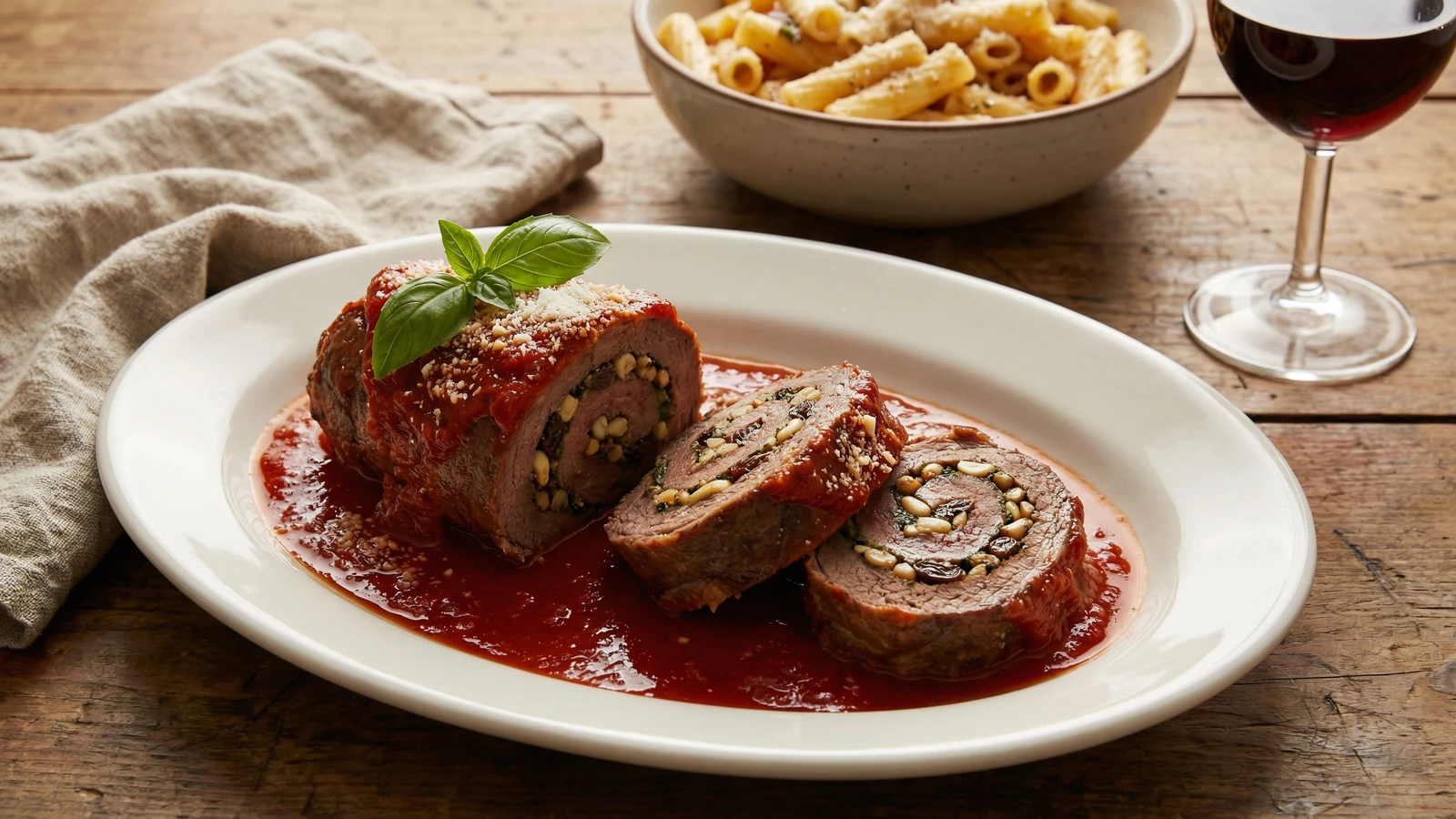
The Sunday ritual of Naples: beef rolls stuffed with pine nuts, raisins, and garlic, braised in tomato sauce until surrendering to tenderness. The sauce goes to the pasta. The meat comes second.
Main Dishes
Italian, Neapolitan
Comfort Food
Make Ahead
Special Occasion
45 min
Active Time
3 hr cook•3 hr 45 min total
Yield6 servings
In Naples, Sunday dinner unfolds in two acts. First, the pasta arrives dressed in the rich sauce that has absorbed hours of braising. Then, and only then, come the braciole themselves, the rolled beef that gave its essence to that sauce. Americans want to serve everything together on one plate. This misses the point entirely.
The rolls must be thin. Pound the beef until you can nearly see through it. The filling must be restrained: pine nuts, raisins, a whisper of garlic, parsley, a grating of cheese. Roll tightly, secure well, and let time do the rest. There is no rushing braciole. Three hours at a lazy simmer transforms tough beef into something that yields to a fork.
What you keep out matters. Some recipes call for breadcrumbs, prosciutto, hard-boiled eggs. Neapolitan grandmothers would recognize none of this excess. The filling exists to perfume the meat, not to compete with it. Pine nuts and raisins: the sweet and savory balance that defines so much of southern Italian cooking. That is enough.
Braciole emerged from the working-class kitchens of Naples, where cooks transformed tough, inexpensive cuts of beef into Sunday celebrations through patient braising. The dish belongs to the tradition of ragù napoletano, the slow-simmered meat sauce that anchors the Neapolitan table. The two-course service, pasta then meat, stretches a modest amount of protein into a feast that feeds many.
The technique, the tradition, and the story behind every dish.
beef top roundcut into 8 slices about 1/4-inch thick
2 pounds
pine nuts
1/3 cup
golden raisins
1/3 cup
garlicminced fine
3 cloves
fresh flat-leaf parsleychopped
1/2 cup
Pecorino Romanofreshly grated
1/2 cup
kosher salt
to taste
black pepperfreshly ground
to taste
extra virgin olive oil
1/4 cup
yellow oniondiced fine
1 medium
garlicsmashed
2 cloves
San Marzano tomatoescrushed by hand
2 cans (28 ounces each)
dry red wine
1 cup
fresh basil leaves
4
ziti or rigatoni
1 pound
Pecorino Romano
for serving
Equipment Needed
•Heavy 6-quart Dutch oven or braising pot
•Meat mallet or heavy pan for pounding
•Toothpicks or kitchen twine
•Large pot for pasta
Instructions
1
Pound the beef
Place each slice of beef between two sheets of plastic wrap. Using a meat mallet or the bottom of a heavy pan, pound the slices until they are uniformly thin, about 1/8 inch thick. The meat should nearly double in size. Work from the center outward, using firm but controlled strokes. Season both sides lightly with salt and pepper.
Ask your butcher to slice the beef thin and pound it for you. A good butcher will do this. A great butcher will know exactly what you are making when you ask.
2
Prepare the filling
In a small bowl, combine the pine nuts, raisins, minced garlic, parsley, and grated Pecorino. Mix well. The filling should be fragrant but not wet. Taste and adjust salt. Remember that the cheese is salty.
3
Fill and roll the braciole
Lay a pounded beef slice flat on your work surface with the shorter end facing you. Place approximately two tablespoons of filling in a line across the lower third of the meat, leaving a half-inch border on each side. Roll the beef away from you, tucking the filling in as you go. Roll tightly but do not squeeze so hard that filling escapes. Secure each roll with two or three toothpicks or tie with kitchen twine at both ends and once in the middle.
Do not overstuff. The temptation is always to add more. Resist it. Too much filling prevents the roll from holding together during braising.
4
Brown the braciole
In a heavy Dutch oven or braising pot, heat the olive oil over medium-high heat until it shimmers. Working in batches to avoid crowding, add the braciole and brown well on all sides. This takes three to four minutes per side. The meat should develop a deep golden crust. Transfer browned rolls to a plate. Do not rush this step. The browning creates flavor that no amount of simmering can replicate.
5
Build the sauce
Reduce heat to medium. Add the diced onion to the pot and cook, stirring occasionally, until soft and golden, about 10 minutes. Add the smashed garlic cloves and cook one minute more. Pour in the wine and scrape up any browned bits from the bottom of the pot. Let the wine reduce by half. Add the crushed tomatoes and basil. Stir well. Season with salt and pepper.
6
Braise the braciole
Return the braciole to the pot, nestling them into the sauce. The sauce should come about three-quarters of the way up the rolls. If needed, add a splash of water. Bring to a gentle simmer, then reduce heat to the lowest possible setting. Cover and cook for 2 1/2 to 3 hours, turning the rolls once halfway through. The braciole are done when they yield easily to a fork. The sauce will have darkened and thickened.
The simmer must be lazy. If you see vigorous bubbling, the heat is too high. A bubble should break the surface every few seconds, no more. Patience is not optional here.
7
Cook the pasta
Bring abundant salted water to a vigorous boil. The water should taste like the sea. Cook the ziti or rigatoni until al dente, one minute less than the package directs. Reserve one cup of pasta water before draining.
8
Serve in two courses
Remove the braciole from the sauce and set aside, loosely covered with foil. Toss the drained pasta with enough sauce to coat generously, adding pasta water as needed. Serve the pasta first, passing Pecorino at the table. When the pasta course is finished, slice the braciole to reveal the spiral of filling and serve with additional sauce spooned over. This is the correct order. The pasta eats first. The meat comes second.
Remove the toothpicks or twine before serving. It seems obvious, but in the excitement of Sunday dinner, people forget.
Chef Tips
•Top round is traditional, but flank steak works if pounded properly. What matters is thin, even slices that will roll without tearing. Avoid cuts with heavy connective tissue running through them.
•The raisins should be golden, not dark. Soak them in warm water for ten minutes if they are dry, then drain well. Plump raisins distribute sweetness evenly. Hard raisins create unpleasant pockets.
•Some Neapolitan cooks add a small piece of lard or a thin slice of prosciutto inside each roll. This is acceptable if you wish. It is not required. The beef provides enough richness.
•The sauce improves overnight. Make the braciole a day ahead if serving for a special occasion. Reheat gently, covered, adding a splash of water if the sauce has thickened too much.
Advance Preparation
•The braciole and sauce can be made two days ahead. Store together in the refrigerator. The meat continues to absorb flavor from the sauce.
•Reheat gently over low heat, covered, until warmed through. Add a splash of water if the sauce has thickened.
•The braciole freeze adequately for two months in their sauce. Thaw overnight in the refrigerator before reheating. The texture changes slightly but remains acceptable.
Frequently Asked Questions
Nutrition Information
1 serving (about 475g)
Calories
765 calories
Total Fat
24 g
Saturated Fat
6 g
Trans Fat
0 g
Unsaturated Fat
16 g
Cholesterol
115 mg
Sodium
780 mg
Total Carbohydrates
79 g
Dietary Fiber
5 g
Sugars
11 g
Protein
57 g
Where cooking meets culture.
Culinary guides, cultural storytelling, and the editorial depth that makes cooking meaningful.