Culinary Explorer

A cooking platform built around craft, culture, and the stories behind what we eat.
Discover Culinary Explorer
Boulfaf (بولفاف)

Boulfaf (بولفاف)

Created by

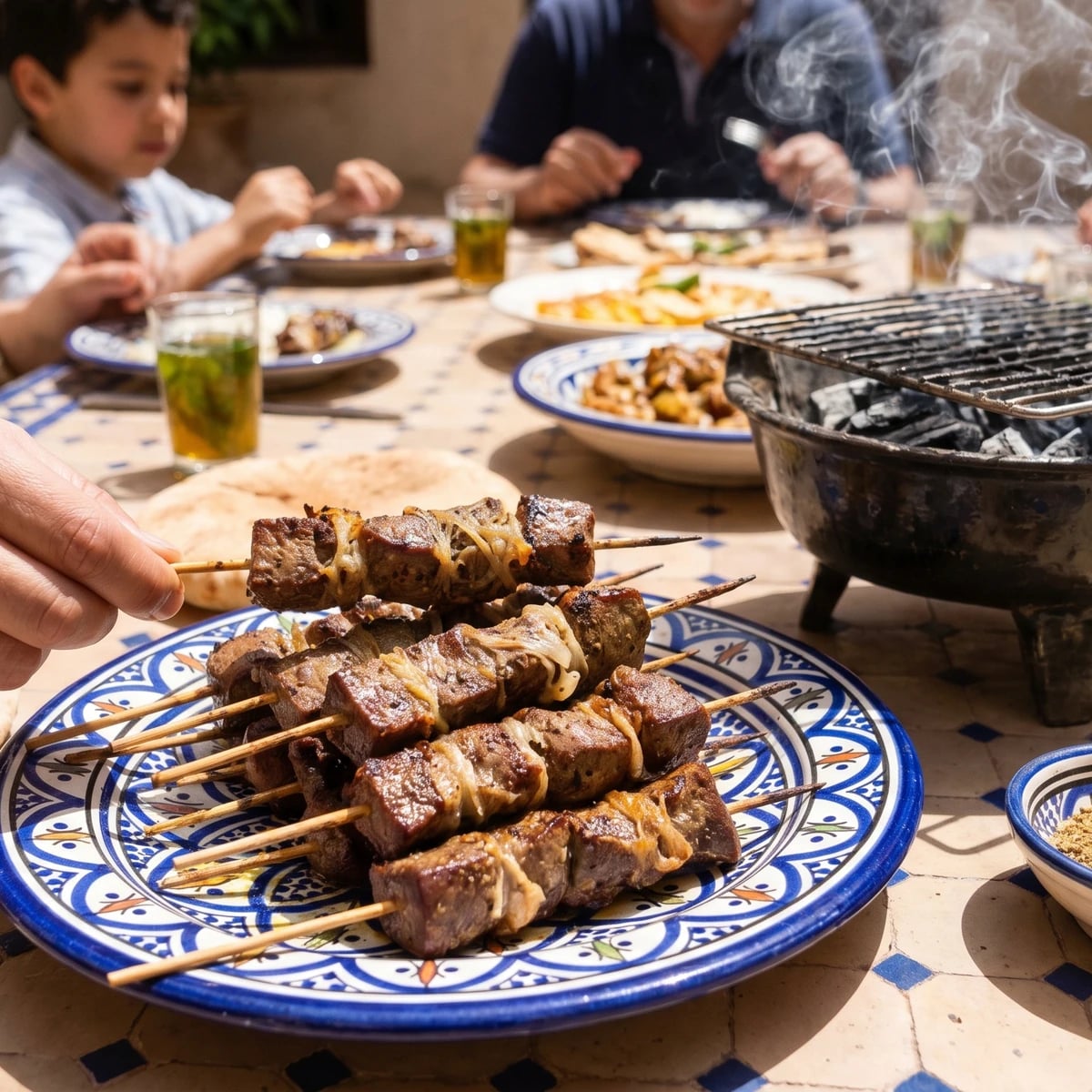
Eid begins at the brazier with sheep liver kissed by coals, wrapped in caul fat, and shared fast with khobz while the house is still busy around the sacrifice.

Appetizers & Snacks
Moroccan
Holiday
BBQ
Celebration
30 min
Active Time
20 min cook50 min total
Yield6 servings, about 12 skewers

On Eid al-Adha, the first thing many Moroccan households want from the fire is not the grand tagine, it is the liver. The sheep has just been divided, the courtyard is busy, and the liver is too tender and too perishable to wait. You season it with cumin and salt, wrap it in the sheep's own lacy caul fat, and put it over coals while the day is still moving around you.

The whole dish lives in that wrapping. Liver dries quickly when it meets heat, but caul fat melts over it and bastes each cube before disappearing into crisp little edges. First you set the liver over the fire in large pieces so it firms and takes the charcoal taste, then you cut, season, wrap, and skewer. Do not bury it in spices. La balance est dans les yeux, the scale is in the eyes: each piece should be touched by cumin, not hidden under it.

Boulfaf is eaten standing around the brazier, or carried to the table on a shared platter with khobz torn and ready. Make more than you think, because someone will pass by, smell the coals, and become a guest. Une table, c'est une porte qu'on laisse ouverte, a table is a door you leave open, and on Eid that door opens early.

Boulfaf is tied to Eid al-Adha, the 10th day of Dhu al-Hijjah, when Moroccan families cook the most perishable parts of the sheep first, especially the liver and caul fat. Its name is commonly linked in Darija to l'fef, wrapping, and versions run from the Rif and Middle Atlas to the Souss and Oujda, with cumin and salt as the steady grammar while paprika or hot pepper shifts by household. The exact age of the named skewer is hard to prove because it lived mostly in oral domestic practice, though caul-fat wrapping belongs to the wider Maghrebi and Andalusi sheep-cookery repertoire recorded from the medieval period.

The technique, the tradition, and the story behind every dish.

Discover Culinary Explorer

Ingredients

fresh sheep or lamb liver

Quantity

700g

membrane trimmed

sheep caul fat (crépine)

Quantity

250g

rinsed, unfolded, and patted dry

ground cumin

Quantity

2 tsp, plus more for serving

fine sea salt

Quantity

1 1/2 tsp, plus more for serving

sweet paprika (optional)

Quantity

1 tsp

hot paprika or cayenne (optional)

Quantity

1/2 tsp

freshly ground black pepper

Quantity

1/2 tsp

white vinegar (optional)

Quantity

1 tbsp

for rinsing the caul fat

round khobz

Quantity

as needed

for serving

Equipment Needed

  • Charcoal brazier (majmar) or outdoor grill
  • Metal skewers, 25-30 cm, or soaked wooden skewers
  • Tongs
  • Instant-read thermometer

Instructions

  1. 1

    Ready the coals

    Prepare a charcoal brazier or grill with medium-hot coals, grey at the edges and alive underneath, not licking with flames. Caul fat melts fast, and flames will scorch it before the liver is ready. If you're using wooden skewers, soak them for 30 minutes while the fire settles.

    A cast-iron grill pan can serve when you have no charcoal, but the Eid taste belongs to coals.
  2. 2

    Clean the caul

    Rinse the caul fat gently in cool water, with the vinegar if it needs freshening, then unfold it without tearing the lace. Pat it very dry and cut it into strips about 4 cm wide and 10 cm long. Keep it cool until you wrap, because cold caul fat handles cleanly and clings to the liver.

  3. 3

    Set the liver

    Put the trimmed liver on the grill in two or three large pieces. Cook it for 2 to 3 minutes per side, just until the outside darkens, firms, and smells of the coals, while the center is still only partly cooked. This first pass gives the liver structure so it cuts cleanly and does not crumble when you wrap it.

  4. 4

    Season by eye

    Cut the warm liver into 3 cm cubes. Toss it with the cumin, salt, black pepper, and the paprika or hot pepper if your household uses them. You want a fine coat on every face, not a crust of spice. Boulfaf is liver, caul fat, cumin, and salt before anything else.

  5. 5

    Wrap and skewer

    Wrap each liver cube in one thin strip of caul fat, then thread 4 or 5 wrapped pieces onto each skewer. One layer is enough. Too much fat masks the liver and feeds flare-ups; the right amount melts, bastes, and leaves little browned edges.

  6. 6

    Grill to finish

    Grill the skewers over the coals for 5 to 8 minutes, turning often, until the caul fat has mostly rendered, the edges are browned, and the liver is just firm. Move the skewers away from flare-ups as they happen. For safety, the thickest piece should have no raw center and reach 70°C or 160°F on an instant-read thermometer.

  7. 7

    Serve at once

    Slide the hot skewers onto a shared platter, dust lightly with more cumin and salt, and bring khobz to the table right away. Boulfaf waits for no one. Tear the bread, catch the juices, and keep one skewer aside for the person who arrives late.

Chef Tips

  • Buy the liver the day you cook it. It should be deep, glossy, and clean-smelling, never dull or sour. Sourcing comes first here; no gesture rescues tired offal.
  • Ask the butcher for caul fat ahead of time. It often sits in the back, not in the display case. If you cannot get it, make grilled liver skewers and call them kebda mechwi, not boulfaf.
  • Keep the seasoning close to cumin and salt. Some households add sweet paprika or a little heat, especially by local habit, but the spice should serve the liver, not cover it.
  • Do not hold cooked boulfaf in a warm oven. The liver tightens and dries. Grill it when people are already near the table.

Advance Preparation

  • Ask for the caul fat one or two days ahead, then keep it well chilled and cook it within 24 hours of buying when you can.
  • You can rinse and cut the caul fat a few hours ahead. Cover it and keep it cold.
  • The liver can be set over the coals, cut, seasoned, wrapped, and chilled up to 3 hours before grilling. Cook the skewers at the last moment.

Frequently Asked Questions

Nutrition Information

1 serving (about 170g)

Calories
490 calories
Total Fat
30 g
Saturated Fat
13 g
Trans Fat
0 g
Unsaturated Fat
15 g
Cholesterol
430 mg
Sodium
820 mg
Total Carbohydrates
25 g
Dietary Fiber
2 g
Sugars
1 g
Protein
29 g

Note: Chef personas and recipes are created with AI assistance. Cook with care: follow safe food-handling practices, check doneness with a thermometer when needed, and adapt for allergies and your kitchen.

Where cooking meets culture.

Culinary guides, cultural storytelling, and the editorial depth that makes cooking meaningful.

Discover Culinary Explorer

More from Moroccan Mezze & Savory Pastries

Browse the full collection