
Chef Freja
Boller
Soft, round, barely sweet Danish buns made with milk, butter, and patient yeast. The first thing most Danish children learn to bake, and the smell that means someone is home.
A cooking platform built around craft, culture, and the stories behind what we eat.
Created by Chef Freja
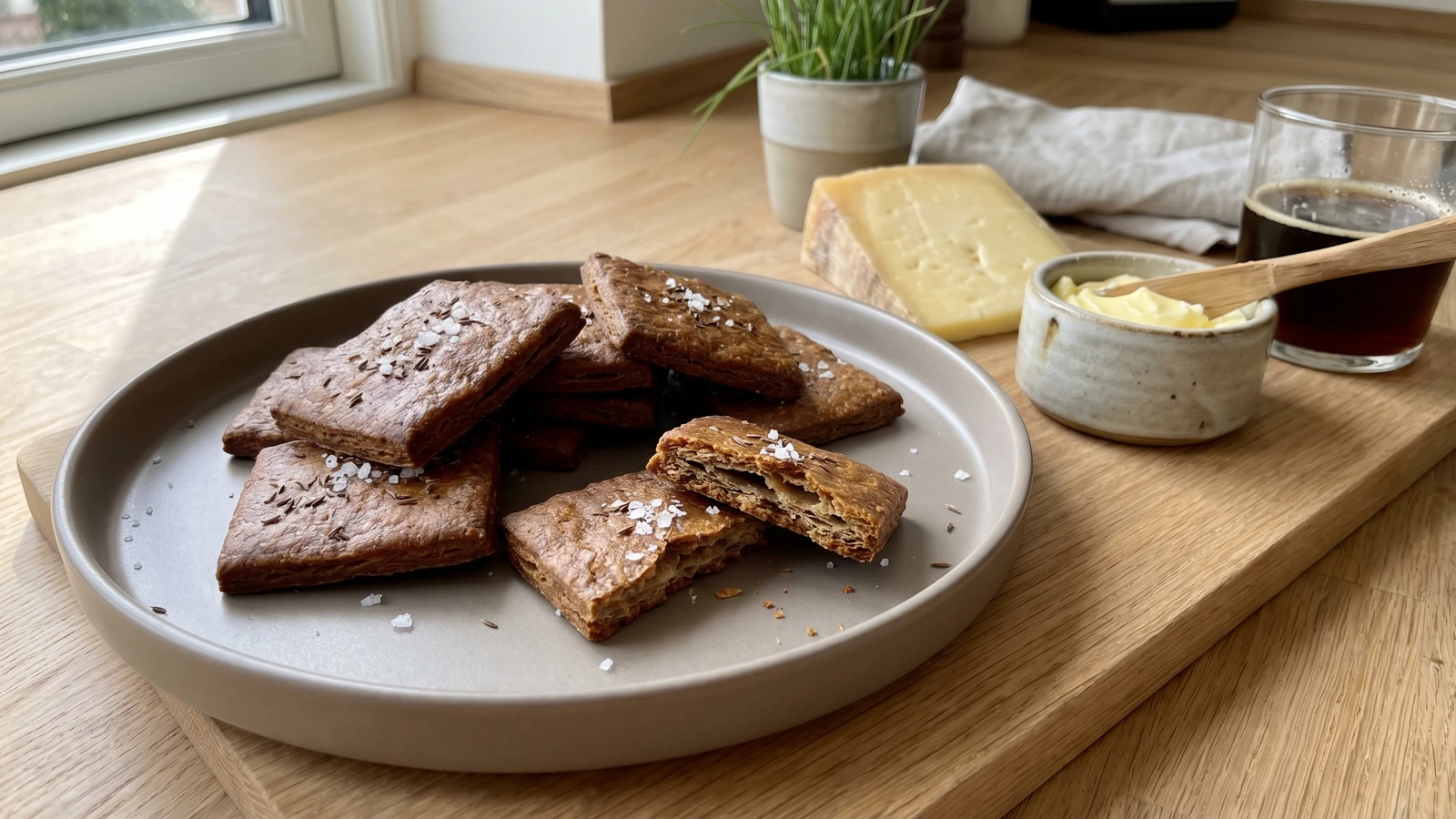
Dark rye crackers from the island of Bornholm, laminated in twenty-seven butter-layered folds and scattered with caraway and sea salt. The kind of thing you keep in a tin for cheese, good butter, and cold dark beer.
Bornholm sits out in the Baltic, closer to Sweden than to Copenhagen, and the island has always cooked with a certain independence. The food there is shaped by smoke and salt and rye and the particular stubbornness of people who live surrounded by cold water. These rugkiks belong to that tradition: dark rye crackers, layered with butter through a lamination that builds twenty-seven distinct sheets of dough into something that cracks sharply when you break it and dissolves into warmth on your tongue.
The technique will feel familiar if you've ever made puff pastry, and entirely new if you haven't. You make a firm rye dough, wrap it around a slab of cold butter, and fold it three times, chilling between each fold. Three folds of three. Twenty-seven layers. That's the architecture. When the crackers hit the oven, the butter between those layers turns to steam and pushes them apart, giving you a crispness that solid rye dough could never achieve on its own.
Don't let the lamination intimidate you. Each fold takes two minutes. The fridge does the rest. What comes out of the oven keeps for weeks in a tin, ready for the moment someone arrives and you set out cheese, butter, and a glass of cold dark beer. You'll know when they're right: they snap cleanly when you break one, and the layers are visible at the edge. That's all you need to see.
The laminated rye cracker tradition on Bornholm dates to at least 1924, when island bakeries began formalizing a technique that home cooks had practiced in simpler forms for generations. Bornholm's geographic isolation in the Baltic fostered a distinct pantry culture built around foods that kept through the long winters: smoked herring from the island's roegerier, salted butter, and hard rye crackers that could sit in a tin for months without losing their snap. The twenty-seven-layer lamination, achieved through three precise tri-folds, became the island's signature, a baker's discipline applied to the humblest of Scandinavian grains.
Quantity
250g
stone-ground
Quantity
100g, plus extra for dusting
Quantity
1½ teaspoons
Quantity
1 tablespoon, plus extra for finishing
Quantity
1 teaspoon
Quantity
170ml
Quantity
150g
Quantity
for finishing
| Ingredient | Quantity |
|---|---|
| dark rye flourstone-ground | 250g |
| plain flour | 100g, plus extra for dusting |
| fine sea salt | 1½ teaspoons |
| caraway seeds | 1 tablespoon, plus extra for finishing |
| dark malt syrup | 1 teaspoon |
| cold water | 170ml |
| cold unsalted butter | 150g |
| flaky sea salt | for finishing |
Combine the dark rye flour, plain flour, salt, and caraway seeds in a large bowl. Dissolve the malt syrup in the cold water and pour it into the dry ingredients. Stir with a wooden spoon until you have a firm, cohesive dough. It won't feel like bread dough. Rye has almost no gluten, so the mixture stays dense and slightly rough under your hands. That's correct. The wheat flour gives it just enough structure to hold the lamination together without changing its character. Shape the dough into a flat rectangle about 2 centimetres thick, wrap tightly, and chill for thirty minutes.
While the dough chills, place the cold butter between two sheets of parchment paper and beat it with a rolling pin until you have a flat, even slab about 12 centimetres square. The butter should be cold but flexible: firm enough to hold its shape, soft enough that it won't crack and shatter when you fold it into the dough. If it feels rigid, give it a few more strikes with the pin. If it feels greasy or warm, chill it for ten minutes. The butter needs to match the dough in firmness so they move together as one piece.
Roll the chilled dough on a lightly floured surface into a rectangle roughly 25 centimetres by 15. Place the butter square in the centre. Fold the two short ends of the dough over the butter like a letter, pressing the edges to seal so no butter escapes. Turn the package ninety degrees so the seam faces you. Now roll it out gently into a long rectangle, about 40 centimetres by 15, keeping even pressure so the butterspreads in an unbroken sheet inside the dough. Fold it in thirds: bottom third up, top third down. This is your first fold. Three layers. Wrap and chill for twenty minutes.
Take the dough from the fridge and place it on a floured surface with the seam facing you. Roll it out again to 40 centimetres by 15. Fold in thirds. Nine layers. Wrap and chill for twenty minutes. Repeat once more: roll, fold, chill. Twenty-seven layers. This final fold is the one that matters most. If the butter starts to break through the surface or the dough resists the pin, stop immediately and return it to the fridge. Patience here is the whole recipe. Forcing it tears the layers and you lose the architecture that makes these crackers what they are. After the third fold, chill for at least thirty minutes before rolling out.
Roll the laminated dough out on a lightly floured surface as thin as you can manage, about 2 millimetres. It should feel almost fragile under the pin, the rye darkening and stretching until the dough is barely there. Work in two batches if your counter is small. Cut into neat rectangles, roughly 6 centimetres by 4, using a sharp knife or pastry wheel. A clean edge matters: dragging the knife tears the layers at the border. Transfer to baking sheets lined with parchment, leaving a small gap between each cracker.
Prick each cracker all over with a fork, pressing firmly enough to go through. This is not decorative. The holes let steam escape evenly during baking, which prevents the crackers from bubbling and warping into uneven puffs instead of flat, crisp sheets. Brush each cracker lightly with water and scatter with a few extra caraway seeds and a pinch of flaky sea salt. The water helps the seeds and salt grip the surface through the heat of the oven.
Heat the oven to 190 degrees Celsius. Bake for fifteen to eighteen minutes, rotating the trays once at the halfway mark so they colour evenly. The crackers are ready when they have deepened a shade and feel firm and completely dry to the touch. They will crisp further as they cool, so don't chase crunchiness in the oven or they'll taste bitter and burnt. Let them cool completely on a wire rack. You'll know when they're right: they snap cleanly when you break one, and you can see the twenty-seven paper-thin layers at the edge, each one distinct.
1 serving (about 13g)
Culinary guides, cultural storytelling, and the editorial depth that makes cooking meaningful.
Discover Culinary ExplorerChef Freja
Soft, round, barely sweet Danish buns made with milk, butter, and patient yeast. The first thing most Danish children learn to bake, and the smell that means someone is home.

Chef Freja
The soft Danish white loaf with a milk-brushed crust and blue poppy seeds that belongs on every weekday breakfast table. Simple dough, gentle rise, toast and butter and jam.

Chef Freja
Danish whole wheat rolls made with grahamsmel, ready in just over an hour. The weekday bun that fills lunch boxes, sits beside soup, and smells like a kitchen where someone cares.

Chef Freja
Danish whole wheat bread from coarse grahamsmel, honey-sweetened and golden, baked in a loaf pan and sliced for school lunches, open sandwiches, and the quiet mornings that hold a household together.