
Chef Isabel
Almussafes Valenciano
Almussafes is Valencian bar-counter food: a crusty roll filled with sobrasada, cheese, and onion, then pressed on the plancha until the bread crisps and the filling runs together.
A cooking platform built around craft, culture, and the stories behind what we eat.
Created by
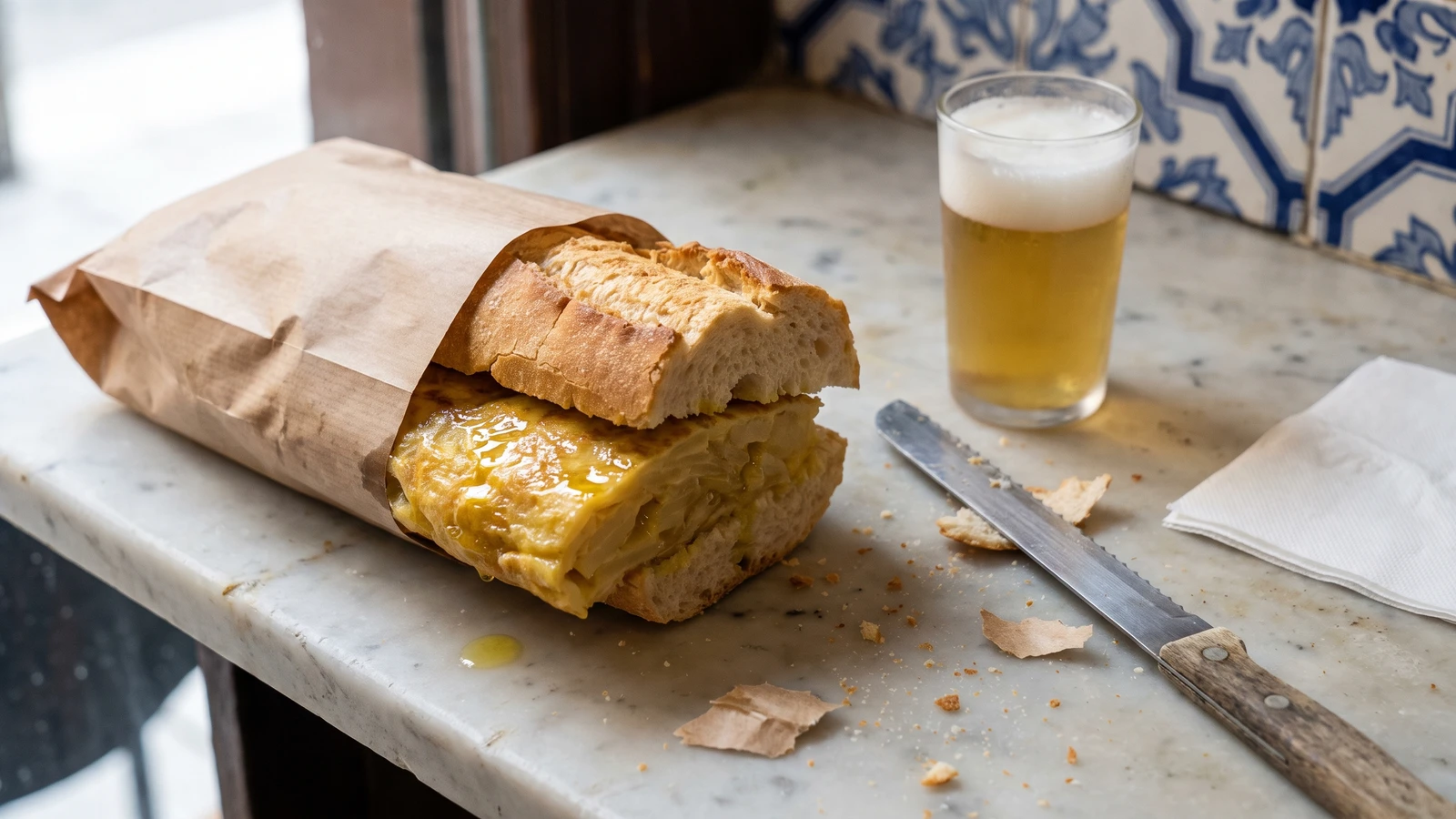
Madrid's plain bocadillo de tortilla is a thick wedge of soft potato omelette pressed into crusty barra. Let the tortilla settle first, and the sandwich slices clean instead of collapsing.
Bocadillo de tortilla de patatas, in its Madrileño bar-counter form, is a thick wedge of tortilla de patatas tucked into crusty barra, plain enough to eat standing up and serious enough to carry a whole lunch. The tortilla is cooked across the peninsula, yes, but this sandwich belongs to the bar counter, the work bag, the train, and the picnic table. What makes it this bocadillo is not decoration. It is good bread, a settled tortilla, and a centre soft enough to be tender but firm enough to slice.
The method that decides it is the potato first, then the rest. You cook the potatoes low and gentle in olive oil, more poached than fried, until they bend without browning. That slow oil gives the tortilla its sweetness and keeps the wedge tender inside the bread. For a bocadillo I let the tortilla rest before cutting; slice it straight from the pan and it collapses into the crumb. Give it fifteen minutes and it behaves.
If you are far from a Spanish barra, use a plain crusty baguette or a firm roll, not soft sliced bread and not a loaf that tastes stronger than the filling. Yukon Gold potatoes will do where Spanish waxy potatoes are not on the market; they hold their shape and give you the right soft layers. Onion is the argument that never ends. I put it in here because a bocadillo wants the moisture. If you leave it out, the sandwich is still itself, just a little plainer.
My Margin says only this: rest the tortilla, then bread. A small line, and it saves the lunch. Siempre sale, si lo sigues.
The bocadillo de tortilla in its plain Madrileño and Castilian bar-counter form grew from two everyday things: the potato omelette and the long crusty barra used for workday sandwiches. Tortilla de patatas itself is one of the dishes no single region owns; an early written trace is often cited in Navarre, where poor households stretched a few eggs with potatoes, and the later Carlist story gives General Tomás de Zumalacárregui a famous but uncertain role. Once set between bread, it became food for almuerzo, school bags, station counters, and picnics, because a rested tortilla travels better than most hot meals.
Quantity
700g
peeled and sliced 3mm thick
Quantity
180g
thinly sliced
Quantity
7
beaten
Quantity
450ml
for poaching; strain and reuse
Quantity
10g
divided
Quantity
1 barra, about 300g, or 4 rolls
cut for sandwiches
Quantity
1 teaspoon
for dry bread
| Ingredient | Quantity |
|---|---|
| waxy or all-purpose potatoespeeled and sliced 3mm thick | 700g |
| yellow onion (optional)thinly sliced | 180g |
| large eggsbeaten | 7 |
| olive oilfor poaching; strain and reuse | 450ml |
| fine sea saltdivided | 10g |
| crusty barra de pan or small bocadillo rollscut for sandwiches | 1 barra, about 300g, or 4 rolls |
| reserved tortilla oil (optional)for dry bread | 1 teaspoon |
Peel the potatoes and slice them 3mm thick, either in rounds or half-moons. Slice the onion thinly if using it. Keep the slices even; thick chunks stay waxy in the middle while thin pieces melt into the egg, and a bocadillo needs a clean, tender bite from edge to edge.
Pour the olive oil into a wide frying pan or saute pan and warm it over medium-low heat, about 140C if you measure it, until a potato slice bubbles lazily at the edge. Add the potatoes, onion, and 7g of the salt. Cook 20 to 25 minutes, turning gently every few minutes, until the potatoes are completely soft and a slice folds against the spoon without browning. You are not making crisps. This slow poach is where the sweetness comes from.
Set a sieve over a bowl and lift the potato-onion mixture into it with a slotted spoon. Let it drain for 5 minutes. Beat the eggs with the remaining 3g salt in a large bowl, then fold in the hot potatoes, breaking a few edges but not mashing them. Rest 10 minutes. The potato drinks in a little egg and the tortilla sets as one piece instead of loose potato trapped in scrambled egg.
Wipe out a 22-24cm non-stick or well-seasoned frying pan and add 1 tablespoon of the reserved oil. Warm it over medium heat, pour in the egg and potato mixture, and settle it into an even layer. Cook 4 to 5 minutes, drawing in the edge with a spatula now and then, until the edge is set and the top is still loose. Cover with a plate larger than the pan, turn it over in one committed motion, then slide the tortilla back into the pan. Cook 2 to 3 minutes more. For a bocadillo, take it just past runny: the centre should yield under your finger but not flow when cut. If it breaks, push it together and carry on; nadie nace sabiendo.
Slide the tortilla onto a board or plate and rest it 15 to 20 minutes. This is the bocadillo step people skip. The egg finishes setting, the potato settles, and the wedge cuts thick and clean instead of falling into the bread. Cut the tortilla into 4 sturdy wedges.
Cut the barra into 4 equal lengths and split each one horizontally, leaving a hinge if you like. If the bread is very dry, brush the cut sides with 1 teaspoon of reserved tortilla oil. Lay one tortilla wedge in each piece of bread, press gently so the bread meets the filling, and wrap in paper or foil if carrying. Eat warm, room temperature, or cool, but do not leave an egg sandwich in summer sun.
1 serving (about 370g)
Culinary guides, cultural storytelling, and the editorial depth that makes cooking meaningful.
Discover Culinary ExplorerChef Isabel
Almussafes is Valencian bar-counter food: a crusty roll filled with sobrasada, cheese, and onion, then pressed on the plancha until the bread crisps and the filling runs together.

Chef Isabel
The Murcian bicicleta is the anchovy-free cousin of the marinera: ensaladilla rusa mounded on a crisp rosquilla de pan. Keep the salad cold and the bread dry until the last minute.

Chef Isabel
The Barcelona bikini is Catalan bar food at its plainest: white bread, jamón dulce, melting cheese, butter, and gentle heat until the crust crisps and the middle runs.

Chef Isabel
This is the bocadillo of the northern pantry: good tuna in olive oil, sweet piquillo peppers from Navarra, and a crusty barra that stays clean if you drain the tin properly.