Culinary Explorer

A cooking platform built around craft, culture, and the stories behind what we eat.
Discover Culinary Explorer
Berkoukes (بركوكس)

Berkoukes (بركوكس)

Created by

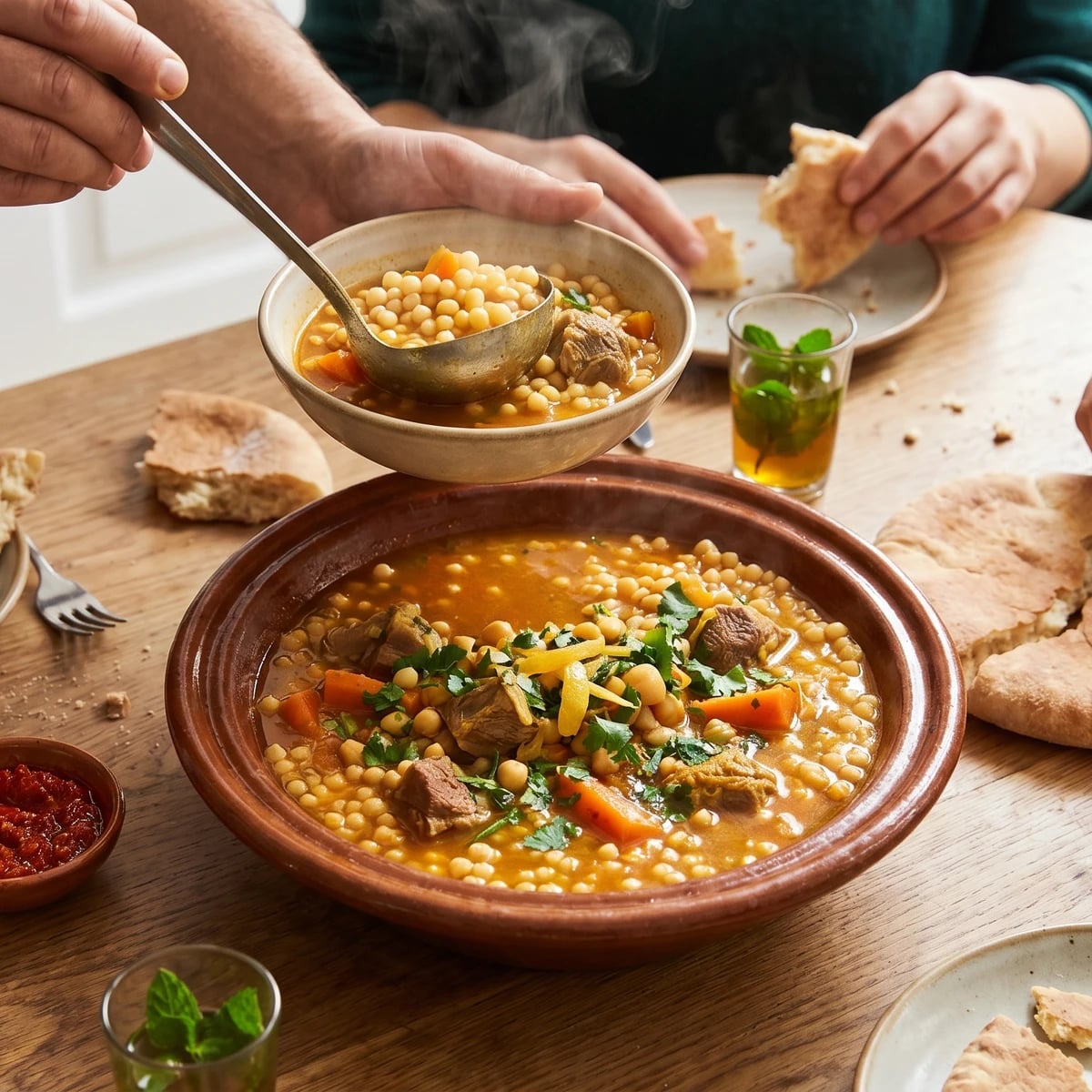
My frontier's Mawlid bowl: large hand-rolled semolina pearls swelling in a tomato-lamb broth, scented with saffron and ras el hanout, made to feed one more guest.

Soups & Stews
Moroccan
Holiday
Celebration
Comfort Food
1 hr
Active Time
1 hr 45 min cook2 hr 45 min total
Yield6 to 8 servings

On Mawlid, in the east, the bowl arrives full enough that the spoon stands proud for a moment before the broth folds around it. Berkoukes is not couscous made large and forgotten in soup. It has its own place. The pearls are bigger, rounder, meant to drink a spiced tomato broth until they become tender and full, with chickpeas and lamb tucked through the bowl.

The gesture that decides the dish is the rolling. You wet the semolina little by little, rub it between your palms, and sift until the pearls are even enough to cook together. Too dry and they stay hard at the heart. Too wet and they clump. La balance est dans les yeux, the scale is in the eyes, but your hands will learn quickly if you listen to them.

When time is short, good dried berkoukes from a Moroccan grocer is honest. I won't pretend every home cook must roll the grain on a weekday. But don't confuse this with boiling couscous. Couscous is steamed in passes and stands as the mountain of the meal; berkoukes is a soup grain, cooked in the broth because that broth is what seasons it from the inside.

Make the pot generous. This is la cuisine du lien, the cooking of connection, a holiday and comfort bowl from des cuisines marocaines, not one Moroccan cuisine flattened into a few famous dishes. A table is a door you leave open, and this one should have room for the person who arrives after the ladle is already in your hand.

Berkoukes belongs strongly to eastern Morocco, including Oujda and the frontier with western Algeria, where large hand-rolled semolina grains appear in winter and festival cooking, especially around Mawlid. Its technique sits in the older Amazigh and Maghrebi family of rolled grain dishes, while the tomato, saffron, and spice grammar reflect later trade routes and city-market habits from the medieval and early modern periods. The exact dating is contested because the dish lived mostly in household hands, not court manuscripts, which is often where the truest recipes hide.

The technique, the tradition, and the story behind every dish.

Discover Culinary Explorer

Ingredients

medium semolina

Quantity

350g

plus extra for dusting

fine semolina or flour

Quantity

80g

for rolling and sifting

fine salt

Quantity

1/2 tsp

for the semolina pearls

warm water

Quantity

180ml

added little by little

olive oil

Quantity

2 tbsp

divided

lamb shoulder or neck

Quantity

500g

cut into small bone-in pieces

onion

Quantity

1 large

finely grated

ripe tomatoes

Quantity

2

grated, or 250g canned crushed tomato

tomato paste

Quantity

2 tbsp

cooked chickpeas

Quantity

200g

drained

carrots

Quantity

2

diced small

turnip

Quantity

1 small

diced small

celery stalk with leaves

Quantity

1

finely chopped

fresh coriander

Quantity

1 small bunch

chopped

flat-leaf parsley

Quantity

1 small bunch

chopped

ras el hanout

Quantity

1 tbsp

freshly ground if you can

ground ginger

Quantity

1 tsp

sweet paprika

Quantity

1 tsp

turmeric

Quantity

1/2 tsp

freshly ground black pepper

Quantity

1/2 tsp

saffron threads

Quantity

1 pinch

bloomed in 3 tbsp warm water

preserved lemon rind

Quantity

1

rinsed and finely chopped

water or light lamb broth

Quantity

2 liters

plus more as needed

sea salt

Quantity

to taste

smen or butter (optional)

Quantity

1 tbsp

for finishing

harissa (optional)

Quantity

to taste

for the table

Equipment Needed

  • Wide gsaa or large shallow bowl for rolling semolina
  • Medium-holed sieve
  • Deep 5 to 6 liter soup pot

Instructions

  1. 1

    Roll the pearls

    Spread the medium semolina in a wide gsaa or large shallow bowl and mix in the salt. Sprinkle in warm water by the spoonful while raking with your fingers, then rub the damp grains between your palms in circles. Dust with fine semolina or flour, roll again, and sift. Keep the pearls about the size of small peppercorns to tiny peas, larger than couscous but not so large that they stay hard inside.

    If you use dried berkoukes, use 350g and skip the rolling. Rinse quickly and drain before adding it to the pot so loose starch doesn't make the broth heavy.
  2. 2

    Dry them briefly

    Spread the rolled pearls on a tray and let them air-dry for 20 to 30 minutes while you start the broth. This short rest firms the outside, so the berkoukes keeps its shape when it meets the liquid instead of turning the pot pasty.

  3. 3

    Start the broth

    Warm 1 tablespoon olive oil in a deep pot. Add the lamb, grated onion, ras el hanout, ginger, paprika, turmeric, black pepper, and a good pinch of salt. Stir until the onion melts into the spices and the lamb loses its raw color. With ras el hanout, on ne triche pas, you don't cheat: use a blend from someone who'll tell you what is in it.

  4. 4

    Build tomato depth

    Add the grated tomatoes and tomato paste. Cook, stirring often, until the tomato darkens slightly and the oil begins to show at the edges. Add the bloomed saffron with its water, the celery, half the coriander, half the parsley, and 2 liters water or light broth.

  5. 5

    Simmer the meat

    Bring the pot to a lively simmer, then lower the heat and cover it partly. Cook for about 1 hour, until the lamb is nearly tender and the broth tastes rounded, not raw with tomato. Skim only what looks harsh; a little fat on the surface carries the spice.

  6. 6

    Add vegetables

    Stir in the chickpeas, carrots, turnip, and preserved lemon rind. Simmer 20 minutes, until the vegetables are tender but still hold their shape. Taste now for salt, because the berkoukes will drink the seasoning.

  7. 7

    Cook the berkoukes

    Rain the berkoukes into the simmering broth with one hand while stirring with the other, so the pearls separate as they fall. Cook uncovered for 18 to 25 minutes, stirring often at the bottom of the pot. The broth should stay loose and spoonable; add hot water by the ladle if it thickens too much before the pearls are tender.

  8. 8

    Finish and rest

    When the pearls are tender through the center and the broth has a glossy body, stir in the remaining olive oil, the remaining herbs, and the smen if you're using it. Rest the pot off the heat for 10 minutes. Berkoukes keeps drinking as it sits, so loosen it with hot water if the table is slow to gather.

  9. 9

    Serve wide

    Ladle into one large warm serving bowl or deep beldi bowls, making sure every serving gets lamb, chickpeas, vegetables, and pearls. Put harissa on the table for those who want fire, and keep khobz nearby for the last broth. Serve it generous, because this dish doesn't like a counted table.

Chef Tips

  • Hand-rolled berkoukes should look uneven in the human way, not careless. Aim for close sizes so they cook together.
  • Use real saffron threads bloomed in warm water, not powdered yellow. The color should spread slowly and smell floral, not dusty.
  • Preserved lemon gives the broth its deep salted brightness. Fresh lemon is sharp in a different way and doesn't stand in for it here.
  • If your vegetables are tired, change the pot. Use pumpkin in season, or leave the turnip out. No gesture rescues a sad vegetable.
  • For a meatless table, leave out the lamb and use more chickpeas, carrot, turnip, celery, and a spoon of olive oil at the end. It won't be the Mawlid meat pot, but it will still keep the door open.

Advance Preparation

  • Roll the berkoukes up to 2 days ahead and dry it fully on trays before storing it in a cloth-lined container.
  • Soak dried chickpeas overnight and cook them ahead, or use good cooked chickpeas when the day is full.
  • The broth can be made through the meat-simmering step 1 day ahead. Add the berkoukes only before serving, because it keeps swelling as it rests.

Frequently Asked Questions

Nutrition Information

1 serving (about 485g)

Calories
495 calories
Total Fat
18 g
Saturated Fat
6 g
Trans Fat
0 g
Unsaturated Fat
11 g
Cholesterol
40 mg
Sodium
890 mg
Total Carbohydrates
62 g
Dietary Fiber
8 g
Sugars
6 g
Protein
20 g

Note: Chef personas and recipes are created with AI assistance. Cook with care: follow safe food-handling practices, check doneness with a thermometer when needed, and adapt for allergies and your kitchen.

Where cooking meets culture.

Culinary guides, cultural storytelling, and the editorial depth that makes cooking meaningful.

Discover Culinary Explorer

More from Moroccan Soups & Bean Stews

Browse the full collection