Culinary Explorer

A cooking platform built around craft, culture, and the stories behind what we eat.
Discover Culinary Explorer
Balche Lacandon

Balche Lacandon

Created by

Chiapas Selva balche is a Lacandon Maya ceremonial ferment of balche bark, honey, and water, a lightly alcoholic drink that belongs to ritual space, not the bar cart.

Beverages
Mexican
Special Occasion
Celebration
25 min
Active Time
10 min cook72 hr 35 min total
Yield2 quarts

Chiapas, in the Lacandon Selva, is where this version lives. Not in a cocktail shaker. Not with lime wedges and clever names. Balche is bark, honey, water, time, and ceremony. The forest is not decoration here. It is the pantry, the altar, and the rulebook.

The ingredient that defines it is the bark of the balche tree, commonly identified with Lonchocarpus longistylus in Maya regions. The old drink was sweetened with honey from native stingless bees, melipona honey when a family had access to it. That honey carries the smell of the forest: flowers, resin, wet wood. If you use supermarket honey, the drink will ferment, yes. It will not speak the same language.

I learned to treat balche with restraint from Lacandon cooks who understood that some foods are not everyday refreshments. The bark is steeped, the honey is dissolved, and the vessel is covered while the drink wakes up slowly. No me vengas con atajos. Too much heat dulls the bark. Too much fermentation turns the drink harsh. You are looking for light alcohol, faint sourness, wood, honey, and discipline.

This is a 32-state cuisine, and Chiapas is not a footnote. Its Maya foodways are older than the borderlines on the map. Make this only with food-safe balche bark from a trusted Mexican or Maya herbal vendor. Do not strip bark from a tree you cannot identify. Ask the women at the market. Preguntale a las senoras del mercado.

Balche is one of the best documented Maya fermented drinks, prepared for ritual use across the Yucatan Peninsula and in Lacandon communities of Chiapas. Colonial writers described Maya ceremonial drinking of bark-and-honey ferments as part of religious practice, and Spanish authorities tried repeatedly to suppress it because it belonged to Indigenous ritual life. The drink survived because families preserved the knowledge privately, tied to forest ecology, honey production, and ceremonial obligation.

The technique, the tradition, and the story behind every dish.

Discover Culinary Explorer

Ingredients

filtered water

Quantity

2 quarts

divided

food-safe dried balche bark

Quantity

2 ounces

rinsed quickly

raw melipona honey or raw Mexican wildflower honey

Quantity

1 cup

piloncillo (optional)

Quantity

1 small piece, about 1 ounce

optional, for a stronger fermentation

active tepache or unpasteurized fermented honey water (optional)

Quantity

1/4 cup

optional starter

Equipment Needed

  • Clay olla or stainless steel saucepan
  • 2-quart glass jar or glazed clay fermentation vessel
  • Clean cotton cloth
  • Fine-mesh strainer or clean woven cloth
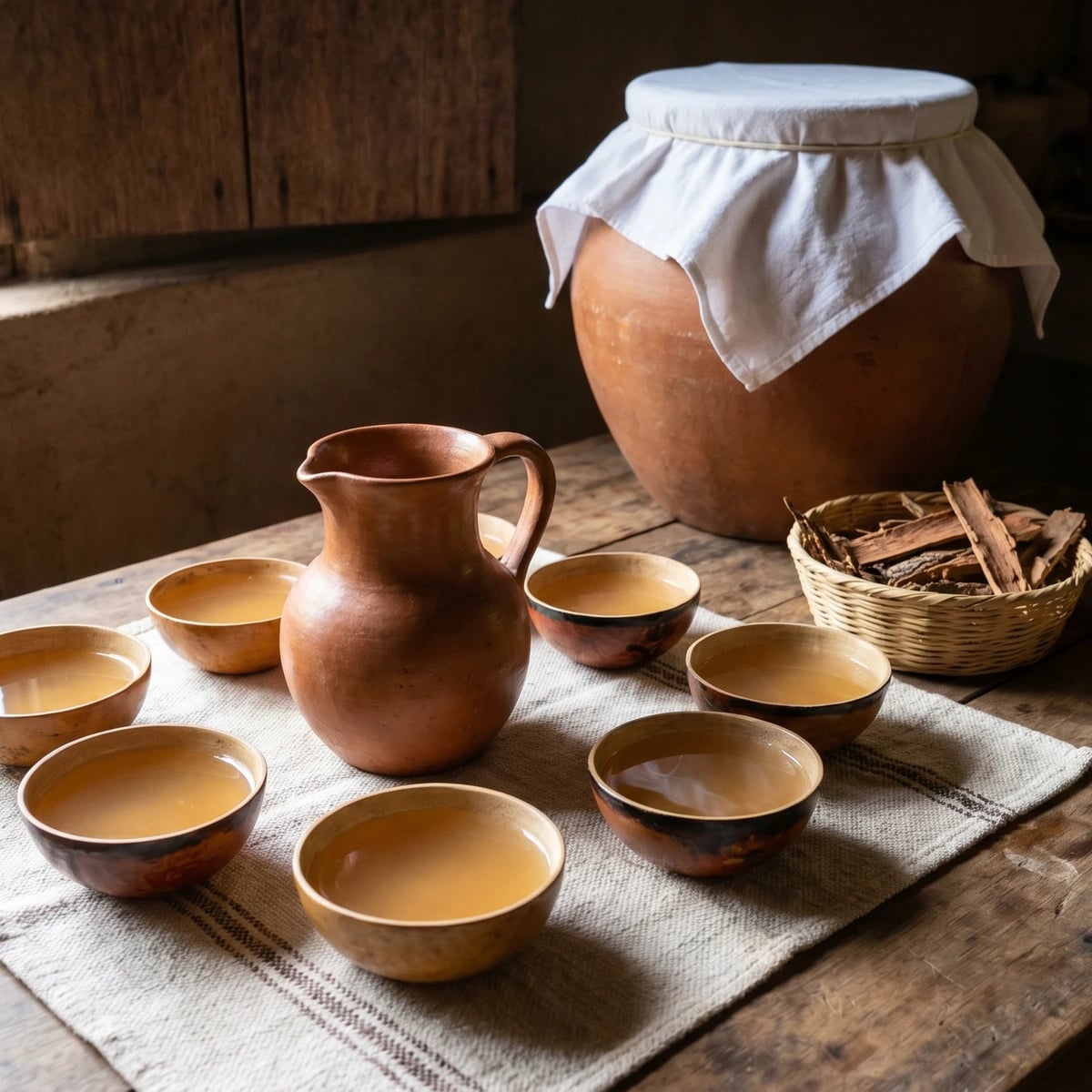
  • Small clay cups or jicaras for serving

Instructions

  1. 1

    Check the bark

    Use only food-safe balche bark from a trusted vendor who knows the plant. Rinse it quickly under cool water to remove dust, then drain. Do not gather bark from an unknown tree. Lonchocarpus species can be misidentified, and guessing with bark is foolish.

  2. 2

    Steep the bark

    Bring 1 quart of the filtered water just to a simmer in a clay olla or stainless steel pot. Add the balche bark, lower the heat, and keep it below a hard boil for 10 minutes. The water should turn pale amber and smell woody, a little bitter, like wet bark after rain. Boiling hard makes the infusion rough. Respect the bark.

  3. 3

    Cool completely

    Remove the pot from the heat. Cover and let the bark steep until the liquid is room temperature, about 1 hour. Strain through clean cloth into a glass jar or clay fermentation vessel. Press lightly on the bark, but do not wring it like laundry. You want the infusion, not every bitter drop.

  4. 4

    Dissolve the honey

    Add the remaining 1 quart filtered water to the cooled infusion. Stir in the raw honey until fully dissolved. If using piloncillo, dissolve it separately in a little warm water first, then add it. Honey feeds the ferment and gives the drink its forest sweetness. Melipona honey is the old flavor. Wildflower honey is a compromise, not an upgrade.

  5. 5

    Start fermentation

    Stir in the active tepache or fermented honey water if using. Cover the vessel with clean cotton cloth and secure it with string. Leave it at room temperature, away from direct sun, for 2 to 3 days. Stir once each day with a clean wooden spoon. You should see small bubbles at the edge and smell honey, bark, and a faint sourness.

  6. 6

    Taste and stop

    Begin tasting after 48 hours. Balche should be lightly alcoholic, gently sour, still honeyed, and woody on the finish. If it smells rotten, moldy, or sharply chemical, throw it out. If a white film forms, skim it. If fuzzy mold appears, the batch is finished in the bad way. No ceremony is improved by bad fermentation.

  7. 7

    Strain and serve

    Strain again through clean cloth and serve in small clay cups or jicaras. This is not a drink for a tall glass with ice. Serve it cool or at room temperature, in small portions, with respect for what it is. Ritual, not casual. Asi se hace y punto.

Chef Tips

  • The bark matters more than your technique. If the vendor cannot tell you the plant name or where it came from, do not buy it. Si no conoces el mercado, no conoces la cocina.
  • Melipona honey is difficult to find outside southern Mexico and the Yucatan Peninsula. Use it if you can get it from an ethical producer. Raw Mexican wildflower honey works, but it changes the drink.
  • Do not ferment in reactive metal. Use glass, glazed clay, or food-safe ceramic. The old vessels were local and practical. The material affects cleanliness and flavor.
  • This is mildly alcoholic. Keep it away from children, pregnant people, and anyone avoiding alcohol. Tradition does not cancel common sense.

Advance Preparation

  • The bark infusion can be steeped and cooled one day ahead, then refrigerated before honey is added.
  • Once fermented to your taste, strain and refrigerate the balche for up to 3 days. The flavor will keep sharpening, so do not forget it in the refrigerator.

Frequently Asked Questions

Nutrition Information

1 serving (about 250g)

Calories
130 calories
Total Fat
0 g
Saturated Fat
0 g
Trans Fat
0 g
Unsaturated Fat
0 g
Cholesterol
0 mg
Sodium
5 mg
Total Carbohydrates
32 g
Dietary Fiber
0 g
Sugars
32 g
Protein
0 g

Note: Chef personas and recipes are created with AI assistance. Cook with care: follow safe food-handling practices, check doneness with a thermometer when needed, and adapt for allergies and your kitchen.

Where cooking meets culture.

Culinary guides, cultural storytelling, and the editorial depth that makes cooking meaningful.

Discover Culinary Explorer

More from Chiapas & Tabasco Beverages

Browse the full collection