
Chef Klaus
Ahle Wurst
North Hesse's old sausage is cured, not cooked: coarse pork, pepper, garlic, and cold weeks in a chamber until the slice turns firm enough for rye and cider.
A cooking platform built around craft, culture, and the stories behind what we eat.
Created by
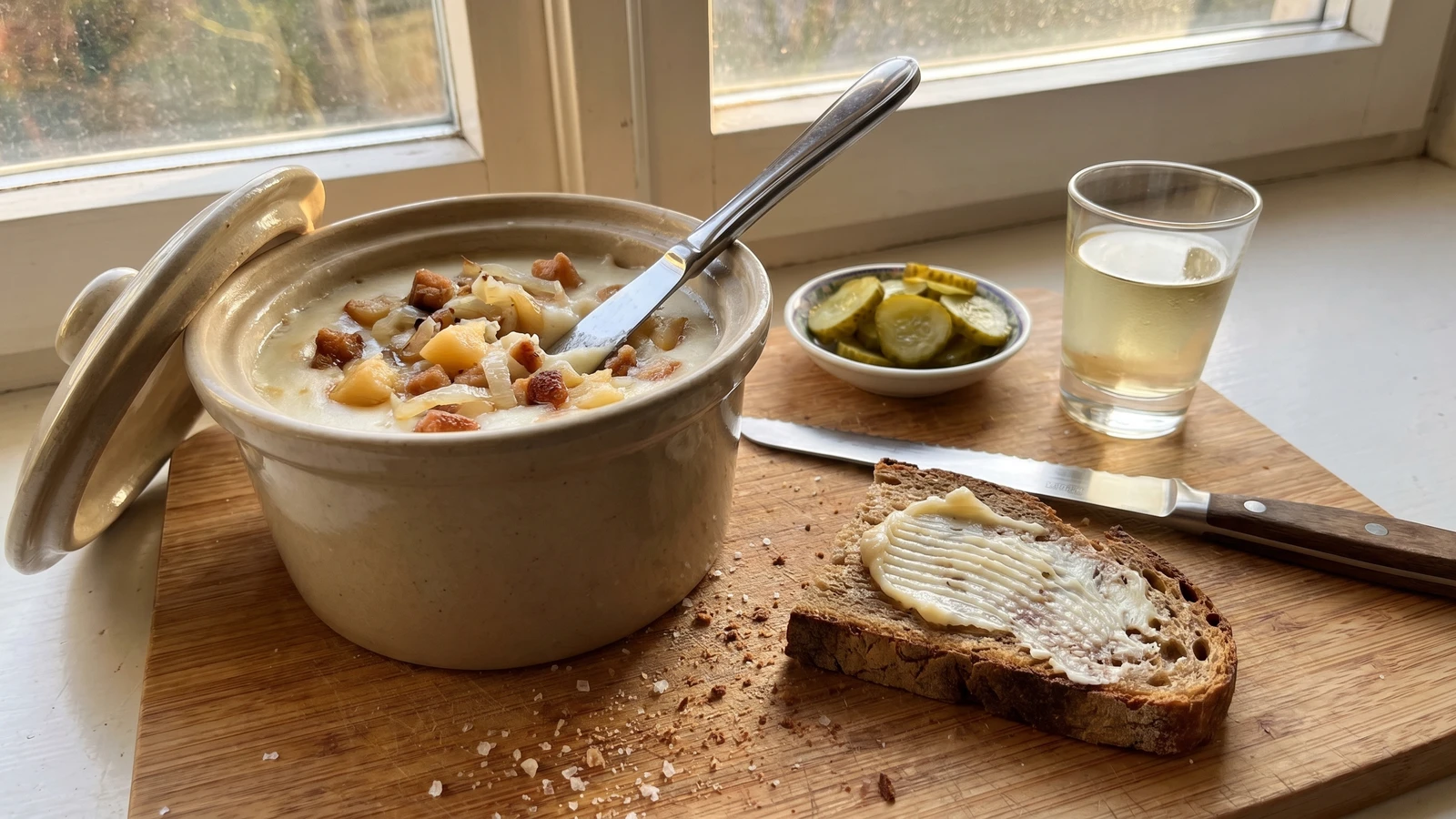
Baden's lard spread is thrift in a crock: pork fat rendered slowly, onion and apple added when the water is gone, and the crisp Grieben stirred back before it sets.
Badisches Griebenschmalz is a crock from the southwest, not a starter with airs. In Baden it sits on the table with Bauernbrot, pickled cucumber, radishes if the garden has them, and a glass of new wine in autumn, the season when the pig was slaughtered and the fat had to be made useful. Weggeworfen wird nichts. The little crisp Grieben, cracklings, are not garnish. They're the point.
Every region has an opinion. Baden and Swabia like onion and apple in the fat, soft sweetness against salt; Franconian and Bavarian pots often lean harder on caraway or marjoram; farther north you may find plainer pork lard or goose fat for winter bread. Im Norden anders, im Süden anders. This is the Badische way: clean pork fat, onion, apple, a little marjoram, good bread.
One technique decides it: render low until the fat is clear and the water has driven off before the onion and apple go in. Add them too early and their moisture keeps the Grieben soft; add them too late and they scorch in hot fat and turn the crock bitter. When the fat starts to cloud, stir it as it cools so the crisp bits hang through the Schmalz instead of sinking to the bottom. Das braucht seine Zeit, but it's only a pot and a wooden spoon.
Griebenschmalz belongs to the Hausschlachtung, the farm pig slaughtered in the cold months, when fat, rind, blood, bones, and trim were rendered, salted, smoked, or cooked before anything could spoil. In Baden's wine country it also fits the Straußwirtschaft, the seasonal grower's tavern custom commonly traced to Charlemagne's Capitulare de villis of 812, where simple bread plates made sense beside the year's wine. The regional split is plain: Baden and Swabia often soften the pork fat with onion and apple, while northern winter tables may use plainer pork lard or goose fat.
Quantity
800g
rind removed, chilled and cut into 5mm dice
Quantity
2 tablespoons
Quantity
1 small
very finely diced
Quantity
1 small
peeled, cored, and very finely diced
Quantity
1
Quantity
1 teaspoon
Quantity
1/4 teaspoon
Quantity
1 teaspoon, plus more to taste
Quantity
1/2 teaspoon
Quantity
to serve
Quantity
to serve
| Ingredient | Quantity |
|---|---|
| fresh unsmoked pork back fatrind removed, chilled and cut into 5mm dice | 800g |
| water | 2 tablespoons |
| onionvery finely diced | 1 small |
| tart apple, such as Boskoop or Elstarpeeled, cored, and very finely diced | 1 small |
| bay leaf | 1 |
| dried marjoram | 1 teaspoon |
| crushed caraway (optional) | 1/4 teaspoon |
| fine salt | 1 teaspoon, plus more to taste |
| freshly ground black pepper | 1/2 teaspoon |
| Bauernbrot | to serve |
| pickled cucumbers or radishes (optional) | to serve |
Chill the pork fat until firm, then cut it into even 5mm dice. Cold fat cuts cleanly; warm fat smears under the knife and gives you uneven pieces, which means some brown before the rest has given up its fat. Keep the rind. It belongs in beans, cabbage, or soup. Weggeworfen wird nichts.
Put the diced fat and the water in a heavy pot and set it over low heat. The water protects the dry bottom of the pot until the first fat melts, then it boils away. Start too hot and the outside browns while fat is still trapped inside the dice, and that is how you get bitter Schmalz.
Cook gently for 40 to 50 minutes, stirring often, until the fat is clear and the Grieben have shrunk to small pale-golden pieces. Keep the bubbling steady, never fierce. Runter mit der Temperatur if the bits darken quickly, because scorched pork fat carries its bitterness through the whole jar.
Stir in the onion, apple, bay leaf, marjoram, and caraway if using. Cook 10 to 15 minutes more, until the onion is golden, the apple has collapsed, and the bubbles turn small and quiet. Their water has to cook out, because water shortens the keeping time and softens the Grieben you worked to crisp.
Remove the bay leaf and take the pot off the heat. Let the fat stand 5 minutes, then stir in the salt and pepper. Taste it on a piece of bread, not from a spoon, because this is eaten cold on bread and cold fat mutes salt. Würzen, Fett, Salz zum Schluss.
Spoon the warm Schmalz into clean jars or a small crock and stir every 10 minutes as it cools and turns cloudy. This is not fussing. If you leave it alone while hot, the Grieben sink to the bottom and the top sets plain. Cover once it reaches room temperature, then refrigerate until firm.
Spread it thick on Bauernbrot and serve with pickled cucumbers or radishes. The bread needs a dark crust and a little sourness, because the fat wants something to push against. Soft white bread gives up before the first bite. Schön ist, was schmeckt.
1 serving (about 30g)
Culinary guides, cultural storytelling, and the editorial depth that makes cooking meaningful.
Discover Culinary ExplorerChef Klaus
North Hesse's old sausage is cured, not cooked: coarse pork, pepper, garlic, and cold weeks in a chamber until the slice turns firm enough for rye and cider.

Chef Klaus
Baden's Vesper spread is nothing more than quark, cream, onion, and chives, but the whole dish depends on controlling the whey so the bowl stays spoonable beside hot potatoes.

Chef Klaus
The Bavarian beer-garden salad that lives by the cut: thin sausage strips, raw onion, vinegar and oil, no cheese, rested long enough to taste like supper.

Chef Klaus
Bavarian Brotzeit in a crock: slow-rendered pork fat, browned cracklings, onion, and apple, set firm for dark bread because the cheapest part of the pig still deserves proper work.