
Chef Graziella
Bigoli con l'Anatra
The thick, rough pasta of the Veneto dressed with slow-braised duck, a dish that proves why this region's cooking stands apart from everything else called Italian.
A cooking platform built around craft, culture, and the stories behind what we eat.

Created by
The patient, milk-braised salt cod of the Veneto, where hours of gentle heat transform preserved fish into something silken and profound. Vicenza guards this recipe jealously, and with good reason.
The people of Vicenza call this dish baccalà, but they are lying to you. What they use is stoccafisso, air-dried cod, not salt-cured. This is the kind of regional stubbornness that makes Italian cooking impossible to codify and wonderful to study. The Vicentini have called it baccalà for five hundred years, and they are not about to change now.
This is not a quick supper. The fish must soak for days. The cooking takes hours. You cannot rush it, and you should not try. The long braise in milk and oil transforms what begins as a board of dried fish into something silken, almost creamy, falling apart at the touch of a fork. The anchovies dissolve completely, leaving only their depth behind. The onions melt into the sauce.
I have watched cooks in Vicenza make this dish in earthenware pots that have held nothing else for generations. The pot knows what to do. You must learn. The heat must be so gentle that the sauce barely trembles. Any higher and the fish toughens, the milk curdles, and you have wasted three days of soaking.
Baccalà alla Vicentina traces to 1432, when Venetian sea captain Pietro Querini was shipwrecked on a Norwegian island and discovered stockfish. He brought samples back to the Veneto, where resourceful cooks in the inland city of Vicenza created this milk-braised preparation. A brotherhood, the Venerabile Confraternita del Bacalà alla Vicentina, still meets to preserve the authentic recipe.
Quantity
2 pounds
soaked (see instructions)
Quantity
1 cup
Quantity
4 tablespoons
Quantity
2 pounds (about 4 large)
sliced very thin
Quantity
6
rinsed and chopped
Quantity
2 cups
warmed
Quantity
1/2 cup
freshly grated
Quantity
3 tablespoons
Quantity
1/4 cup
chopped
Quantity
to taste
freshly ground
Quantity
if needed
Quantity
for serving
| Ingredient | Quantity |
|---|---|
| dried stockfish or salt codsoaked (see instructions) | 2 pounds |
| extra virgin olive oil | 1 cup |
| unsalted butter | 4 tablespoons |
| yellow onionssliced very thin | 2 pounds (about 4 large) |
| salt-packed anchovy filletsrinsed and chopped | 6 |
| whole milkwarmed | 2 cups |
| Parmigiano-Reggianofreshly grated | 1/2 cup |
| all-purpose flour | 3 tablespoons |
| fresh flat-leaf parsleychopped | 1/4 cup |
| white pepperfreshly ground | to taste |
| salt | if needed |
| soft polenta | for serving |
If using stockfish, soak it in cold water for 3 to 4 days, changing the water at least twice daily. The fish should become soft and pliable, like fresh cod. If using salt cod, soak for 24 to 48 hours, changing the water every 8 hours. Taste a small piece before proceeding. It should be pleasantly mild, not aggressively salty.
Drain the soaked fish and pat it completely dry. Remove all bones and skin with care. The flesh should be white and clean. Cut the fish into pieces roughly 3 inches square. Dust each piece lightly with flour, shaking off any excess.
In a heavy-bottomed pot or Dutch oven, combine half the olive oil and all the butter over medium-low heat. Add the sliced onions and cook very slowly, stirring occasionally, until completely soft and golden but not browned. This takes 30 to 40 minutes. Do not rush. The onions must melt, not fry.
Add the chopped anchovies to the softened onions. Stir and cook for 2 to 3 minutes until the anchovies dissolve completely into the onions. You should no longer see distinct pieces. They become part of the foundation, providing depth without any fishy taste.
Spread half the onion mixture in the bottom of a heavy earthenware or enameled cast iron pot. Arrange the floured fish pieces in a single layer on top. Cover with the remaining onions. Pour the warm milk and the remaining olive oil over everything. Scatter the grated Parmigiano on top.
Cover the pot and place in an oven preheated to 250°F. Cook for 4 to 4 and a half hours. Every 30 minutes, rotate the pot gently without stirring. The Vicentini call this movement 'pipare': a gentle rocking that allows the sauce to penetrate without breaking the fish. The dish is ready when the fish flakes easily and the sauce is creamy and unified.
Remove from the oven and let rest, covered, for 15 minutes. The sauce will continue to thicken. Taste for salt, though you will likely need none. Add freshly ground white pepper and scatter the parsley over the top. Serve immediately over soft, freshly made polenta. The polenta is not a suggestion.
1 serving (about 310g)
Culinary guides, cultural storytelling, and the editorial depth that makes cooking meaningful.
Discover Culinary ExplorerChef Graziella
The thick, rough pasta of the Veneto dressed with slow-braised duck, a dish that proves why this region's cooking stands apart from everything else called Italian.

Chef Graziella
A Venetian Lenten dish of startling depth: fat whole-wheat noodles tangled with onions cooked to silk and anchovies dissolved to nothing. Three ingredients. One hour. Umami before we had the word.

Chef Graziella
The great liver dish of Venice, where onions melt into silk over an hour of patient stirring, and the liver cooks in barely two minutes. Timing is everything. Restraint is love.
Chef Graziella
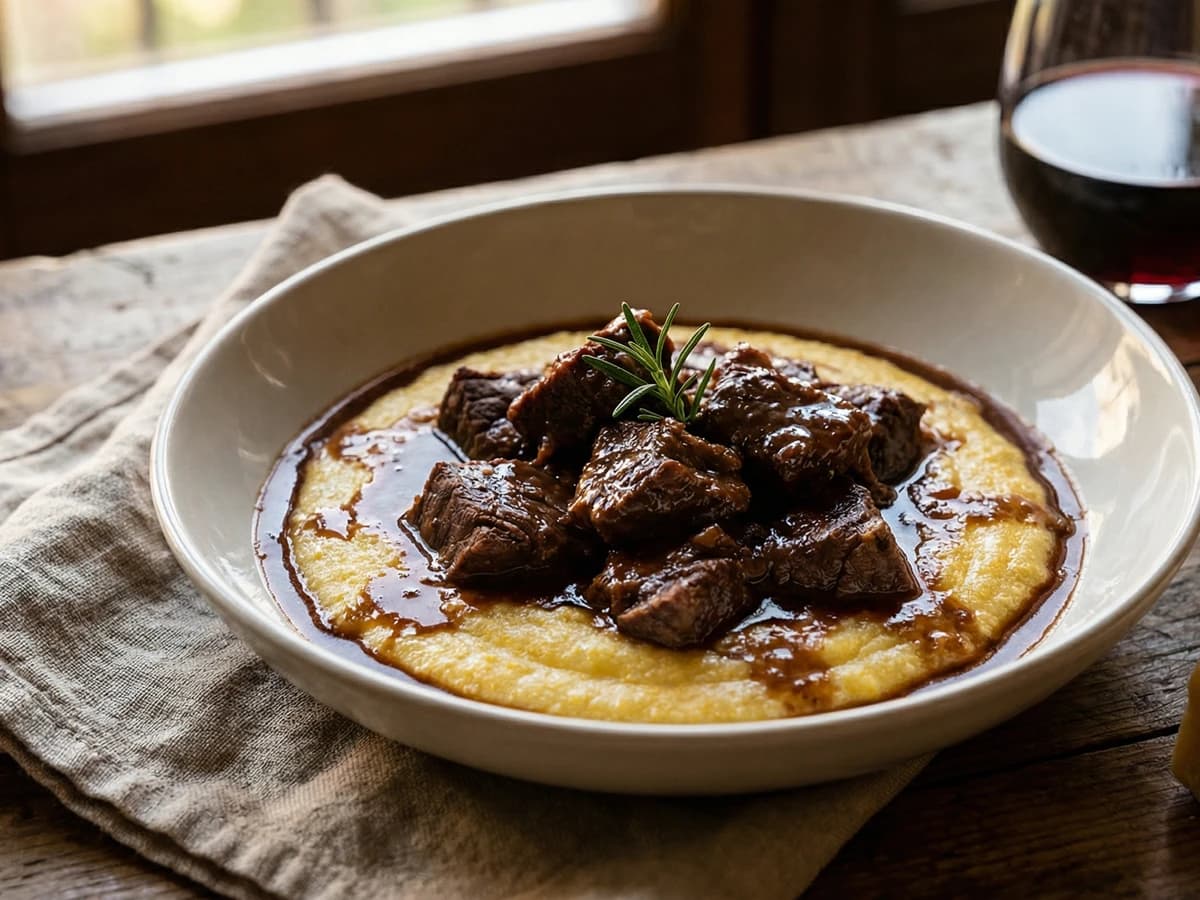
Verona's ancient braise, older than Italy itself, where beef surrenders to Amarone over hours of patient simmering until wine and meat become inseparable. Served always with soft polenta, as the Veronese have done for generations beyond counting.