Culinary Explorer

A cooking platform built around craft, culture, and the stories behind what we eat.
Discover Culinary Explorer
Avena con Piloncillo y Canela Norteña

Avena con Piloncillo y Canela Norteña

Created by

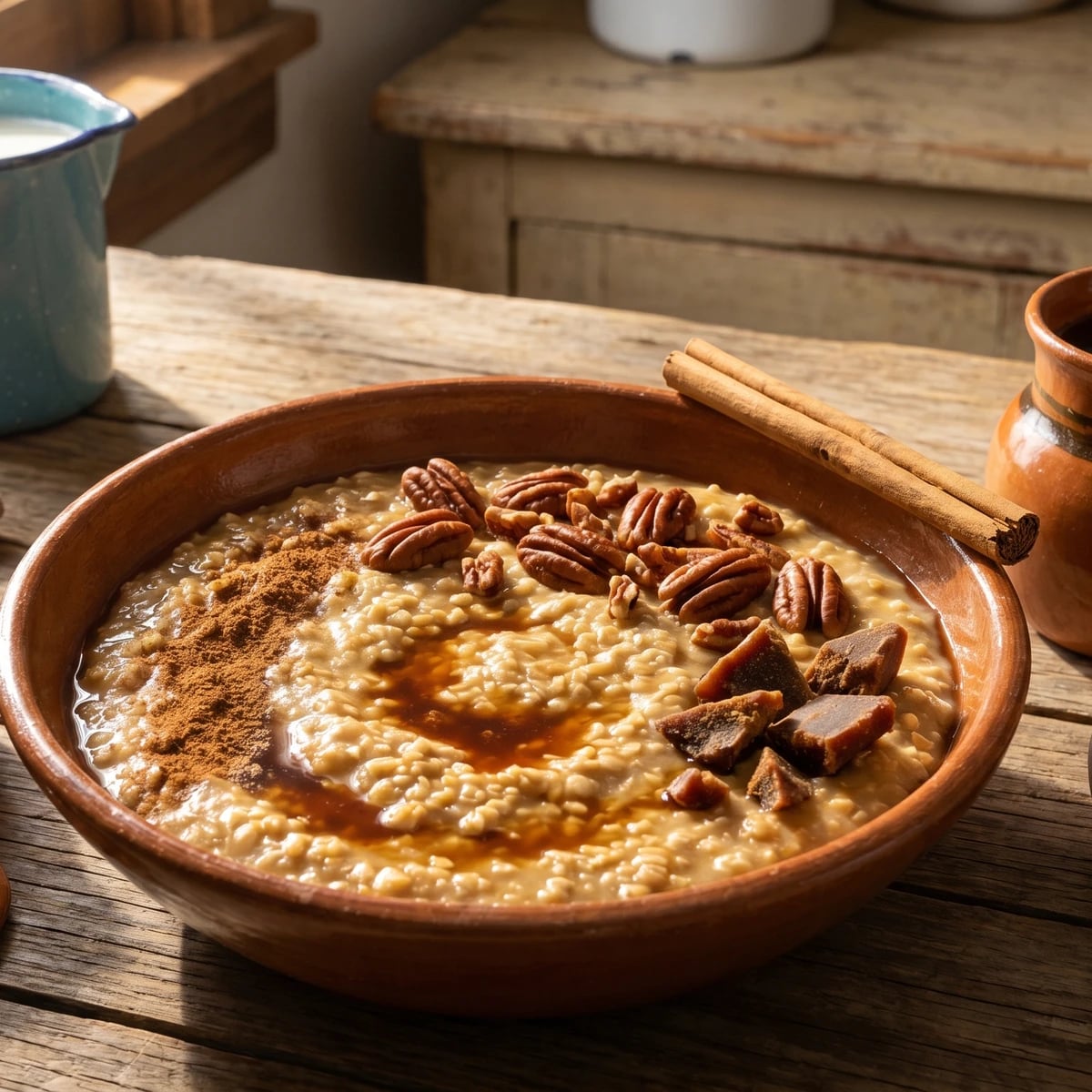
The Sonoran ranch breakfast: steel-cut oats simmered slow with whole milk, a stick of true canela, and dark piloncillo from the mercado, until the porridge turns thick, golden, and serious.

Breakfast & Brunch
Mexican
Comfort Food
Weeknight
Quick Meal
5 min
Active Time
35 min cook40 min total
Yield4 servings

This is a norteño breakfast. Sonora, Chihuahua, parts of Sinaloa, the cattle states where the morning starts before the sun and the cook needs something that will hold a man in the saddle until midday. Avena con piloncillo is what she makes. It is not the dry, sad oatmeal an office worker microwaves at his desk. It is a real porridge, slow-simmered in whole milk, sweetened with a cone of piloncillo, perfumed with a stick of canela that has been in the cupboard since the last trip to the mercado.

The ingredients are short and they are all non-negotiable. Steel-cut oats, not rolled. Whole milk, not water. Piloncillo, not brown sugar. True canela, the soft stick that crumbles between your fingers, not the hard cassia bark sold as cinnamon in American supermarkets. Cassia is sharp and one-note. Canela de Ceylán is floral and complex and it is what every Mexican kitchen uses for café de olla, for capirotada, for arroz con leche, for this. If your spice jar says Ceylon cinnamon on it, you have what you need. If it says cinnamon and nothing else, you do not.

My mother was Jalisciense and she made arroz con leche, not avena. I learned this dish in a kitchen outside Hermosillo, from a senora who fed her sons and her ranch hands every morning the same way her mother had fed her. She did not measure the piloncillo. She broke off a chunk by feel, dropped it in the pot, and tasted at the end. Her instructions to me were short: toast the oats first, never let the milk boil, and do not walk away. Saber cocinar es saber vivir. This is the dish she meant.

Oats are not native to Mexico and they did not arrive on Mexican tables in any quantity until the late 19th century, when the railroad and the porfiriato-era trade with the United States and Canada brought North American grain south in volume. The norteño embrace of avena tracks closely with the rise of the great cattle ranches of Sonora and Chihuahua, where ranch hands needed dense, portable, slow-burning calories before a day on horseback, and where dairy was already abundant. The pairing with piloncillo and canela is older than the oat itself: piloncillo (also called panela in southern Mexico) has been produced from sugarcane in trapiches since the 16th century, and canela de Ceylán was one of the spices the Manila Galleon brought into Acapulco from the Spanish East Indies, eventually becoming so central to Mexican baking and beverages that 'cinnamon' in any Mexican recipe means Ceylon and nothing else.

The technique, the tradition, and the story behind every dish.

Discover Culinary Explorer

Ingredients

steel-cut oats (avena cortada)

Quantity

1 cup

whole milk

Quantity

3 cups

water

Quantity

2 cups

piloncillo

Quantity

4 ounces (about one small cone)

chopped

true canela (Ceylon cinnamon stick)

Quantity

1 stick, about 4 inches

orange peel

Quantity

1 strip, about 2 inches

no white pith

fine sea salt

Quantity

1 pinch

vanilla bean (optional)

Quantity

1

split lengthwise

whole milk for serving (optional)

Quantity

to taste

warmed

Mexican pecans (nuez) (optional)

Quantity

1/2 cup

toasted and chopped

ground canela (optional)

Quantity

for dusting

Equipment Needed

  • Heavy-bottomed 3-quart pot
  • Wooden spoon
  • Deep ceramic bowls (Sonoran salt-glazed earthenware or blue-rimmed enamelware if you have it)

Instructions

  1. 1

    Toast the oats

    Set a heavy-bottomed pot over medium heat. Add the steel-cut oats dry, no fat. Stir constantly for three to four minutes until they smell like warm bread and turn one shade darker. This is what a ranch cook does on a wood stove without thinking. Skip it and your avena tastes flat and pasty. Toast it and the oats hold their shape and take on a nuttiness that pairs with the piloncillo.

  2. 2

    Build the milk base

    Pour in the water first, then the milk. The water keeps the milk from scorching at the bottom. Add the chopped piloncillo, the canela stick, the orange peel, and the pinch of salt. If you are using the vanilla bean, scrape the seeds in and drop the pod in too. Stir until the piloncillo dissolves into the milk and the liquid turns the color of weak coffee with cream.

    Use real piloncillo, the dark cone sold at any Mexican mercado. Brown sugar is not the same. Piloncillo carries a molasses-and-smoke depth that brown sugar does not, and it is what makes the avena taste like a Sonoran kitchen and not a hotel breakfast bar.
  3. 3

    Simmer low and slow

    Bring the pot to a bare simmer over medium-low heat. The surface should barely move. Stir often, especially around the edges where the milk likes to catch. Cook for 25 to 30 minutes uncovered. The oats will swell, the milk will reduce, and the avena will go from thin to thick to glossy. You are looking for a porridge that holds a wooden spoon upright for a second before it falls back. No me vengas con atajos. Quick oats finish in five minutes and taste like nothing. Steel-cut oats earn the half hour.

  4. 4

    Check the sweetness

    Taste with a clean spoon. The avena should be sweet but not cloying, with the canela and the orange peel sitting just behind the piloncillo. If it is shy, break off another small piece of piloncillo and stir it in until it dissolves. The salt should be barely there, just enough to wake the sweetness up. A norteño cook builds flavor by tasting, not by measuring.

  5. 5

    Rest off the heat

    Pull the pot off the burner. Fish out the canela stick, the orange peel, and the vanilla pod. Cover the pot and let it rest for five minutes. This is when the avena finishes thickening and the flavors settle. Skip this step and the porridge tastes hot but unfinished.

  6. 6

    Serve at the table

    Ladle the avena into deep ceramic bowls, the kind a rancher's hand wraps around on a cold morning. Pour a generous splash of warm whole milk on top so it pools at the rim and breaks the thickness. Scatter toasted nuez over the surface and dust with ground canela. Eat it standing at the kitchen counter or sitting at the wooden table, with a clay jarro of café de olla beside it. This is how a Sonoran day starts. Asi se hace y punto.

Chef Tips

  • Steel-cut oats are not rolled oats. Steel-cut are the whole oat groat chopped into pieces, and they hold their shape through a long simmer. Rolled oats turn to glue in milk this rich. Quick oats are not in the conversation. If your bag says avena cortada or pinhead oats, you have the right one.
  • Piloncillo varies in size by region. The small cones (panocha chica) weigh about 4 ounces. The big cones can weigh half a pound. Weigh yours or break it down by eye. Too little and the avena is bland. Too much and it tastes like dessert.
  • If your canela stick is hard and curls into a tight scroll, that is cassia and it will not give you the flavor you want. Real Mexican canela is pale tan, soft, and crumbly. Any tienda mexicana carries it. It costs a third of what cassia costs at the supermarket and it is the correct ingredient.
  • Toasted Mexican pecans on top are the norteño finish. Sonora and Chihuahua are pecan country and a handful of toasted nuez over the bowl is how a ranch kitchen would serve it. Walnuts work in a pinch. Almonds do not belong here.

Advance Preparation

  • Avena thickens hard in the refrigerator. It keeps three days. Reheat in a small pot over low heat with a generous splash of whole milk to loosen it back to a porridge.
  • The piloncillo and canela can be steeped in the milk overnight in the refrigerator before cooking. The next morning, warm the infused milk with the toasted oats and you cut five minutes off a working morning.

Frequently Asked Questions

Nutrition Information

1 serving (about 410g)

Calories
455 calories
Total Fat
16 g
Saturated Fat
5 g
Trans Fat
0 g
Unsaturated Fat
10 g
Cholesterol
25 mg
Sodium
145 mg
Total Carbohydrates
68 g
Dietary Fiber
5 g
Sugars
37 g
Protein
14 g

Note: Chef personas and recipes are created with AI assistance. Cook with care: follow safe food-handling practices, check doneness with a thermometer when needed, and adapt for allergies and your kitchen.

Where cooking meets culture.

Culinary guides, cultural storytelling, and the editorial depth that makes cooking meaningful.

Discover Culinary Explorer

More from Noroeste Breakfast & Almuerzo

Browse the full collection