Culinary Explorer

A cooking platform built around craft, culture, and the stories behind what we eat.
Discover Culinary Explorer
Atápakua Verde con Cilantro y Serrano

Atápakua Verde con Cilantro y Serrano

Created by

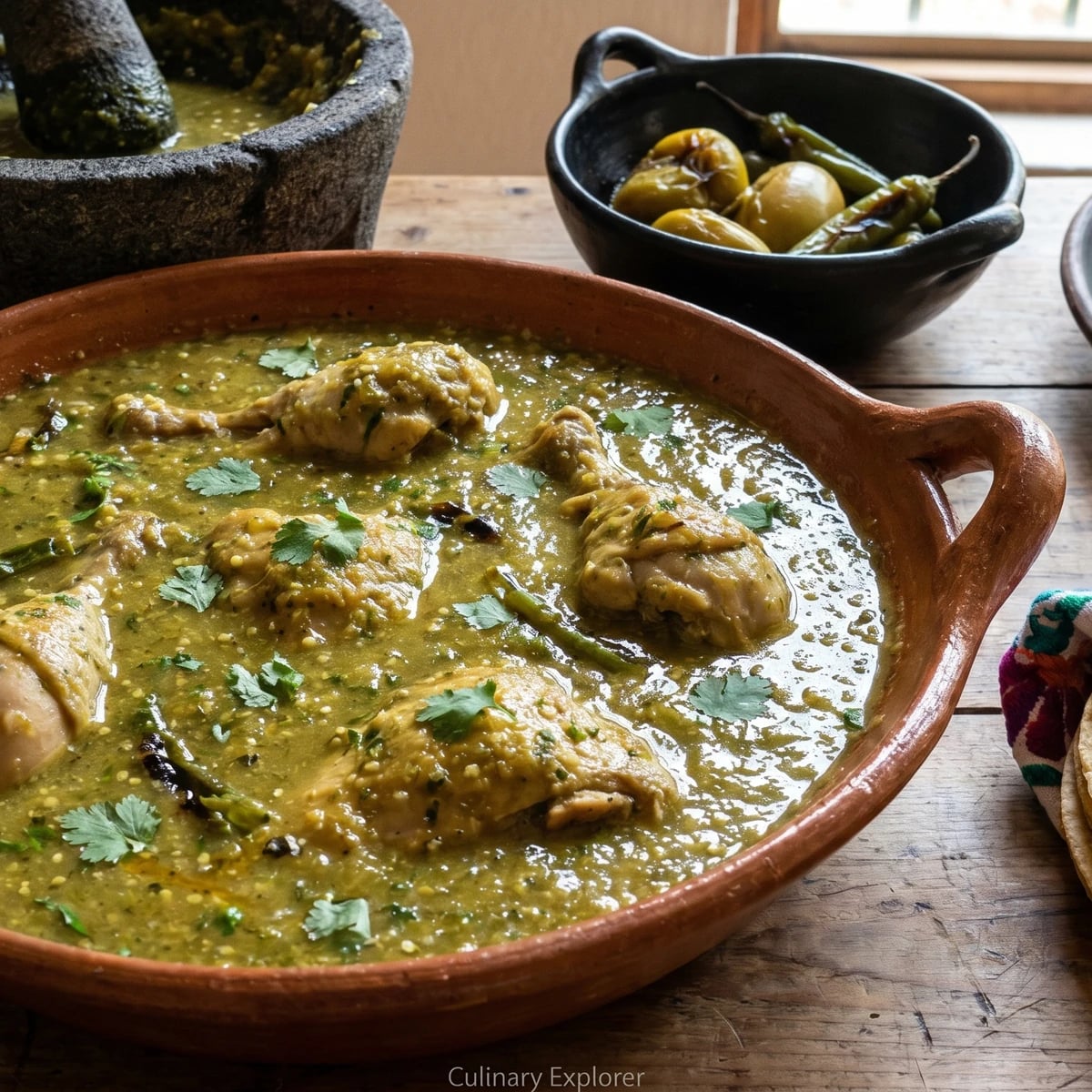
Michoacán's green atápakua is a P'urhépecha masa-thickened sauce of tomate verde, cilantro, hierbabuena, and serrano, martajada in a molcajete and ladled over chicken in a Cocucho cazuela.

Sauces & Condiments
Mexican
Make Ahead
Comfort Food
Special Occasion
25 min
Active Time
35 min cook1 hr total
Yieldabout 4 cups sauce, enough for 6 servings over chicken

Michoacán, the Meseta P'urhépecha and the Lake Pátzcuaro towns, that is where this atápakua lives. Not in a restaurant bottle. Not under the word mole. Atápakua is its own thing: a green sauce thickened with fresh masa de maíz, cooked until it can hold onto chicken, vegetables, or whatever the family pot is feeding that day.

The green here comes from tomate verde, cilantro, hierbabuena, and chile serrano. In the Meseta, if the market has chile perón, the yellow-orange Capsicum pubescens grown around Uruapan and Pátzcuaro, use it and be grateful. Serrano gives a clean green bite, but it does not have the floral citrus perfume or the thick skin of perón. A substitution is a compromise, not an upgrade.

I learned this style from P'urhépecha women who cooked over leña and did not separate technique from daily life. The molcajete stayed on the table. The masa came from corn that had been nixtamalized, not from a bag of shortcuts. The sauce thickened slowly in a cazuela de barro, and nobody called it mole because nobody needed to borrow another region's name. Cada estado, su propia cocina.

Understand the principle before you start: the masa is the architecture. It binds the tomatillo, softens the chile, carries the herbs, and gives the sauce its body. If you thicken this with nuts or seeds, you made another sauce. Maybe a good one. Not atápakua.

Atápakua is a P'urhépecha preparation from Michoacán whose defining technique, thickening a chile and vegetable sauce with nixtamalized corn masa, belongs to the pre-Hispanic corn kitchen. In 2010, UNESCO recognized Traditional Mexican Cuisine using the Michoacán and P'urhépecha cooking system as a central paradigm, citing milpa agriculture, nixtamalization, communal cooking, and wood-fire kitchens. Green atápakuas use tomate verde and fresh herbs, while other regional versions may be red with chile guajillo or built around local greens, but the shared body is masa, not mole paste.

The technique, the tradition, and the story behind every dish.

Discover Culinary Explorer

Ingredients

tomate verde (tomatillos)

Quantity

1 1/2 pounds

husked and rinsed

fresh chile serrano

Quantity

4

stemmed

small white onion

Quantity

1

quartered

garlic cloves

Quantity

3

unpeeled

fresh cilantro leaves and tender stems

Quantity

1 1/2 cups, packed

fresh hierbabuena leaves

Quantity

1/2 cup, packed

fresh masa de maíz nixtamalizado

Quantity

1/2 cup

warm chicken broth

Quantity

3 cups

preferably homemade from bone-in chicken

kosher salt

Quantity

1 1/2 teaspoons, plus more to taste

warm cooked bone-in chicken pieces (optional)

Quantity

6 pieces

for serving

hand-pressed corn tortillas (optional)

Quantity

for serving

warmed

Equipment Needed

  • Volcanic stone molcajete with tejolote
  • Comal or heavy cast iron skillet
  • 10 to 12 inch clay cazuela, preferably Cocucho barro, or a heavy saucepan
  • Wooden spoon
  • Fine-mesh strainer for the masa slurry

Instructions

  1. 1

    Roast the vegetables

    Heat a comal over medium heat. Roast the tomate verde, serranos, onion, and unpeeled garlic, turning them as they soften. The tomatillos should turn from sharp green to olive and leak a little juice. The serrano skins should blister in patches. The garlic is ready when it feels soft inside its skin. Do not blacken everything. Char is seasoning, not the whole dish.

  2. 2

    Grind the salsa

    Peel the garlic. In a volcanic stone molcajete, grind the garlic with the salt until it becomes a paste. Add the serranos, then the onion, then the roasted tomate verde with all its juices. Grind until martajada, rough enough that you still see bits of chile skin and tomatillo seed. Add the cilantro and hierbabuena last and work them into the green base. A blender works for a large batch, but pulse it. If you make it perfectly smooth, the sauce loses the hand of the cook.

    The molcajete bruises the herbs and gives the sauce body before the masa enters. That texture is part of the atápakua. No me vengas con atajos.
  3. 3

    Make the masa slurry

    Put the fresh masa in a bowl and whisk in 1 cup of the warm chicken broth a little at a time until smooth. Rub it between your fingers. If you feel hard lumps, keep whisking or pass it through a fine strainer. This is the binder. Not almonds. Not pepitas. Not bread. Masa de maíz. Así se hace y punto.

  4. 4

    Cook the base

    Pour the ground green salsa into a clay cazuela or heavy saucepan. Add the remaining 2 cups warm chicken broth and bring it to a gentle bubble over medium heat. Cook for 5 minutes, stirring with a wooden spoon, until the raw edge of the tomatillo calms down and the herbs smell cooked but still green.

  5. 5

    Thicken with masa

    Lower the heat and stream in the masa slurry while stirring constantly. The sauce will look thin at first. Give it time. Simmer gently for 15 to 20 minutes, scraping the bottom of the cazuela so the masa does not catch. It is ready when the atápakua coats the spoon in a soft green layer and the smell of raw corn is gone. If it gets too thick, add broth by the tablespoon.

  6. 6

    Serve with chicken

    Taste for salt. If serving with pollo, nestle the warm cooked chicken pieces into the cazuela and spoon the atápakua over them. Let them sit in the sauce for 5 minutes over low heat so the chicken takes the flavor. Bring the cazuela to the table with warm corn tortillas. This is not mole. It is atápakua, and Michoacán knows the difference.

Chef Tips

  • Ask for fresh masa at a tortillería that smells like corn, not sour dough. Fresh masa gives the sauce a soft, living thickness. Masa harina will thicken in an emergency, use 1/3 cup mixed with 1/2 cup warm water, but you lose the sweetness of corn ground that day.
  • If you find chile perón from Michoacán, use 2 perones in place of 2 serranos. That chile has a floral, citrus heat and thicker skin from the P'urhépecha highlands. Jalapeño is dull here. Serrano is sharper and greener, useful outside Michoacán, but it is not the same chile.
  • Atápakua is not mole and not pipián. Pepita belongs to pipián as flavor and body. This sauce is bound with masa de maíz. Nuts and seeds will make it heavier and wrong for this dish.
  • Do not strip every bit of fat from the chicken broth. A little yellow chicken fat on the surface gives the sauce shine and carries the chile. La manteca es el sabor in the dishes that need lard. Here, the broth's own fat does the work.
  • The molcajete gives the best texture. A blender is acceptable for a larger batch, especially in a working kitchen, but pulse it and stop before it turns flat and smooth. The señora who taught this would see the difference from across the table.

Advance Preparation

  • The tomatillos, serranos, onion, and garlic can be roasted one day ahead and refrigerated. Grind the herbs and cook the masa-thickened sauce the day you serve it so the green flavor stays clean.
  • Finished atápakua keeps refrigerated for up to 3 days. Reheat gently with splashes of chicken broth because the masa tightens as it cools.
  • Do not freeze it. Masa-thickened sauces thaw grainy and tired. Cook what you need, or share the extra with tortillas.

Frequently Asked Questions

Nutrition Information

1 serving (about 320g)

Calories
445 calories
Total Fat
17 g
Saturated Fat
4 g
Trans Fat
0 g
Unsaturated Fat
11 g
Cholesterol
95 mg
Sodium
760 mg
Total Carbohydrates
43 g
Dietary Fiber
7 g
Sugars
6 g
Protein
34 g

Note: Chef personas and recipes are created with AI assistance. Cook with care: follow safe food-handling practices, check doneness with a thermometer when needed, and adapt for allergies and your kitchen.

Where cooking meets culture.

Culinary guides, cultural storytelling, and the editorial depth that makes cooking meaningful.

Discover Culinary Explorer

More from Atápakuas, Salsas de Chile Perón & Recados P'urhépechas

Browse the full collection