Culinary Explorer

A cooking platform built around craft, culture, and the stories behind what we eat.
Discover Culinary Explorer
Arroz con Huitlacoche

Arroz con Huitlacoche

Created by

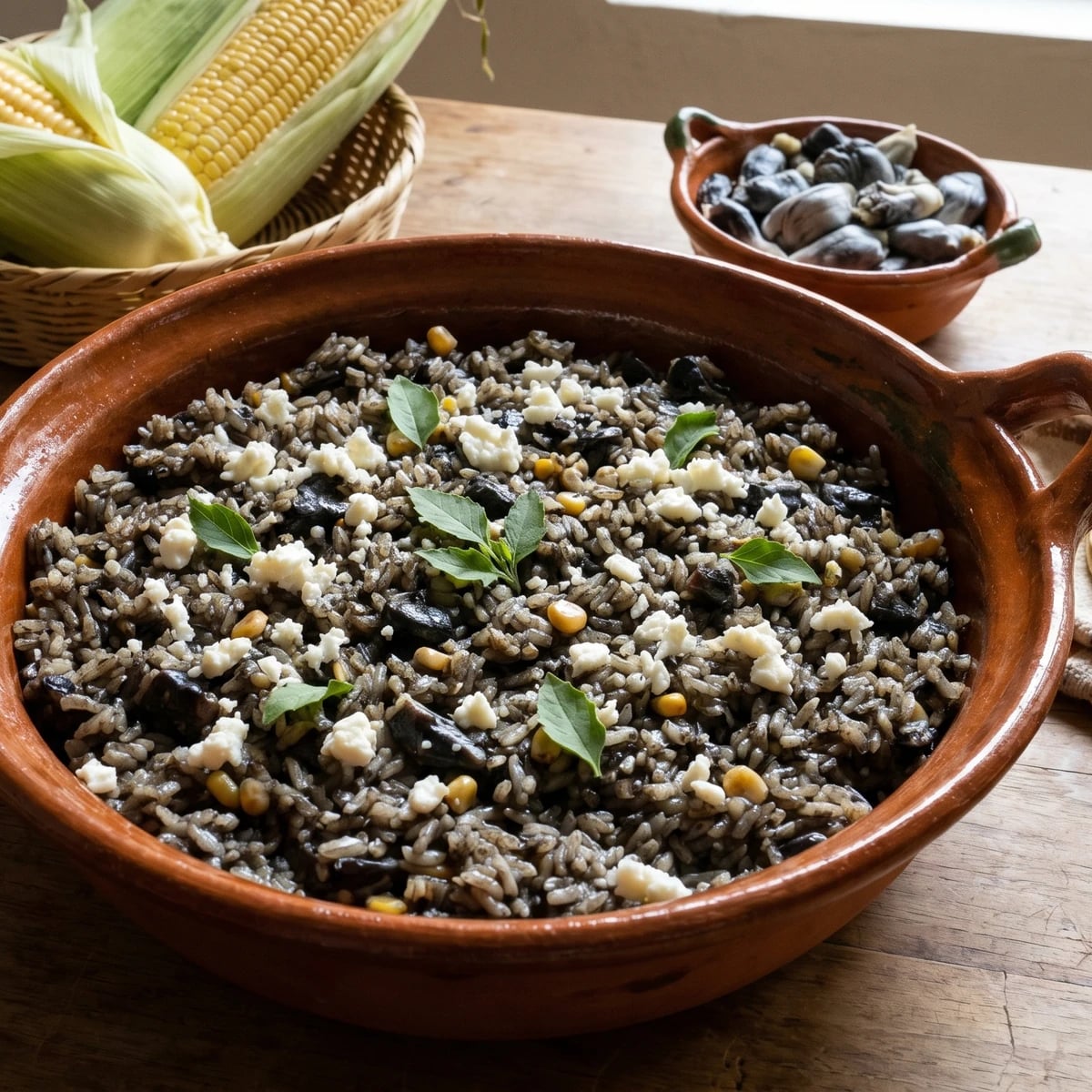
Estado de Mexico's central highlands rice, darkened by fresh huitlacoche from the milpa, toasted in manteca and cooked with onion, garlic, epazote, and chile serrano.

Side Dishes
Mexican
Special Occasion
Dinner Party
Comfort Food
20 min
Active Time
30 min cook50 min total
Yield6 servings

Estado de Mexico, the central highlands around Toluca and the milpas that feed Ciudad de Mexico, is where this rice makes sense. Huitlacoche belongs to corn country. When the rainy season swells the ears and the fungus blooms black and silver between the kernels, market women know exactly what to do with it.

This is not dirty rice and it is not mushroom rice wearing a Mexican costume. Huitlacoche has its own flavor: damp corn, earth, smoke without fire. The rice is fried first in manteca de cerdo so each grain seals and stays separate. Then the onion, garlic, chile serrano, and epazote carry the perfume of the central highlands. Epazote is not decoration. It is the herb that makes huitlacoche taste like itself.

I learned this version from a señora near the Mercado 16 de Septiembre in Toluca, who served it from a clay cazuela with queso fresco crumbled over the top and warm tortillas at the side. She told me, 'No lo ahogues.' Do not drown it. Rice needs enough broth to cook, not enough to become soup. Recetas probadas y garantizadas, but only if you respect the grain.

Huitlacoche, also called cuitlacoche, has been eaten in central Mexico since pre-Columbian times, especially in Nahua and Otomi corn-growing regions where the milpa shaped daily cooking. The Spanish and later urban elites often dismissed it as a crop disease, but rural cooks preserved its value because it appears exactly where corn, rain, and good soil meet. In the 20th century, restaurants in Mexico City began presenting huitlacoche as a prized ingredient, but market cooks in Estado de Mexico, Puebla, Tlaxcala, and Hidalgo had already been cooking it in quesadillas, soups, tamales, and rice for generations.

The technique, the tradition, and the story behind every dish.

Discover Culinary Explorer

Ingredients

long-grain white rice

Quantity

2 cups

manteca de cerdo

Quantity

3 tablespoons

white onion

Quantity

1/2 medium

finely chopped

garlic cloves

Quantity

2

finely chopped

fresh chile serrano

Quantity

1

stemmed and finely chopped

fresh huitlacoche

Quantity

2 cups

cleaned and roughly chopped

fresh corn kernels

Quantity

1/2 cup

warm chicken broth or vegetable broth

Quantity

3 cups

kosher salt

Quantity

1 teaspoon, plus more to taste

fresh epazote

Quantity

2 sprigs

queso fresco (optional)

Quantity

1/2 cup

crumbled

warm corn tortillas (optional)

Quantity

for serving

Equipment Needed

  • Wide clay cazuela or heavy 3-quart saucepan with tight lid
  • Fine-mesh strainer for draining rice
  • Wooden spoon
  • Fork for fluffing the cooked rice

Instructions

  1. 1

    Rinse the rice

    Rinse the rice in several changes of cool water until the water runs mostly clear. Drain it well in a fine-mesh strainer for 10 minutes. Wet rice dropped into hot fat splutters and steams instead of toasting. You want dry grains that can take the manteca.

  2. 2

    Toast the grains

    Melt the manteca de cerdo in a wide cazuela or heavy saucepan over medium heat. Add the drained rice and stir constantly for 6 to 8 minutes, until the grains turn opaque and a few at the edges become pale gold. This is the step that keeps Mexican rice from becoming paste. No me vengas con atajos.

  3. 3

    Cook the aromatics

    Add the onion, garlic, and chile serrano to the rice. Stir for 2 minutes, just until the onion softens and the garlic smells sharp and sweet. Do not brown the garlic. Burned garlic will sit in the pot like a scolded aunt and ruin the whole thing.

    Chile serrano gives a clean green heat. This rice should have presence, not punishment. One serrano is enough for the huitlacoche to remain the main flavor.
  4. 4

    Add huitlacoche

    Stir in the huitlacoche and corn kernels. Cook for 3 to 4 minutes, until the huitlacoche darkens, releases its juices, and stains the rice gray-black. The smell should be earthy and sweet, like wet corn husks after rain. If it smells sour or fermented, your huitlacoche was old before it reached the pan.

  5. 5

    Simmer covered

    Pour in the warm broth and add the salt and epazote sprigs. Stir once, only once, scraping the bottom so nothing sticks. Bring to a gentle boil, then cover tightly, reduce the heat to low, and cook for 18 minutes. Do not lift the lid. Rice cooks by trust and trapped heat.

  6. 6

    Rest and fluff

    Turn off the heat and let the covered pot rest for 10 minutes. Remove the epazote sprigs. Fluff the rice with a fork, lifting from the edges toward the center so you do not crush the grains. Taste for salt. The rice should be dark, loose, and glossy, with small pockets of huitlacoche throughout.

  7. 7

    Serve in clay

    Spoon the rice into a warm clay cazuela or serve it straight from the pot. Scatter queso fresco over the top if using and bring warm corn tortillas to the table. This is side dish food, yes, but in the central highlands a good side dish can carry the meal. Saber cocinar es saber vivir.

Chef Tips

  • Fresh huitlacoche is a rainy-season ingredient, usually best from June through September in central Mexico. If the market has none, do not pretend canned huitlacoche is the same. Frozen huitlacoche is the better compromise. Canned works only when you drain it well and accept that the flavor will be flatter.
  • Ask for huitlacoche at Mexican markets that sell fresh masa, squash blossoms, and epazote. If the vendor also has quelites and corn still in the husk, you are in the right place. Preguntale a las señoras del mercado.
  • Do not replace epazote with cilantro. They are not cousins. Epazote has a resinous, wild taste that belongs with corn, beans, and huitlacoche. Cilantro will make this rice taste like a different dish.
  • Manteca de cerdo gives the rice body and aroma. Vegetable oil will cook the rice, yes, but it will not give the same round flavor. A substitution is a compromise, not an upgrade.
  • If using canned huitlacoche, drain off the excess liquid and reduce the broth by 2 tablespoons. Canned huitlacoche carries extra moisture, and rice notices.

Advance Preparation

  • The onion, garlic, serrano, and huitlacoche can be chopped up to 4 hours ahead and refrigerated separately. Keep the huitlacoche covered so it does not dry out.
  • This rice is best the day it is made. Leftovers keep refrigerated for 2 days and reheat well in a covered skillet with a spoonful of broth.
  • Do not fully cook the rice ahead for a dinner party unless you are comfortable reheating rice gently. It can turn heavy if stirred too much after chilling.

Frequently Asked Questions

Nutrition Information

1 serving (about 270g)

Calories
425 calories
Total Fat
11 g
Saturated Fat
4 g
Trans Fat
0 g
Unsaturated Fat
6 g
Cholesterol
15 mg
Sodium
910 mg
Total Carbohydrates
72 g
Dietary Fiber
5 g
Sugars
3 g
Protein
11 g

Note: Chef personas and recipes are created with AI assistance. Cook with care: follow safe food-handling practices, check doneness with a thermometer when needed, and adapt for allergies and your kitchen.

Where cooking meets culture.

Culinary guides, cultural storytelling, and the editorial depth that makes cooking meaningful.

Discover Culinary Explorer

More from Central Mexican Side Dishes

Browse the full collection