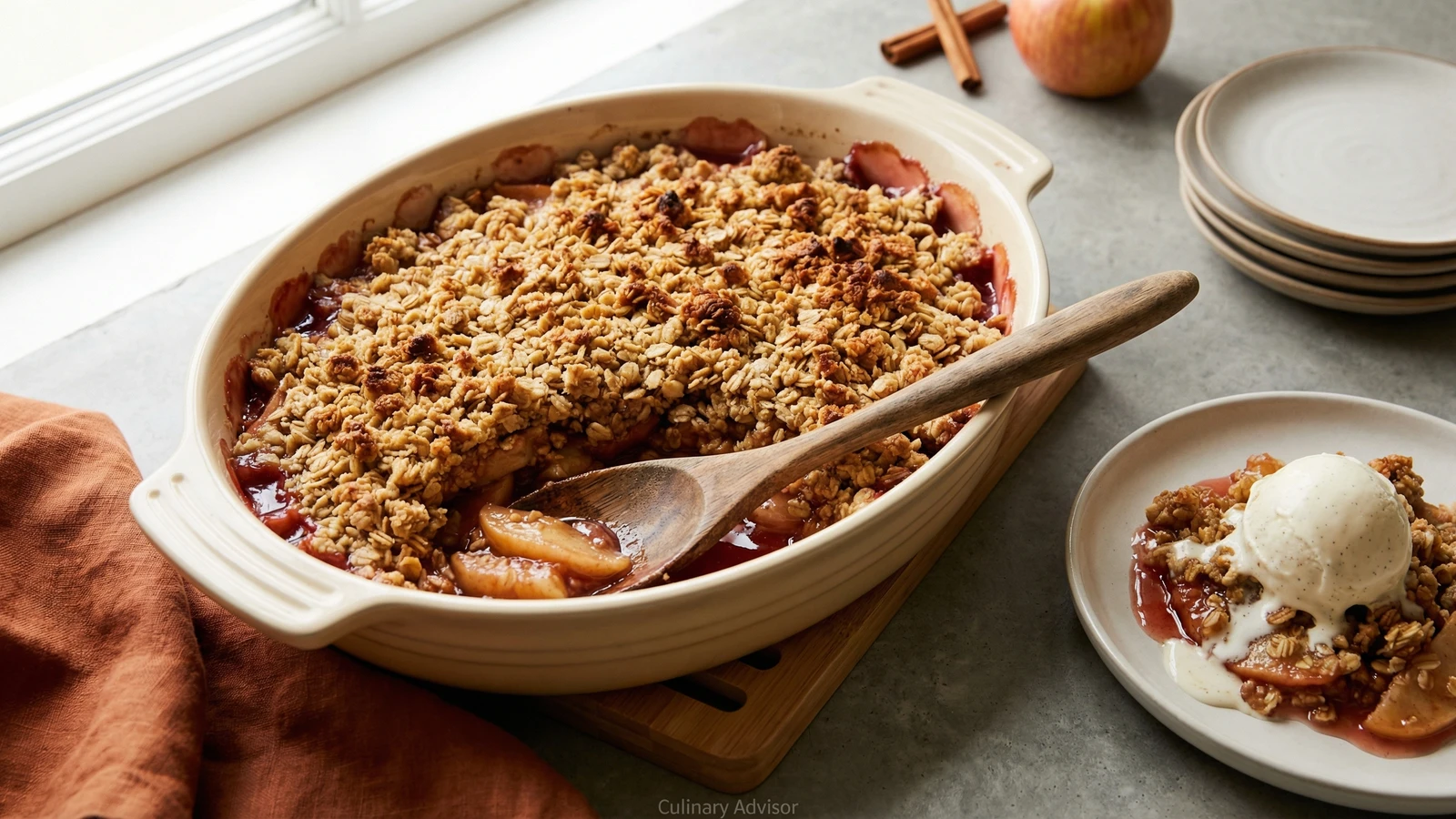
A tumble of cinnamon-kissed apples beneath a shaggy, golden oat topping that shatters into buttery crumbs with every spoonful. This is the dessert that makes your kitchen smell like autumn and your guests ask for seconds before they've finished firsts.
Desserts
American
Thanksgiving
Comfort Food
Weeknight
25 min
Active Time
50 min cook•1 hr 15 min total
Yield8 servings
Apple crisp belongs to that noble category of American desserts that require no special skill, just a willingness to trust the process. No blind baking, no lattice weaving, no anxious moments wondering if your crust will hold. You pile spiced apples into a dish, scatter a crumbly topping over them, and let the oven do what ovens do best.
The dish traces its roots to English crumbles, but Americans made it our own by adding oats to the topping. Those oats toast as the crisp bakes, turning golden and slightly chewy while the butter surrounding them crisps into something closer to a cookie than a crust. The apples beneath collapse into tender, jammy layers that bubble up through the topping in spots, creating those caramelized edges everyone fights over.
I have made this dessert more times than I can count, for Thanksgiving tables seating twenty and for Tuesday nights when nothing but warm fruit and cold ice cream would do. The proportions here are generous. You will have enough topping to create a proper crust, not a sparse scattering that disappears into the fruit. This matters. The topping is why people come back.
The technique, the tradition, and the story behind every dish.
•9x13-inch baking dish or 10-inch deep-dish pie plate
•Rimmed baking sheet
•Vegetable peeler
•Large mixing bowl
Instructions
1
Prepare baking dish and oven
Position a rack in the center of your oven and preheat to 350°F. Butter a 9x13-inch baking dish or a 10-inch deep-dish pie plate. Set it on a rimmed baking sheet to catch any bubbling juices. This saves you from scrubbing your oven floor later.
A ceramic or glass dish works beautifully here and can go straight from oven to table. The crisp looks most inviting served family-style.
2
Prepare the apples
Peel, core, and slice your apples about 1/4-inch thick. Uniformity matters here because uneven slices cook unevenly. Drop slices into a large bowl as you work and toss them with the lemon juice to prevent browning. The acid also brightens the flavor of the finished filling.
3
Season the filling
Add the granulated sugar, two teaspoons cinnamon, nutmeg, salt, and two tablespoons flour to the apples. Toss thoroughly with your hands, making sure every slice is coated. The flour thickens the juices as the apples release their liquid, preventing a soupy bottom. Transfer to your prepared baking dish and spread into an even layer.
Your hands are the best tool here. A spoon cannot coat the apples as evenly, and you need that sugar and spice distributed into every crevice.
4
Make the oat topping
In a medium bowl, combine the oats, brown sugar, 3/4 cup flour, 1/2 teaspoon cinnamon, and 1/4 teaspoon salt. Whisk briefly to distribute the spices. Add the cold butter cubes. Using your fingertips, work the butter into the dry ingredients until you have a shaggy mixture with some pea-sized butter pieces remaining. Do not overwork it into a paste.
Cold butter is essential. Those distinct pieces of butter steam as they melt in the oven, creating pockets of crispness. Warm butter makes a dense, cookie-like topping instead of a proper crumble.
5
Top and bake
Scatter the oat mixture evenly over the apples, covering them completely. Do not pack it down. A loose, irregular surface creates more crispy edges. Bake until the topping is deeply golden and the fruit juices bubble vigorously around the edges, 45 to 50 minutes. The bubbling tells you the apples have fully softened.
6
Rest before serving
Remove from oven and let the crisp rest for at least fifteen minutes. This cooling period allows the juices to thicken slightly. Serve warm, not hot, with a generous scoop of vanilla ice cream that will melt into rivulets over the golden topping. A crisp eaten too quickly burns tongues and robs you of the pleasure of watching ice cream surrender to warm fruit.
Leftover crisp reheats beautifully. Cover loosely with foil and warm in a 350°F oven for fifteen minutes. The topping will recrisp as it heats.
Chef Tips
•The best apple crisp uses a mix of varieties. Combine a firm tart apple like Granny Smith with a sweeter, softer one like Honeycrisp, Jonagold, or Fuji. The tart apples hold their shape while the sweeter ones break down into a jammy sauce. This contrast is essential.
•If your brown sugar has hardened into a brick, microwave it with a damp paper towel for twenty seconds. Life is too short for lumpy topping.
•For a deeper flavor, toast your oats briefly in a dry skillet before making the topping. Three minutes over medium heat until fragrant. Let them cool before adding to the butter mixture.
•A splash of bourbon or dark rum in the apple filling transforms this from homey to sophisticated. Two tablespoons is plenty. The alcohol cooks off, leaving only warmth.
•This crisp pairs beautifully with a glass of late-harvest Riesling or hard cider. The sweetness of the wine matches the fruit without overwhelming it.
Advance Preparation
•The topping can be made up to three days ahead and refrigerated in an airtight container. The cold rest actually improves it, allowing the butter to firm up completely for an even crispier result.
•You can assemble the entire crisp, cover tightly with plastic wrap, and refrigerate for up to 24 hours before baking. Add five to ten minutes to the baking time since you're starting cold.
•Baked crisp keeps at room temperature for one day or refrigerated for up to four days. Reheat uncovered in a 350°F oven until warmed through and the topping recrisps, about fifteen minutes.
Frequently Asked Questions
Nutrition Information
1 serving (about 260g)
Calories
650 calories
Total Fat
18 g
Saturated Fat
11 g
Trans Fat
0 g
Unsaturated Fat
7 g
Cholesterol
35 mg
Sodium
95 mg
Total Carbohydrates
81 g
Dietary Fiber
2 g
Sugars
51 g
Protein
4 g
Where cooking meets culture.
Culinary guides, cultural storytelling, and the editorial depth that makes cooking meaningful.