
Chef Klaus
Apfelweingulasch
Hesse's pork goulash belongs to Apfelwein country: shoulder, onions, and tart cider cooked low until the cheap cut turns soft and the sauce lands sweet-sour, not sour-sweet.
A cooking platform built around craft, culture, and the stories behind what we eat.
Created by
North Hesse's old sausage is cured, not cooked: coarse pork, pepper, garlic, and cold weeks in a chamber until the slice turns firm enough for rye and cider.
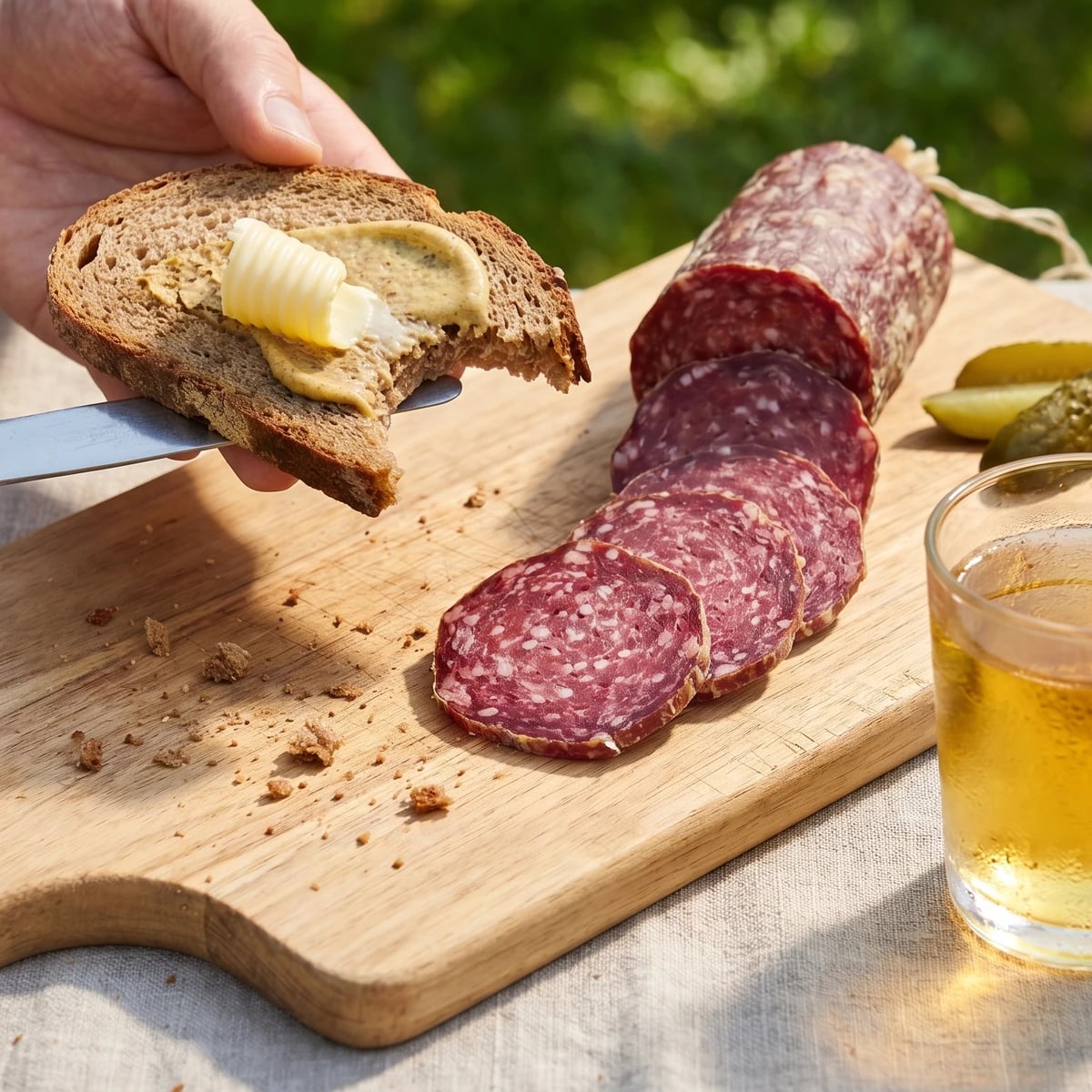
Ahle Wurst belongs to North Hesse, around Kassel, the Schwalm, and Waldeck, where it sits on the Brotzeit board, the bread-and-cold-cut meal, for picnics, Kirmes, a church fair, and Sunday evening when the hot meal is already behind you. It starts in the cold slaughter season and earns its place weeks later, when the casing has gone dry, the cut face is dark red, and the fat stands clean and white. I serve it thin on rye with butter, mustard, pickles, onion, and a glass of cider. Never cooked. Das braucht seine Zeit.
North Hesse argues inside its own border. Some want Stracke, long and straight; some want Runde, round and thicker. Some cellars air-dry it pale; some give it a little beech smoke. The south has Landjager and Kaminwurzen, the Eichsfeld has Feldgieker, Westphalia has Mettwurst. Good sausages, different logic. Im Norden anders, im Süden anders, and here the line runs through casing, smoke, and patience. Das ist kein Bierzelt.
The work is controlled water loss. Salt, cure, starter, and cold air protect the meat while water leaves slowly; rush the drying and the outside hardens into a shell while the center stays wet and wrong. The old makers had slaughter-warm meat and cellars they knew by hand. At home, use a chamber, record the weight, and check the pH. Guessing with raw pork is not tradition. Erst verstehen, dann kochen.
Ahle Wurst, often Ahle Wurscht in North Hessian dialect, means old sausage, a name tied to Hausschlachtung, home pig slaughter, in the cold months after Martinmas on 11 November. Before rural refrigeration became common, that cold season gave pork sausage the weeks it needed to dry safely enough for field lunches, travel food, and Sunday bread boards long after slaughter day. North Hessian makers still split over straight Stracke and round Runde, air-dried cellar sausage and lightly beech-smoked sausage, which is why one name can cut differently from village to village.
Quantity
2.3kg
chilled below 4C and diced
Quantity
700g
chilled hard and diced
Quantity
76g
Quantity
7.5g
weighed accurately
Quantity
6g
Quantity
dose for 3kg meat and fat
use packet directions
Quantity
40ml
Quantity
9g
coarsely cracked
Quantity
4g
freshly ground
Quantity
6g
crushed to a paste
Quantity
2g
Quantity
2g
lightly crushed
Quantity
enough for 3kg filling
43 to 55mm, soaked and rinsed
Quantity
to serve
Quantity
to serve
Quantity
to serve
Quantity
to serve
Quantity
to serve
| Ingredient | Quantity |
|---|---|
| very fresh pork shoulderchilled below 4C and diced | 2.3kg |
| firm pork back fatchilled hard and diced | 700g |
| fine sea salt | 76g |
| Cure #2, nitrite and nitrate curing saltweighed accurately | 7.5g |
| dextrose | 6g |
| dry sausage starter cultureuse packet directions | dose for 3kg meat and fat |
| cold chlorine-free water | 40ml |
| black peppercoarsely cracked | 9g |
| white pepperfreshly ground | 4g |
| fresh garliccrushed to a paste | 6g |
| ground mace or nutmeg | 2g |
| caraway seeds (optional)lightly crushed | 2g |
| natural beef middles or wide hog casings43 to 55mm, soaked and rinsed | enough for 3kg filling |
| dense rye bread | to serve |
| good butter | to serve |
| German mustard | to serve |
| pickled cucumbers and raw onion | to serve |
| dry Hessian cider or Apfelwein (optional) | to serve |
Clean the grinder, stuffer, trays, hooks, and work surface, then set the curing chamber to 12 to 15C and 75 to 82 percent humidity before you cut the meat. This is raw pork that will never be cooked, so the chamber is not decoration; stable cold, humidity, and light airflow let water leave without giving bad bacteria a warm wet home. If you cannot hold those numbers or check pH, buy a mature Ahle Wurst from a good butcher and use the serving step.
Trim away glands, heavy sinew, and bruised bits, then cut the shoulder and back fat into 2cm dice and spread them on trays. Chill until the meat is firm and the fat is hard, but not frozen solid. Cold fat cuts clean; warm fat smears into paste, and then the finished slice loses those clean white cubes that tell you the sausage was handled properly. Weggeworfen wird nichts: good lean trim goes in, bad trim does not.
Mix the sea salt, Cure #2, dextrose, peppers, garlic, mace, and caraway if using. Rehydrate the starter culture in the cold chlorine-free water and keep it separate for the mixing step. Weigh the cure on a scale accurate to 0.1g, because curing salt is measured by meat weight, not by spoon. The dextrose is there to feed the starter enough acid for safety; it is not there to make the sausage sweet.
Toss the cold pork and fat with the dry cure and spice mix, then grind through an 8mm plate into a chilled bowl. Keep the bowl cold and work quickly. Ahle Wurst should cut with visible lean and fat, not as a smooth salami paste, so the coarse grind is part of the dish and not a rustic accident.
Add the starter water and mix the sausage meat by hand or paddle until it turns sticky and holds together, usually 2 to 3 minutes. That tacky bind is the meat protein doing its work; without it, the slice crumbles, and with too much warmth, the fat smears. Keep the mixture below 10C. Fry a teaspoonful to check salt and pepper, because tasting raw pork is foolish.
Stuff the sausage meat firmly into the soaked casings, tie into straight lengths or rounds, and prick only visible air pockets with a clean needle. Air pockets rot from the inside, so they come out now. Weigh each sausage and write the starting weight on a tag; the scale will tell you when enough water has left, and guessing by feel lies to beginners.
Hang the sausages at 20 to 22C and 90 to 95 percent humidity for 24 to 48 hours, until the pH reaches 5.3 or lower. That acid drop is the safety gate; it gives the starter control before the long cold drying begins and helps the cured red colour set cleanly. If the pH has not reached the mark after 48 hours, do not move it to ageing and do not serve it.
Move the sausages to the curing chamber at 12 to 15C and 75 to 82 percent humidity. Dry for 6 to 10 weeks, until each sausage has lost 35 to 40 percent of its starting weight and feels firm from edge to center. Too much airflow or too little humidity hardens the casing and traps a wet core; too much humidity gives you sour smell and slime. Runter mit der Temperatur, and let the cold do its work.
Cut one test sausage when it has reached the weight loss target. The center should be firm, dark red, and even, with clean white fat and a mild cured smell of pork, pepper, and garlic. Slice thinly and lay it on buttered rye with mustard, pickled cucumber, and raw onion. Never cook Ahle Wurst; heat drives out the fat and ruins the texture. Würzen, Fett, Salz zum Schluss, then eat it with cold cider. Schön ist, was schmeckt.
1 serving (about 160g)
Culinary guides, cultural storytelling, and the editorial depth that makes cooking meaningful.
Discover Culinary Explorer
Chef Klaus
Hesse's pork goulash belongs to Apfelwein country: shoulder, onions, and tart cider cooked low until the cheap cut turns soft and the sauce lands sweet-sour, not sour-sweet.

Chef Klaus
Frankfurt's seven sauce herbs turn into a warm spring soup here, thickened with potato, sharpened with sorrel and cress, and kept green by one rule: herbs in last, heat off.

Chef Klaus
Frankfurt's spring sauce is seven raw herbs folded into cold dairy, served with potatoes and hard eggs, and the whole dish fails the moment you heat or bruise the green.

Chef Klaus
Frankfurt spring soup lives or dies in the last minute: potato gives the body, Schmand softens the edge, and raw garden cress keeps its green bite.