
Chef Lupita
Agua de Alfalfa
Ciudad de México's highland market agua fresca, fresh alfalfa blended with pineapple and lime until bright green, strained clean, and poured cold from the vitrolero.
A cooking platform built around craft, culture, and the stories behind what we eat.
Created by
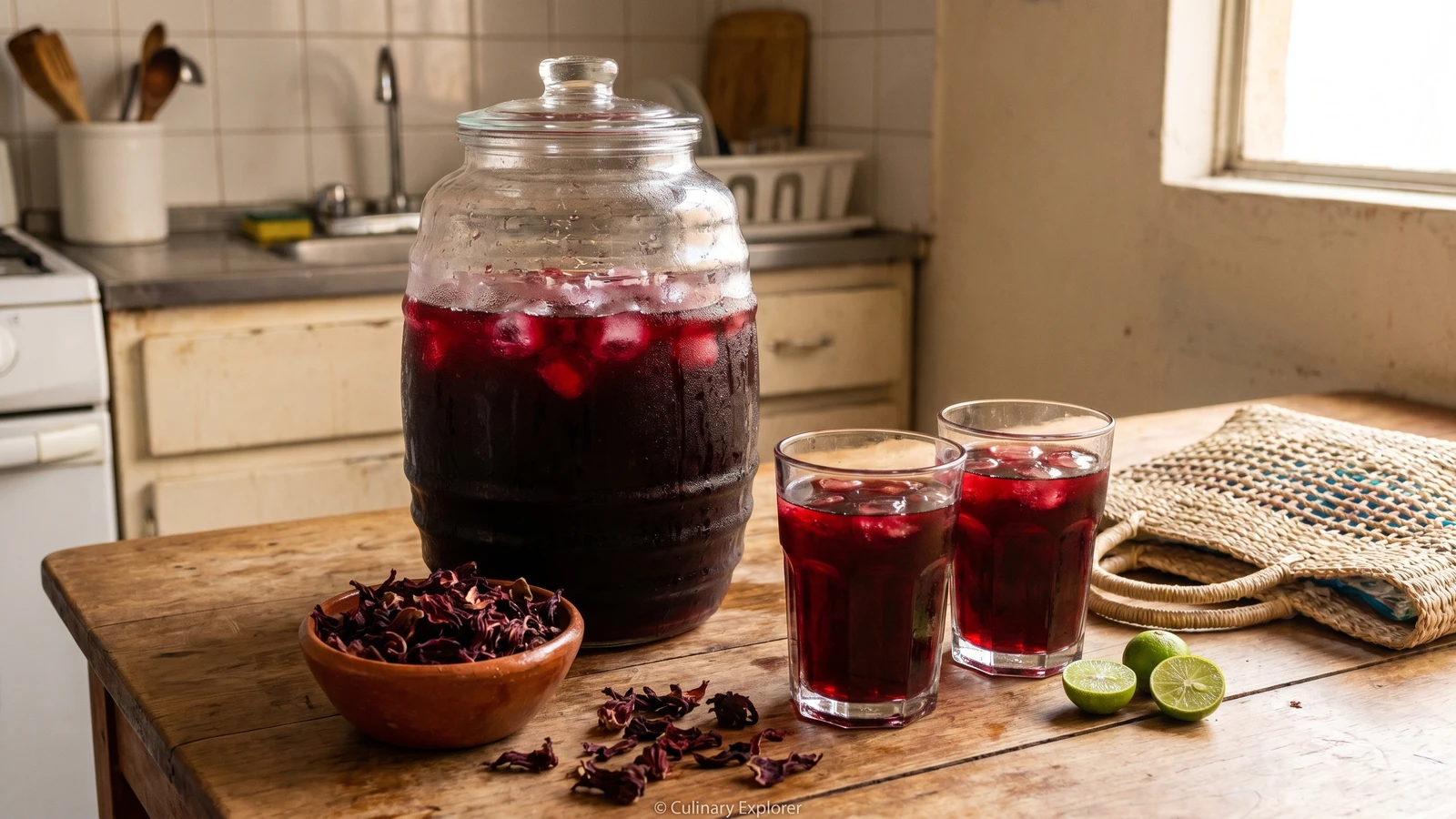
Ciudad de Mexico's market-table agua fresca, made from dried flor de jamaica simmered until the water turns garnet, then chilled and poured over ice for hot afternoons.
Ciudad de Mexico, Valle de Mexico, is where this agua lives on the table: in fondas, market stalls, school lunches, and plastic pitchers sweating beside a plate of comida corrida. Agua de jamaica is not a cocktail. It is not a fancy tea. It is the daily red agua fresca that cuts through heat, salt, and fried food without making a speech about it.
The ingredient is flor de jamaica, dried hibiscus calyces, sold by the scoop in La Merced, Jamaica Market, Sonora, and every mercado that knows how people actually cook. The good flowers are deep burgundy, dry but still flexible, and they smell tart and floral. If they look dusty brown, leave them there. Sourcing wins. You can simmer perfectly and still make a flat agua if the jamaica is dead before it reaches your pot.
The technique belongs to the women who run lunch counters and home kitchens: rinse the flowers, simmer briefly, steep off the heat, strain, sweeten while warm, then dilute with cold water. Do not boil it to death. You want tartness, color, and that clean cranberry-like edge, not bitterness. My mother wrote in her notebook: 'poca lumbre, mucho reposo.' Low flame, long rest. She was right.
This is a 32-state cuisine, and agua de jamaica travels across all of it, but the capital made it part of the everyday public table. Serve it in a glass vitrolero or a scratched plastic pitcher if that is what you have. La cocina no es decoracion, es trabajo.
Hibiscus sabdariffa likely reached New Spain through colonial trade routes connecting Africa, Asia, and the Americas, and by the 19th century it was established in Mexican markets as flor de jamaica. Today the plant is grown in several warm Mexican states, especially Guerrero, Oaxaca, Michoacan, Nayarit, and Colima, while Mexico City made the drink a standard agua fresca of fondas and mercados. Its tart infusion also appears in savory cooking, where the spent flowers are reused for tacos, salsas, and stews, a practical habit from kitchens that waste nothing.
Quantity
2 cups
Quantity
8 cups
divided
Quantity
3/4 cup, plus more to taste
Quantity
1
halved
Quantity
for serving
| Ingredient | Quantity |
|---|---|
| dried flor de jamaica (hibiscus calyces) | 2 cups |
| waterdivided | 8 cups |
| granulated sugar | 3/4 cup, plus more to taste |
| small Mexican lime (optional)halved | 1 |
| ice (optional) | for serving |
Put the dried flor de jamaica in a bowl and cover with cool water. Swish with your hand, then drain through a fine-mesh strainer. Do this once. You are removing field dust and loose grit, not washing away the flavor. Good jamaica will stain the rinse water almost immediately.
Bring 4 cups of water to a gentle boil in a stainless steel or enamel pot. Add the rinsed jamaica. Lower the heat and simmer for 8 minutes. The water should turn dark garnet, almost like red wine. Do not let it pound away on high heat. Hard boiling pulls bitterness from the flowers.
Turn off the heat, cover the pot, and let the flowers steep for 20 minutes. This is where the color deepens and the tartness settles. No me vengas con atajos. If you strain too soon, the agua tastes thin. If you cook too long, it tastes harsh.
Strain the liquid into a large pitcher or bowl, pressing lightly on the flowers. Do not mash them into paste. Stir in the sugar while the concentrate is still warm so it dissolves completely. Taste. It should be tart first, sweet second. Agua de jamaica that tastes like syrup has lost the point.
Add the remaining 4 cups cold water and stir well. Refrigerate for at least 45 minutes, until fully cold. The color should stay clear and deep red. If it looks cloudy, you boiled too hard or pressed the flowers too aggressively.
Fill glasses with ice and pour the agua de jamaica over the top. Add a squeeze of Mexican lime only if the flowers are dull or the day is very hot. Serve from a vitrolero or a big pitcher at the table. Recetas probadas y garantizadas.
1 serving (about 245g)
Culinary guides, cultural storytelling, and the editorial depth that makes cooking meaningful.
Discover Culinary ExplorerChef Lupita
Ciudad de México's highland market agua fresca, fresh alfalfa blended with pineapple and lime until bright green, strained clean, and poured cold from the vitrolero.

Chef Lupita
Aguascalientes' Lenten agua fresca, jewel-red from cooked beet and full of apple, banana, orange, lettuce, and ground peanuts, served cold when Holy Week meets the Feria de San Marcos.

Chef Lupita
Sonora and Sinaloa's creamy malted barley water, built on toasted cebada perla, Mexican canela, vanilla from Papantla, and evaporated milk. Pink-beige, rich, and served cold over heavy ice in a heavy glass tumbler. Liquid cookie comfort the northwest way.

Chef Lupita
Yucatán's everyday tonic of boiled chaya leaves blended with lima agria, sugar, and ice. The bright green jarra that sits on every Peninsula table from Mérida to Valladolid.