
Chef Juliette
John Dory (St. Pierre)
John Dory has the delicacy of sole and the firmness of turbot. A light flouring, a quick butter sauté, and nut-brown beurre noisette show exactly why looks never mattered.
A cooking platform built around craft, culture, and the stories behind what we eat.
Created by Chef Juliette
Based on No. 950, Homard à la Palestine, from Le Guide Culinaire (1907) by Auguste Escoffier
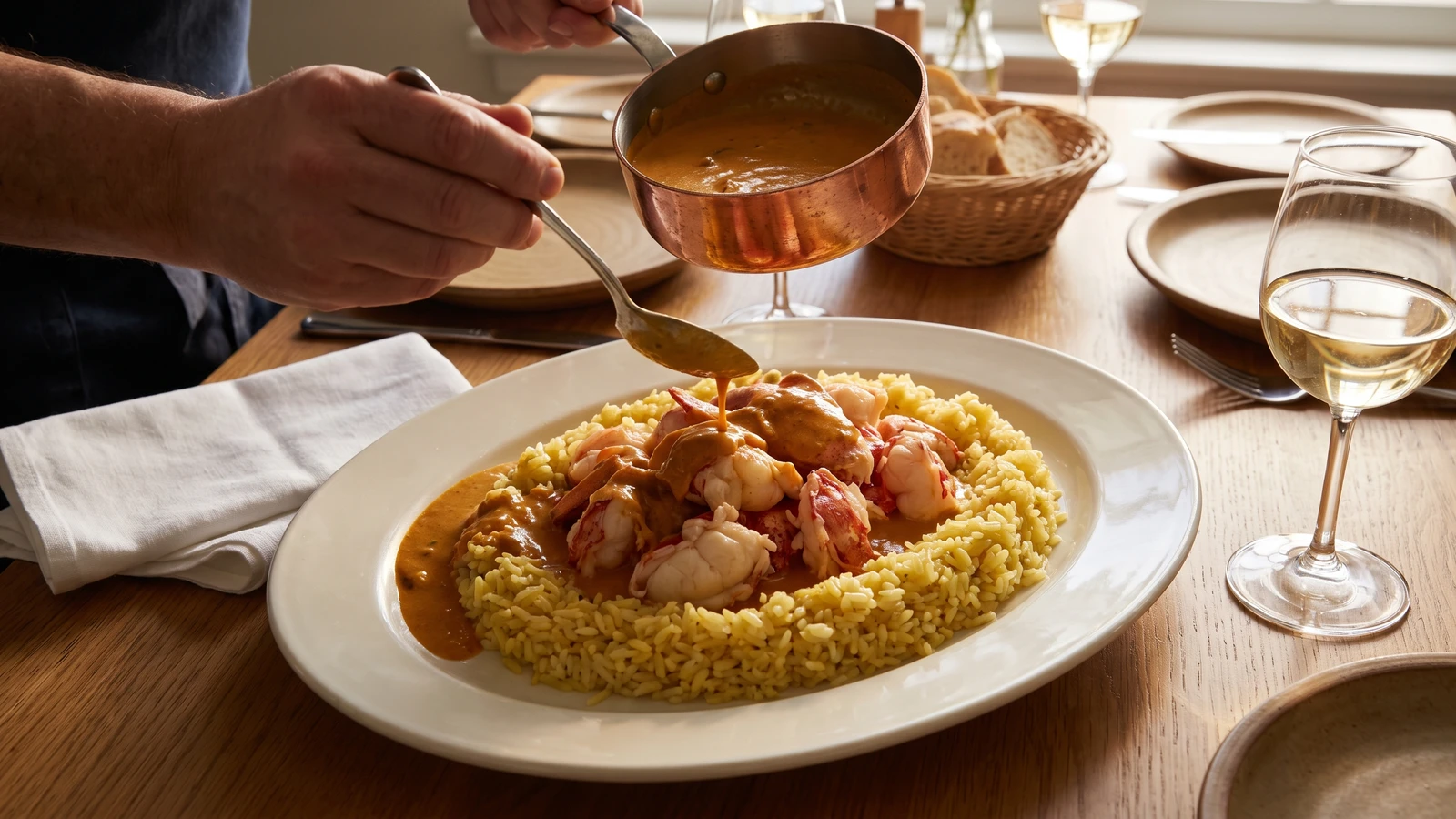
Homard à la Palestine rests on one extravagant economy: the lobster shells become a concentrated sauce, mounted with curry butter and spooned over the meat inside a generous border of pilaff rice.
Homard à la Palestine (curried lobster with pilaff rice) teaches the first law of shellfish cookery: the meat is only half the lobster. The carapace, claws, head, and every coral-colored scrap carry the depth, and this sauce gets its authority by crushing them, frying them hard, and extracting them as though making a bisque. Waste the shells and no amount of curry butter can put the character back.
The original kitchen assumed a saucier on staff, fumet never off the fire, a mortar large enough for the carapace, and a salamander waiting for dishes that needed one, though this sauce never goes beneath it. At home, the fishmonger dispatches and joints one large lobster, a towel and mallet replace the mortar, and one saucepan does the sauce work. I change the live cutting because it is neither humane nor sensible for an unpracticed home cook. The separate brigade stations are scaffolding and can go; pounding the shells, skimming their oil, reducing the liquor, and mounting it with real curry butter are the dish, and they stay. One cook, one stove, one evening.
The finished platter should look generous: butter-gold pilaff around the rim, rosy lobster in the center, and an ochre shell sauce gleaming over it, with more waiting beside the platter. The decisive step comes after the meat leaves its shell. Crush those shells thoroughly and fry them until their aroma fills the kitchen, because the shells carry it; don't waste them.
Homard à la Palestine belongs to the Parisian grand-kitchen repertoire, where an à la name often described a garnish and flavor family rather than the birthplace of a dish. In this entry, curry butter and pilaff rice carry the designation, while the construction remains thoroughly French: shell extraction, fish velouté, reduction, and an off-heat butter finish. The title records French menu nomenclature, not a regional dish from the Palestinian table.
Quantity
1 lobster (about 3 lb / 1.35 kg)
professionally dispatched and jointed immediately before cooking, with every shell and juice reserved
Quantity
3 tablespoons (45 ml / 42 g)
divided
Quantity
1/2 cup (120 ml / 75 g) Mirepoix (No. 228)
prepared and reserved for cooking the lobster
Quantity
1 1/2 cups plus 1 tablespoon (375 ml / 375 g)
Quantity
2 1/3 cups (560 ml / 560 g)
Quantity
3 tablespoons (45 ml / 43 g)
Quantity
1/4 cup (60 ml / 55 g)
Quantity
1/2 cup (120 ml / 75 g) Mirepoix (No. 228)
finely diced and reserved for the shell extraction
Quantity
2 tablespoons (30 ml / 32 g)
Quantity
5 tablespoons (75 ml / 70 g)
made from unsalted butter blended with 1 1/2 teaspoons (7.5 ml / 3 g) mild French curry powder
Quantity
3 cups (720 ml / 600 g) Riz Pilaff (No. 2255)
Quantity
as needed
Quantity
as needed
| Ingredient | Quantity |
|---|---|
| very fresh hard-shell lobsterprofessionally dispatched and jointed immediately before cooking, with every shell and juice reserved | 1 lobster (about 3 lb / 1.35 kg) |
| unsalted butterdivided | 3 tablespoons (45 ml / 42 g) |
| Mirepoixprepared and reserved for cooking the lobster | 1/2 cup (120 ml / 75 g) Mirepoix (No. 228) |
| dry white wine | 1 1/2 cups plus 1 tablespoon (375 ml / 375 g) |
| fish fumet | 2 1/3 cups (560 ml / 560 g) |
| Cognac or other good brandy | 3 tablespoons (45 ml / 43 g) |
| neutral oil | 1/4 cup (60 ml / 55 g) |
| Mirepoixfinely diced and reserved for the shell extraction | 1/2 cup (120 ml / 75 g) Mirepoix (No. 228) |
| fish velouté | 2 tablespoons (30 ml / 32 g) |
| curry buttermade from unsalted butter blended with 1 1/2 teaspoons (7.5 ml / 3 g) mild French curry powder | 5 tablespoons (75 ml / 70 g) |
| hot Riz Pilaff | 3 cups (720 ml / 600 g) Riz Pilaff (No. 2255) |
| fine sea salt | as needed |
| ground white pepper | as needed |
Have both portions of Mirepoix (No. 228), the fish fumet, and the fish velouté ready before the lobster meets the pan. Time the Riz Pilaff (No. 2255) to be hot when the sauce is finished. Blend the softened butter with the curry powder until its color is perfectly even, shape it into a small block, and chill it; cold curry butter forms a cleaner emulsion than warm butter.
Ask the fishmonger to dispatch and joint the lobster immediately before cooking, separating the tail into four thick sections, cracking the claws, and cutting the head and body into manageable pieces. Bring home every shell, leg, juice, and soft interior part over ice. Blot the shell pieces dry and season them lightly; wet shells spit when they meet hot butter.
Melt 2 tablespoons (30 ml / 28 g) of the plain butter in a wide covered sauté pan over medium-high heat. Add the first Mirepoix (No. 228), let it become fragrant for 2 minutes, then add the lobster pieces and collected juices. Toss and turn them for 4 to 5 minutes, until the shells are vivid red and the butter carries a roasted shellfish aroma. Keep the heat lively without browning the butter.
For the flambage (flaming the brandy), warm the Cognac in a small saucepan, then take it away from the burner. Turn off the extractor, keep a lid beside you, and ignite the Cognac with a long match, never from the bottle. Let the flame die, then pour the burnt brandy over the lobster. If it refuses to light, ça se rattrape: boil it briskly for 1 minute before adding it. Pour in the white wine and fish fumet, scraping the pan floor clean, then cover and cook at a lively but controlled simmer for 15 minutes. The shell should be scarlet and the thickest tail section should reach 145°F / 63°C.
Lift out the tail and claw sections. Crack them while still warm, withdraw the meat in the largest pieces possible, and return every empty shell to the head and body remains. Put the meat in a small covered saucepan with the remaining 1 tablespoon (15 ml / 14 g) plain butter. Hold the pan in a water bath kept between 140 and 150°F / 60 and 65°C; direct heat will make the lobster contract and turn rubbery. Remove the feathery gills and hard stomach sac from the body. If coral and creamy parts are present and local shellfish guidance permits their use, press them through a fine sieve and reserve them for the liaison.
Pour the lobster cooking liquor into a bowl and reserve it. Cut the larger shells with sturdy kitchen shears, wrap them in a clean heavy towel, and strike them with a mallet or the base of a small saucepan until they are broken into thumbnail-sized pieces. Do not reduce them to powder, and do not put hard claw shell into a household food processor. Pounding exposes the flavorful inner surface, which is why this step is the dish rather than ceremony.
Heat the neutral oil in a heavy saucepan until fluid and very hot. Add the crushed shells and fry them for 4 minutes, stirring and pressing them against the pan until their aroma deepens and the oil turns coral-red. Add the second Mirepoix (No. 228) and cook for another 3 minutes. Keep the pan moving, because scorched shell makes the entire sauce bitter.
Moisten the fried shells with all the reserved lobster cooking liquor. Bring it just to a simmer, lower the heat, and cook uncovered for 15 minutes, pressing the shells beneath the liquid from time to time. A violent boil muddies the extraction and drives away the delicate wine aroma; a steady tremble draws out the shell without roughening it.
Strain the liquid through a fine sieve lined with damp cheesecloth or muslin, pressing firmly with the back of a ladle. Let it stand undisturbed for 5 minutes so the extraction oil rises, then remove that oil completely with a shallow spoon or fat separator. The sauce must be clean before the butter enters. If a fine slick remains, touch the surface once with the corner of a clean paper towel and lift it straight away.
Return the strained liquid to a clean saucepan and boil it briskly until only a generous 1/2 cup (140 ml) remains. It should smell powerfully of lobster and lightly coat a spoon, but it will not yet be a finished sauce. Watch closely near the end. If it reduces too far or begins to taste salty, ça se rattrape: add fish fumet 1 tablespoon at a time until the balance returns.
Lower the heat and whisk in the fish velouté, followed by the sieved coral and creamy parts if using. This is the liaison (the final thickening), so keep it below a boil and whisk until the sauce is nappé, meaning it coats the back of a spoon in a smooth veil. Remove the pan from the heat and montez au beurre (finish by whisking in butter), adding the cold curry butter piece by piece. Taste for salt and white pepper. If the sauce splits into oily beads, stop. Ça se rattrape: whisk 1 tablespoon of cold fumet in a clean pan, then rebuild the broken sauce into it a spoonful at a time.
Warm an oval serving platter. Arrange the hot Riz Pilaff (No. 2255) as a broad border, pressing it just firmly enough to hold while keeping the grains distinct. Set the buttery tail and claw pieces in the center. Spoon several tablespoons of curry sauce over the lobster, coating it generously without drowning the rice, and send the remaining sauce to the table in a warm sauceboat. Serve at once. À table!
1 serving (about 365g)
Culinary guides, cultural storytelling, and the editorial depth that makes cooking meaningful.
Discover Culinary ExplorerChef Juliette
John Dory has the delicacy of sole and the firmness of turbot. A light flouring, a quick butter sauté, and nut-brown beurre noisette show exactly why looks never mattered.

Chef Juliette
Fresh haddock proves its delicacy in the meunière pan: a fine flour crust, moist pearly flakes, and beurre noisette sharpened with lemon and parsley, ready from one skillet in half an hour.

Chef Juliette
Éperlans à l’Anglaise turns small fish into a lesson in disciplined coating: boned smelts under a close, crisp crumb, pan-fried in clarified butter and finished with bright, half-melted maître d’hôtel butter.

Chef Juliette
Tiny smelts, shallot, mushrooms, white wine, gratin sauce, and fine bread raspings meet a fierce oven, where the fish must turn tender in the same breath the buttered crust bronzes.