
Chef Juliette
John Dory (St. Pierre)
John Dory has the delicacy of sole and the firmness of turbot. A light flouring, a quick butter sauté, and nut-brown beurre noisette show exactly why looks never mattered.
A cooking platform built around craft, culture, and the stories behind what we eat.
Created by Chef Juliette
Based on No. 933, Turbotin Mirabeau, from Le Guide Culinaire (1907) by Auguste Escoffier
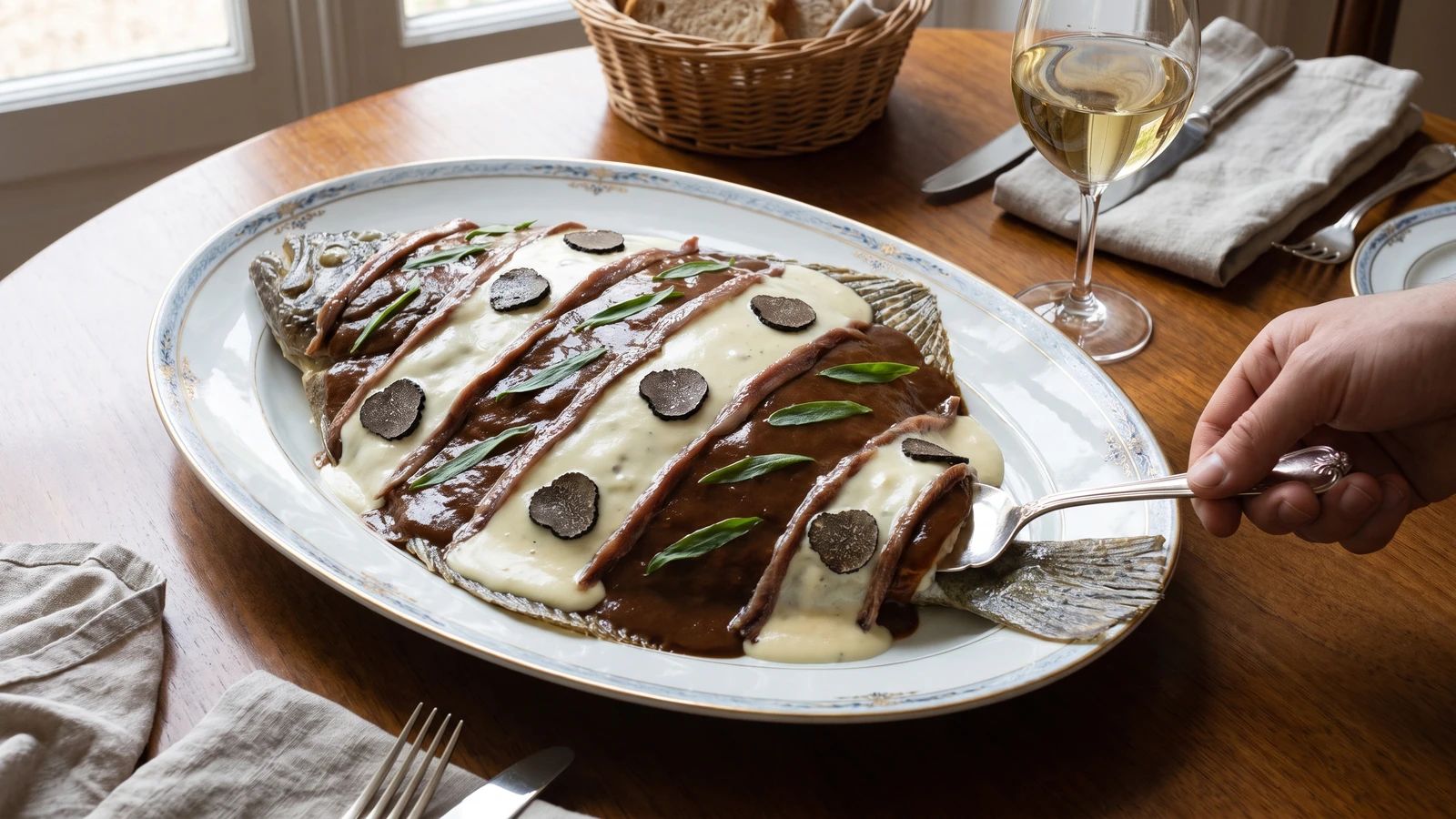
Poached whole in Sauterne court-bouillon, this small turbot wears alternating ivory sauce vin blanc and mahogany sauce Genevoise, their seams marked with anchovy, then truffle and tarragon set in strict, delicious order.
Turbotin Mirabeau (small turbot striped with two sauces) teaches precision in service: two sauces can share one fish only when they have exactly the same body. Bring both to a nappant consistency, thick enough to coat a spoon in an even veil. Too loose and the bands bleed together; too stiff and they sit on the fish like paste. The pattern isn't decoration laid over the dish. It distributes white wine, red wine, anchovy, truffle, and tarragon from one end of the fish to the other.
The original assumed a whole chicken-turbot, a fish poacher with a lifting grid, a saucier holding two finished sauces, and stock never off the fire. At home, a snug roasting pan, a parchment sling, two small saucepans, and good fish stock do the same work for four. The fitted grid and separate sauce station were brigade scaffolding and can go. The Sauterne court-bouillon, the distinct sauce vin blanc and sauce Genevoise, and their alternating bands are the dish and must stay. A salamander contributes nothing here because the fish is poached and coated, never browned. One cook, one stove, one evening.
When it is right, the turbot remains pearly and succulent beneath ribbons of ivory and wine-dark brown, with salty anchovy marking every seam and black truffle answering the green tarragon. Make both sauces before the fish enters its liquor, then match their consistency before the first spoonful touches the platter. That is the step that matters most.
Turbotin Mirabeau belongs to the Parisian classical service table rather than to a provincial larder: a small whole turbot was poached and dressed as an imposing centerpiece through sauce and garniture. “Chicken-turbot” describes the fish's compact market size, not an ingredient, while the Mirabeau finish here is defined by alternating white-wine and Genevoise sauces, anchovy seams, black truffle, and tarragon. The preparation passed naturally from grand dining rooms to private dinner tables because its drama lies in disciplined timing and presentation, not in an impossible technique.
Quantity
1 fish, 3 to 3½ lb (1.4 to 1.6 kg), prepared for Turbotin à l’Amiral (No. 926)
cleaned and prepared for poaching
Quantity
8 cups (1.9 L / 1.9 kg), as required by Turbotin à l’Amiral (No. 926)
cold and strained
Quantity
2 teaspoons (10 ml / 12 g)
divided
Quantity
3 tablespoons (45 ml / 43 g)
divided
Quantity
1 small (about 35 g)
finely minced
Quantity
1 tablespoon (15 ml / 8 g)
Quantity
½ cup (120 ml / 120 g)
Quantity
½ cup (120 ml / 120 g)
Quantity
¼ teaspoon (1.25 ml / 0.5 g)
Quantity
3 tablespoons (45 ml / 43 g)
divided
Quantity
1 small (about 35 g)
finely diced
Quantity
1 small (about 50 g)
finely diced
Quantity
1 small stalk (about 40 g)
finely diced
Quantity
1 teaspoon (5 ml / 6 g)
Quantity
1½ tablespoons (22 ml / 12 g)
Quantity
1 cup (240 ml / 240 g)
Quantity
2 cups (480 ml / 480 g)
Quantity
2 sprigs
Quantity
1
Quantity
4
Quantity
¼ teaspoon (1.25 ml / 0.6 g)
Quantity
6 fillets (about 1 oz / 30 g)
drained and split lengthwise into thin strips
Quantity
1 small truffle (about 1 oz / 28 g)
thinly sliced
Quantity
16 leaves (about 2 tablespoons / 4 g), through Blanchings (No. 273)
drained and dried
Quantity
2 tablespoons (30 ml / 30 g)
reserved for sauce rescue
| Ingredient | Quantity |
|---|---|
| whole chicken-turbotcleaned and prepared for poaching | 1 fish, 3 to 3½ lb (1.4 to 1.6 kg), prepared for Turbotin à l’Amiral (No. 926) |
| previously cooked court-bouillon with Sauterne winecold and strained | 8 cups (1.9 L / 1.9 kg), as required by Turbotin à l’Amiral (No. 926) |
| fine sea saltdivided | 2 teaspoons (10 ml / 12 g) |
| unsalted butter for the sauce vin blancdivided | 3 tablespoons (45 ml / 43 g) |
| shallot for the sauce vin blancfinely minced | 1 small (about 35 g) |
| plain flour for the sauce vin blanc | 1 tablespoon (15 ml / 8 g) |
| dry white wine | ½ cup (120 ml / 120 g) |
| heavy cream | ½ cup (120 ml / 120 g) |
| ground white pepper | ¼ teaspoon (1.25 ml / 0.5 g) |
| unsalted butter for the sauce Genevoisedivided | 3 tablespoons (45 ml / 43 g) |
| shallot for the sauce Genevoisefinely diced | 1 small (about 35 g) |
| carrotfinely diced | 1 small (about 50 g) |
| celeryfinely diced | 1 small stalk (about 40 g) |
| tomato paste | 1 teaspoon (5 ml / 6 g) |
| plain flour for the sauce Genevoise | 1½ tablespoons (22 ml / 12 g) |
| dry red wine | 1 cup (240 ml / 240 g) |
| unsalted fish stock | 2 cups (480 ml / 480 g) |
| thyme | 2 sprigs |
| bay leaf | 1 |
| parsley stems | 4 |
| freshly ground black pepper | ¼ teaspoon (1.25 ml / 0.6 g) |
| oil-packed anchovy filletsdrained and split lengthwise into thin strips | 6 fillets (about 1 oz / 30 g) |
| fresh or preserved whole black trufflethinly sliced | 1 small truffle (about 1 oz / 28 g) |
| fresh tarragon leavesdrained and dried | 16 leaves (about 2 tablespoons / 4 g), through Blanchings (No. 273) |
| ice-cold waterreserved for sauce rescue | 2 tablespoons (30 ml / 30 g) |
Set a warm oval platter beside the stove and place two small saucepans over the gentlest burners. Reserve 1 cup (240 ml / 240 g) of the cold Sauterne court-bouillon for the sauce vin blanc, leaving the remainder for poaching. Lay the anchovy strips, truffle slices, and finished tarragon leaves in separate dishes. The sauces must be ready before the fish cooks, because a whole turbot waits badly while a cook searches for a garnish.
Melt 1 tablespoon (15 ml / 14 g) of the Genevoise butter over medium heat. Add its shallot, carrot, and celery, then cook until the mirepoix, the fine aromatic dice, turns deep golden at the edges, 8 to 10 minutes. Stir in the tomato paste and cook until brick-red. Add another 1 tablespoon (15 ml / 14 g) butter and the Genevoise flour, then stir until the roux reaches the colour of a hazelnut. Pour in the red wine by degrees, whisking the first splash completely smooth before adding more, followed by the fish stock, thyme, bay, parsley stems, black pepper, and a small pinch of salt. Simmer gently until reduced by nearly half and lightly thickened, about 25 minutes. If the roux forms lumps, whisk hard and continue; the sauce will be strained, so ça se rattrape.
Pass the sauce Genevoise (brown fish sauce with red wine) through a fine sieve into a clean saucepan, pressing the vegetables only lightly so the sauce stays clear rather than muddy. Return it to gentle heat and reduce to about 1 cup (240 ml / 240 g). It should coat a spoon but still flow readily. Cover its surface and hold it warm without boiling; keep the final tablespoon of butter for the last moment.
Melt 1½ tablespoons (22 ml / 21 g) of the white-sauce butter over low heat. Add the minced shallot and sweat it until translucent without letting it colour. Stir in the flour and cook the roux blanc, the pale roux, for 90 seconds. Whisk in the dry white wine a little at a time, then the reserved Sauterne court-bouillon. Simmer for 8 minutes, strain into a clean saucepan, add the cream, and reduce gently to about 1 cup (240 ml / 240 g). Season with white pepper and only as much salt as it needs. Hold it warm without boiling, reserving the remaining 1½ tablespoons butter for the finish.
Set the turbot prepared for Turbotin à l’Amiral (No. 926) on the fitted grid of a fish poacher or on a broad parchment sling inside a snug roasting pan. Pour over the remaining cold court-bouillon with Sauterne wine and complete the Turbotin à l’Amiral (No. 926) poach, keeping the liquid at a bare tremble rather than a rolling boil. The fish is ready when the flesh at its thickest shoulder has turned opaque, releases cleanly from the frame, and registers 140 to 145°F (60 to 63°C). A hard boil tightens the flesh, so pull the pan partly off the burner the instant the surface becomes rough.
Lift the fish by its grid or parchment sling and let it drain for 2 minutes. Transfer it carefully to the warmed platter, remove the upper dark skin if it remains, and blot away every bead of liquor with clean kitchen paper. This drying matters. Sauce laid over a wet fish slides into a puddle, however beautifully it was made. Keep the platter in a warm place while the sauces receive their butter.
Bring both sauces to the same nappant consistency: each should cover the back of a spoon evenly, and a finger drawn through it should leave a clean path. If one is thin, reduce it before adding butter; if one is thick, loosen it with a spoonful of the warm poaching liquor. Take both pans off the heat and monter au beurre, whisk in the reserved cold butter until each sauce gleams. If either looks greasy or begins to separate, stop adding butter and whisk in 1 teaspoon (5 ml / 5 g) of the ice-cold water. Ça se rattrape. Taste once more, remembering that the anchovy will bring its own salt.
Spoon broad alternating bands of ivory sauce vin blanc and brown sauce Genevoise across the width of the whole fish, working from head to tail and allowing each band to meet the next without covering it. Lay the anchovy strips end to end along every line where the two sauces meet. Place the truffle slices on the white bands. Take the tarragon leaves prepared through Blanchings (No. 273) and arrange them over the brown bands. Serve immediately, with any remaining sauces passed separately. The order is formal, but the pleasure is direct. À table!
1 serving (about 340g)
Culinary guides, cultural storytelling, and the editorial depth that makes cooking meaningful.
Discover Culinary ExplorerChef Juliette
John Dory has the delicacy of sole and the firmness of turbot. A light flouring, a quick butter sauté, and nut-brown beurre noisette show exactly why looks never mattered.

Chef Juliette
Fresh haddock proves its delicacy in the meunière pan: a fine flour crust, moist pearly flakes, and beurre noisette sharpened with lemon and parsley, ready from one skillet in half an hour.

Chef Juliette
Éperlans à l’Anglaise turns small fish into a lesson in disciplined coating: boned smelts under a close, crisp crumb, pan-fried in clarified butter and finished with bright, half-melted maître d’hôtel butter.

Chef Juliette
Tiny smelts, shallot, mushrooms, white wine, gratin sauce, and fine bread raspings meet a fierce oven, where the fish must turn tender in the same breath the buttered crust bronzes.