
Chef Juliette
John Dory (St. Pierre)
John Dory has the delicacy of sole and the firmness of turbot. A light flouring, a quick butter sauté, and nut-brown beurre noisette show exactly why looks never mattered.
A cooking platform built around craft, culture, and the stories behind what we eat.
Created by Chef Juliette
Based on No. 927, Turbotin à l’Andalouse, from Le Guide Culinaire (1907) by Auguste Escoffier
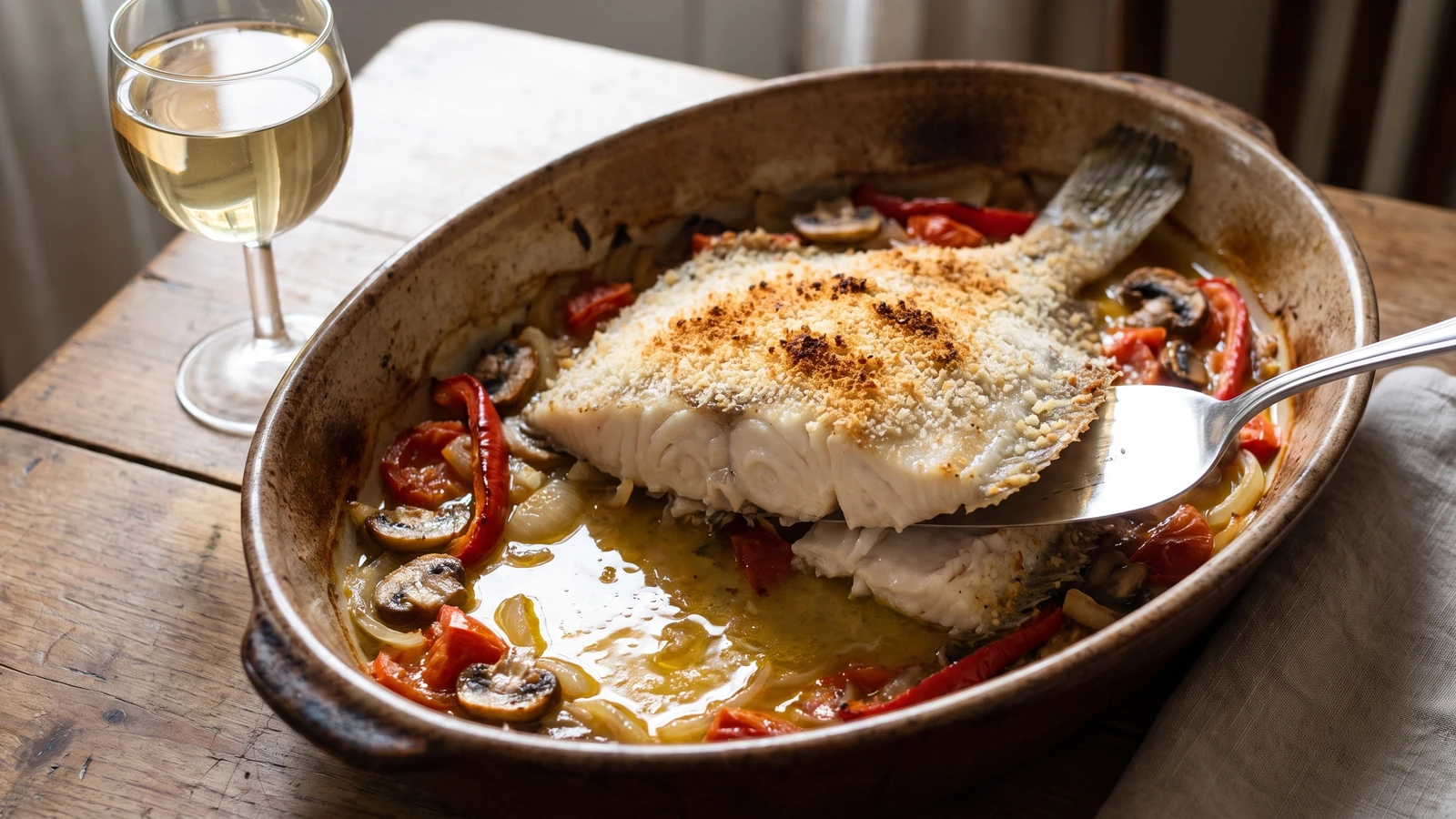
A whole chicken-turbot baked under onions, tomato, mushrooms, and grilled pepper, then finished with its own reduced cooking liquor, glossy with the fish’s natural gelatine and nothing else.
Turbotin à l’Andalouse (small turbot with tomato, mushrooms, and grilled sweet pepper) teaches one true thing: the fish makes its own sauce. Wine and fish fumet, concentrated fish stock, draw gelatine from the skin and bones as the turbot bakes; reduce that liquor afterward and it forms its own liaison, its natural binding. No roux, no cream, no borrowed thickness. The whole fish is the foundation.
The original kitchen assumed fish fumet never far from the fire, a salamander ready to blister the capsicums, and a saucier free to reduce the cooking liquor at precisely the right moment. Your equivalents are good prepared fumet, the broiler, and a small saucepan. The entry already gives the rare sensible home portion, one 2½-pound chicken-turbot for four, so I’ve kept its ratios intact rather than replacing the fish with convenient fillets. The staff and hardware were scaffolding. The whole fish, layered garniture, gentle baking, and final reduction are the dish. One cook, one stove, one evening.
When it is right, the turbot remains pearly and succulent beneath sweet onion, tomato, mushroom, and scarlet pepper, while the reduced liquor gathers around it with a clear buttered gloss. The step that decides everything comes after the baking: lift the fish as soon as it is done, then reduce the liquor without it, so the sauce gains body while the flesh stays tender.
Turbotin à l’Andalouse belongs to the Parisian classical repertoire, where names such as à l’Andalouse identified a garniture inspired by southern Spain, especially tomato and mild capsicum. It is not an Andalusian household preparation transplanted whole: the fish fumet, butter, mushrooms, breadcrumbs, and gelatine-bound reduction speak the grammar of the French grand kitchen. Baked in earthenware rather than presented as a bare poached fish, it carried that formal garnish toward the generous bourgeois table.
Quantity
1 whole, 2½ lb (1.1 kg)
cleaned and fins trimmed
Quantity
1½ teaspoons (7.5 ml / 9 g)
Quantity
½ teaspoon (2.5 ml / 1 g)
Quantity
6 tablespoons (90 ml / 85 g)
divided
Quantity
¾ cup plus 1 tablespoon (190 ml / 190 g)
Quantity
½ cup plus 1½ tablespoons (140 ml / 140 g)
Quantity
2 medium, about 2 cups (475 ml / 300 g)
very finely minced
Quantity
3 medium, about 1½ cups (355 ml / 350 g) prepared
peeled, seeded, pressed dry, and finely minced
Quantity
3 large, about 1½ cups (355 ml / 120 g) sliced
thinly sliced
Quantity
2 large, about 2 cups (475 ml / 300 g) prepared
halved and seeded
Quantity
⅓ cup (80 ml / 25 g)
| Ingredient | Quantity |
|---|---|
| whole chicken-turbotcleaned and fins trimmed | 1 whole, 2½ lb (1.1 kg) |
| fine sea salt | 1½ teaspoons (7.5 ml / 9 g) |
| freshly ground white or black pepper | ½ teaspoon (2.5 ml / 1 g) |
| unsalted butterdivided | 6 tablespoons (90 ml / 85 g) |
| dry white wine | ¾ cup plus 1 tablespoon (190 ml / 190 g) |
| fish fumet | ½ cup plus 1½ tablespoons (140 ml / 140 g) |
| yellow onionsvery finely minced | 2 medium, about 2 cups (475 ml / 300 g) |
| ripe tomatoespeeled, seeded, pressed dry, and finely minced | 3 medium, about 1½ cups (355 ml / 350 g) prepared |
| large white mushroomsthinly sliced | 3 large, about 1½ cups (355 ml / 120 g) sliced |
| mild red capsicumshalved and seeded | 2 large, about 2 cups (475 ml / 300 g) prepared |
| fine fresh white breadcrumbs | ⅓ cup (80 ml / 25 g) |
Set an oven rack about 6 inches (15 cm) below the broiler. Arrange the capsicum halves cut-side down on a rimmed baking sheet and broil until their skins are blistered and blackened in broad patches, 8 to 10 minutes. Cover them in a bowl for 10 minutes, then peel without rinsing and cut the flesh into strips about ⅓ inch (8 mm) wide. Lower the oven to 350°F (180°C).
Dry the turbot thoroughly. On its dark upper side, make one long incision through the skin and flesh along the central backbone, cutting down to the bone without cutting through it; this helps the thick back cook evenly and gives the juices a path into the moistening liquor. Rub a deep 3-quart (2.8 L) earthenware or ceramic baking dish generously with 1 tablespoon of the butter. Lay in the fish white-side down, season it inside and out with the salt and pepper, then pour the white wine and fish fumet around it.
Melt 3 tablespoons of the butter in a wide pan over medium-low heat. Add the minced onions and cook for 8 to 10 minutes, stirring often, until soft and evenly yellow-gold but not browned. Browning would make the garnish heavy and sweet. If small brown patches appear, lower the heat immediately and stir in a tablespoon of water to release them before they scorch.
Spread the yellowed onions evenly over the turbot. Scatter the pressed, minced tomatoes over the onions, then lay on the raw sliced mushrooms without packing them down. Arrange the grilled capsicum strips across the top. Sprinkle moderately with the fresh breadcrumbs, enough to catch the butter and juices without forming a thick crust, then dot with the remaining 2 tablespoons of butter.
Bake uncovered for about 30 minutes. The cooking liquor should tremble quietly at the edges, never boil hard, and the breadcrumbs should become pale gold where the butter catches them. Begin checking after 25 minutes: the flesh beside the backbone is done when it is opaque, separates readily from the bone, and registers 140 to 145°F (60 to 63°C) at the thickest point. If the crumbs colour before the fish is ready, cover the top loosely with foil; if the liquor boils fiercely, lower the oven to 325°F (165°C).
Use two broad spatulas to lift the turbot with its garniture onto a rimmed tray. Tip every drop of cooking liquor from the earthenware dish into a small saucepan and keep the dish warm. Boil the liquor steadily for 4 to 7 minutes, swirling the pan, until its bubbles grow close and glossy and the sauce lightly coats a spoon. The fish’s gelatine is the liaison, so add no flour or cream. If the sauce becomes sticky or too tight, whisk in cold water one teaspoon at a time. If it looks oily, take it off the heat and whisk in one tablespoon of cold water until it gathers again. Ça se rattrape. If it remains thin, it simply needs another minute of reduction.
Slide the fish carefully back into the warm earthenware dish and spoon the reduced liquor around it, leaving the coloured garniture visible. Serve at once, cutting portions from either side of the backbone and giving each plate tomato, mushroom, capsicum, and a generous spoonful of the glossy sauce. À table!
1 serving (about 360g)
Culinary guides, cultural storytelling, and the editorial depth that makes cooking meaningful.
Discover Culinary ExplorerChef Juliette
John Dory has the delicacy of sole and the firmness of turbot. A light flouring, a quick butter sauté, and nut-brown beurre noisette show exactly why looks never mattered.

Chef Juliette
Fresh haddock proves its delicacy in the meunière pan: a fine flour crust, moist pearly flakes, and beurre noisette sharpened with lemon and parsley, ready from one skillet in half an hour.

Chef Juliette
Éperlans à l’Anglaise turns small fish into a lesson in disciplined coating: boned smelts under a close, crisp crumb, pan-fried in clarified butter and finished with bright, half-melted maître d’hôtel butter.

Chef Juliette
Tiny smelts, shallot, mushrooms, white wine, gratin sauce, and fine bread raspings meet a fierce oven, where the fish must turn tender in the same breath the buttered crust bronzes.