
Chef Juliette
John Dory (St. Pierre)
John Dory has the delicacy of sole and the firmness of turbot. A light flouring, a quick butter sauté, and nut-brown beurre noisette show exactly why looks never mattered.
A cooking platform built around craft, culture, and the stories behind what we eat.
Created by Chef Juliette
Based on No. 899, Filets de Soles Rachel, from Le Guide Culinaire (1907) by Auguste Escoffier
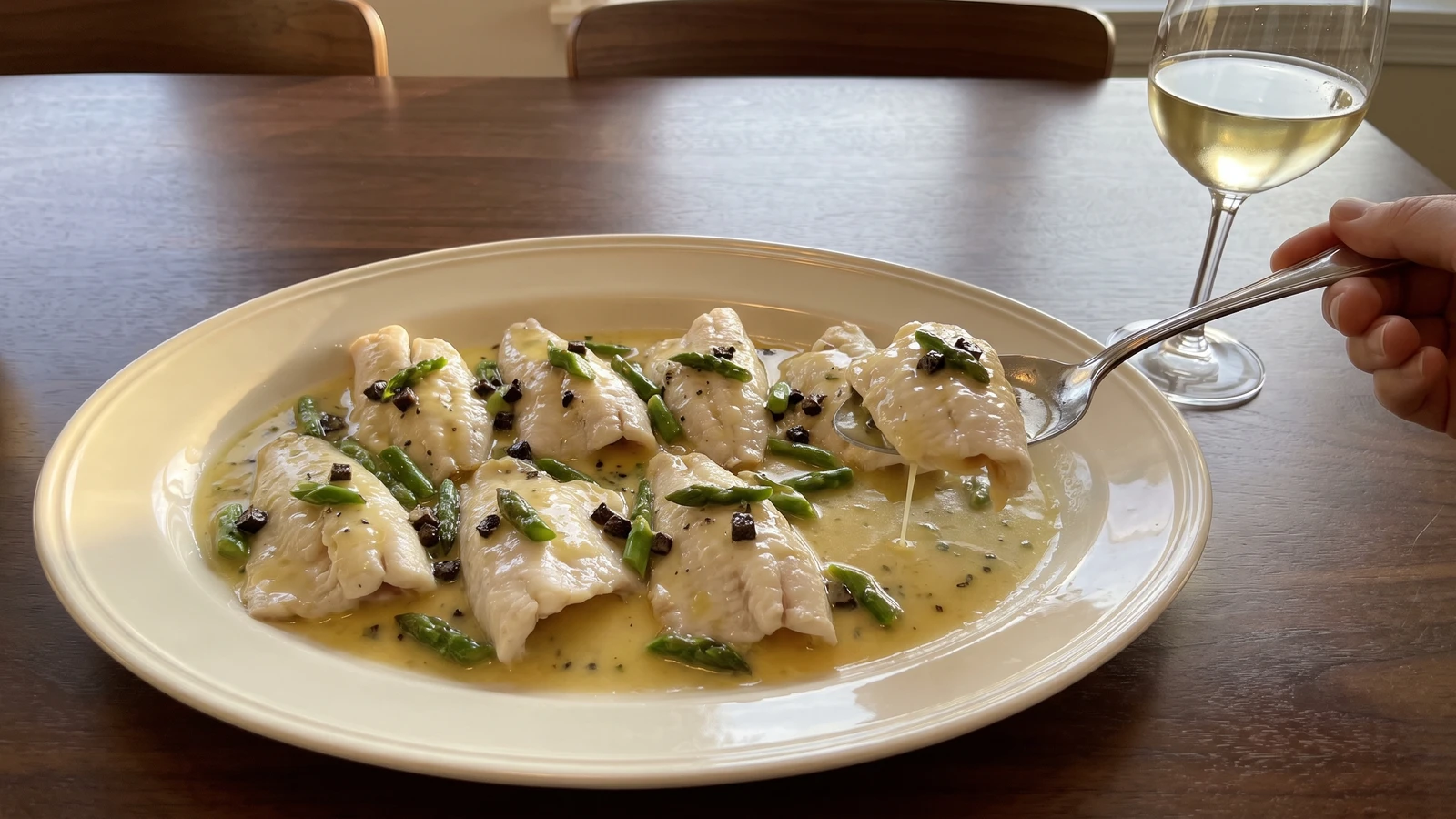
Eight folded sole fillets, each hiding delicate fish forcemeat and four truffle slices, poached at a bare tremble and coated with sauce vin blanc brightened by warm asparagus heads and black truffle.
Filets de Soles Rachel (folded sole with truffle, asparagus, and white-wine sauce) teaches proportion. Its farce mousseline (delicate fish forcemeat) must support the sole without overwhelming it, while the truffle perfumes rather than dominates. The one true thing to know before touching a pan is this: keep the fish, cream, bowl, and blade truly cold, because a warm farce cannot hold its fine emulsion.
The original entry assumed a saucier on staff, a fish stock never off the fire, and ready pots of mushroom cooking liquor, farce, and sauce vin blanc (white-wine sauce). A salamander has no work here, because Rachel is poached and coated, never gratinéed. For the home table, a small processor makes the farce, a saucepan builds a compact fish velouté, and the poaching liquor finishes the sauce. The platter is scaled to eight fillets for four, and only the mushroom liquor needed tonight is made; the brigade's holding pots are scaffolding and can go.
What stays is the dish: four truffle slices on every fillet, the fold, the buttered mushroom-liquor poach, and sauce vin blanc finished with freshly cooked, still-warm asparagus heads and diced truffle in the source's proportion. One cook, one stove, one evening. Keep the farce ice-cold through mixing; that is the step that decides whether Rachel arrives silky or merely elaborate.
Filets de Soles Rachel belongs to the Parisian classical table, not to a regional household repertoire; sole arriving from the Channel coast was distinguished in the capital through its filling, sauce, and named garnish. The Rachel identity is carried here by truffle folded inside the fish and sauce vin blanc containing asparagus heads and more truffle, an exact combination rather than a free garnish. The dish passed naturally into private dining because its luxury is divisible: each fillet can be prepared separately, while the sauce gathers the platter into one composition.
Quantity
8, about 1½ pounds (680 g) total
pin bones removed
Quantity
4 ounces (115 g)
diced
Quantity
1
Quantity
1/3 cup (80 ml / 80 g)
divided, for the farce
Quantity
1¼ teaspoons (6.25 ml / 7 g)
divided
Quantity
1/4 teaspoon (1.25 ml / 0.5 g)
divided
Quantity
1 large, about 1½ ounces (45 g)
trimmed into 32 paper-thin slices with 1¼ tablespoons (19 ml / 13 g) of the remainder finely diced
Quantity
8 ounces (225 g)
thinly sliced
Quantity
3/4 cup (180 ml / 180 g)
Quantity
2 teaspoons (10 ml / 10 g)
Quantity
1 tablespoon (15 ml / 14 g)
Quantity
2 tablespoons (30 ml / 28 g)
cut into small pieces
Quantity
1 cup (240 ml / 240 g)
warmed
Quantity
1/2 cup (120 ml / 120 g)
Quantity
1 tablespoon (15 ml / 14 g)
Quantity
1 tablespoon (15 ml / 8 g)
Quantity
1/2 cup (120 ml / 120 g)
Quantity
2 tablespoons (30 ml / 28 g)
diced
Quantity
8, about 1¼ tablespoons (19 ml / 15 g)
trimmed to 1-inch (2.5 cm) lengths
| Ingredient | Quantity |
|---|---|
| small skinless sole filletspin bones removed | 8, about 1½ pounds (680 g) total |
| very cold skinless whiting or sole, for the farcediced | 4 ounces (115 g) |
| large egg white | 1 |
| heavy cream, very colddivided, for the farce | 1/3 cup (80 ml / 80 g) |
| fine sea saltdivided | 1¼ teaspoons (6.25 ml / 7 g) |
| ground white pepperdivided | 1/4 teaspoon (1.25 ml / 0.5 g) |
| whole black truffle, fresh or preservedtrimmed into 32 paper-thin slices with 1¼ tablespoons (19 ml / 13 g) of the remainder finely diced | 1 large, about 1½ ounces (45 g) |
| white button mushroomsthinly sliced | 8 ounces (225 g) |
| water | 3/4 cup (180 ml / 180 g) |
| fresh lemon juice | 2 teaspoons (10 ml / 10 g) |
| unsalted butter, for the mushroom liquor | 1 tablespoon (15 ml / 14 g) |
| unsalted butter, for poachingcut into small pieces | 2 tablespoons (30 ml / 28 g) |
| unsalted fish stockwarmed | 1 cup (240 ml / 240 g) |
| dry white wine | 1/2 cup (120 ml / 120 g) |
| unsalted butter, for the roux | 1 tablespoon (15 ml / 14 g) |
| all-purpose flour | 1 tablespoon (15 ml / 8 g) |
| heavy cream, for the sauce | 1/2 cup (120 ml / 120 g) |
| cold unsalted butter, for finishingdiced | 2 tablespoons (30 ml / 28 g) |
| slender asparagus headstrimmed to 1-inch (2.5 cm) lengths | 8, about 1¼ tablespoons (19 ml / 15 g) |
Put the mushrooms, water, lemon juice, 1 tablespoon butter, and 1/4 teaspoon of the salt in a small saucepan. Cover, bring just to a simmer, and cook for 8 minutes, until the mushrooms have surrendered their liquor but remain pale. Strain through a fine-mesh sieve without crushing the mushrooms, which would cloud the liquid. Measure 3/4 cup (180 ml); if you are short, add enough water to reach it. Keep the liquor warm and reserve the mushrooms for another meal, because the solids do not belong in Rachel.
Chill the processor bowl and blade for 10 minutes. Pat the whiting or sole dry, then process it with 1/2 teaspoon salt and half the white pepper until the fish becomes smooth and tacky. Add the egg white and process only until absorbed. Reserve 1 tablespoon of the cold cream, then add the rest in a thin stream with the machine running in short pulses. Add the reserved cream last. If the paste turns loose, warm, or glossy with beads of fat, stop immediately and set the bowl over ice for 10 minutes before pulsing in that final spoonful of cream. Ça se rattrape. Continued processing while warm is what breaks it.
Press the farce through a fine-mesh sieve into a cold bowl, scraping firmly with a flexible spatula. This single pass removes sinew and gives the filling its delicate texture; repeated pounding and several sievings were brigade labor, but one careful pass is worth keeping. Cover the surface directly and refrigerate while you build the sauce foundation.
Melt 1 tablespoon butter in a small saucepan over medium-low heat, stir in the flour, and cook this blond roux for 2 minutes without letting it color. Add the warm fish stock gradually, whisking until smooth, then simmer gently for 10 minutes, stirring often, until the fish velouté lightly coats a spoon. If it forms lumps, pass it through the sieve and carry on. Pour the velouté into a bowl. In the same saucepan, boil the white wine until reduced to 3 tablespoons (45 ml), then whisk that reduction into the velouté. Cover and hold it warm off the heat.
Lay the sole fillets former skin-side up and season them lightly with the remaining salt and white pepper. Divide the cold farce among them, spreading it in a thin, even layer and leaving a narrow border. Place exactly four paper-thin truffle slices over the farce on each fillet. Fold the tapered end over the thicker half so each parcel has an even thickness, then arrange the fillets seam-side down in a single layer in a 12-inch (30 cm) lidded sauté pan. If farce presses from the edges, scrape away the excess rather than forcing it back inside. The filling supports the sole; it must not turn the fillet into a stuffed parcel.
Pour the warm mushroom liquor around the fillets, taking care not to wash the farce from their edges, then dot the fish with the 2 tablespoons of poaching butter. Cover and bring the liquor to the barest tremble over medium-low heat. Lower the heat and poach for 7 to 10 minutes, until the sole is opaque, the parcels feel gently resilient, and the center of the farce reaches 145°F (63°C). Never let the liquor boil. If rapid bubbles appear, remove the pan from the burner, uncover it for 30 seconds, then continue over lower heat.
Transfer the fillets carefully to a warmed oval platter and cover loosely. Strain the poaching liquor into the saucepan and boil it down to about 1/3 cup (80 ml). Whisk in the prepared velouté and the 1/2 cup cream, then simmer until the sauce nappes the spoon, coating it in a smooth ivory layer, and measures about 1½ cups (360 ml). Remove the pan from the heat and whisk in the cold butter a few pieces at a time. If the sauce looks greasy, stop adding butter and whisk in 1 teaspoon of cold water until it comes together; if it is too thick, loosen it with a spoonful of fish stock.
While the sauce reduces, blanch the asparagus heads in salted water for 45 to 60 seconds, until bright green and just tender. Drain them thoroughly without cooling them. Fold the freshly cooked, still-warm asparagus and the measured diced truffle into the finished sauce. The ratio is deliberate: 1¼ tablespoons each for 1½ cups of sauce, preserving the source's proportion without turning the garnish into a vegetable ragout.
Arrange the folded fillets in a clean oval, their edges just overlapping. Spoon the sauce vin blanc over them so every fillet is coated and the asparagus and truffle are distributed across the platter. Serve immediately while the sauce remains glossy and the farce tender. À table!
1 serving (about 390g)
Culinary guides, cultural storytelling, and the editorial depth that makes cooking meaningful.
Discover Culinary ExplorerChef Juliette
John Dory has the delicacy of sole and the firmness of turbot. A light flouring, a quick butter sauté, and nut-brown beurre noisette show exactly why looks never mattered.

Chef Juliette
Fresh haddock proves its delicacy in the meunière pan: a fine flour crust, moist pearly flakes, and beurre noisette sharpened with lemon and parsley, ready from one skillet in half an hour.

Chef Juliette
Éperlans à l’Anglaise turns small fish into a lesson in disciplined coating: boned smelts under a close, crisp crumb, pan-fried in clarified butter and finished with bright, half-melted maître d’hôtel butter.

Chef Juliette
Tiny smelts, shallot, mushrooms, white wine, gratin sauce, and fine bread raspings meet a fierce oven, where the fish must turn tender in the same breath the buttered crust bronzes.