
Chef Juliette
John Dory (St. Pierre)
John Dory has the delicacy of sole and the firmness of turbot. A light flouring, a quick butter sauté, and nut-brown beurre noisette show exactly why looks never mattered.
A cooking platform built around craft, culture, and the stories behind what we eat.
Created by Chef Juliette
Based on No. 873, Filets de Soles Chauchat, from Le Guide Culinaire (1907) by Auguste Escoffier
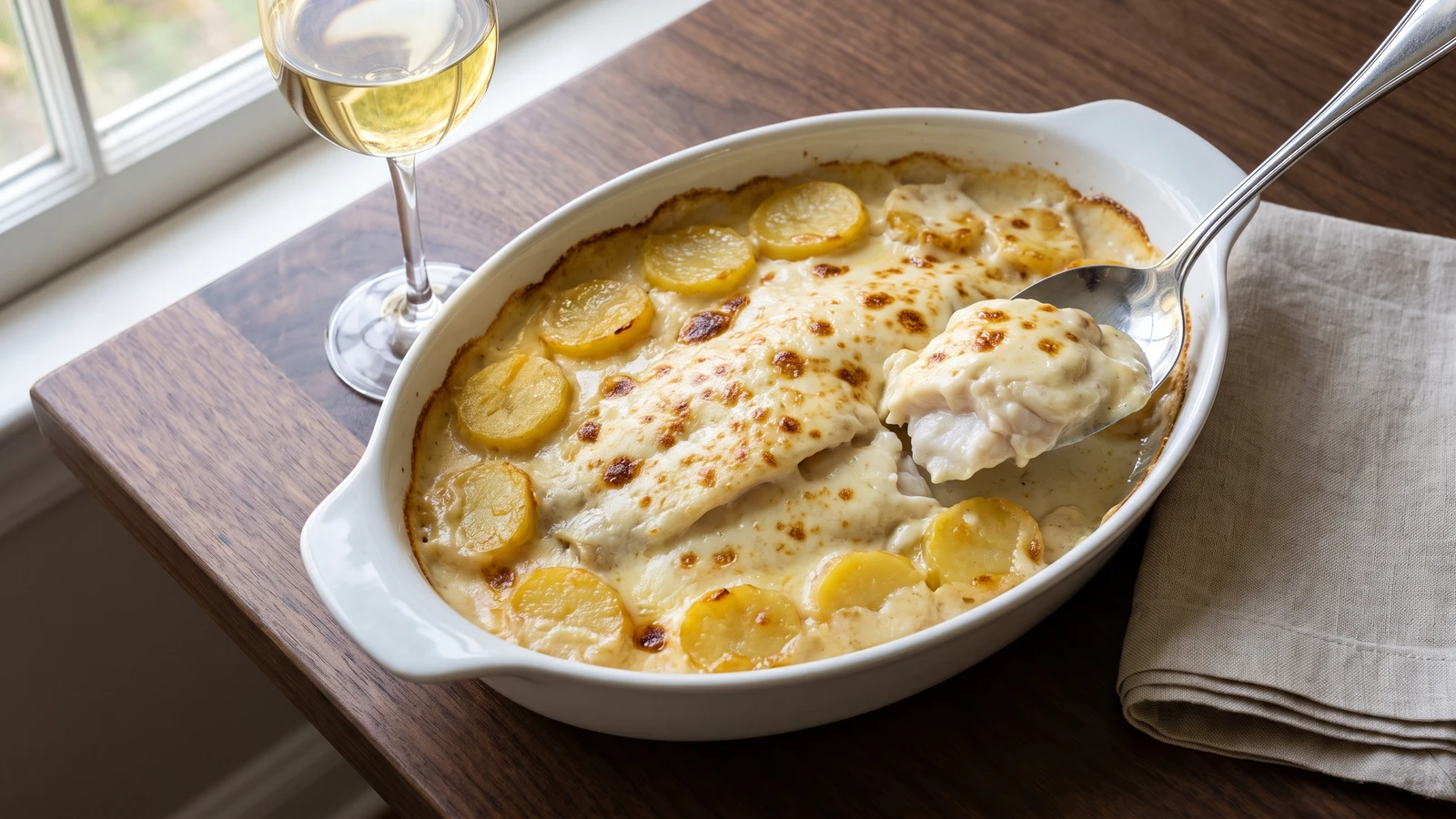
Folded sole in lemon butter, ivory Mornay, and a precise ring of potato roundels, glazed in one fierce burst: the salamander's work translated for one cook and a home broiler.
Filets de Soles Chauchat (folded sole fillets with Mornay and potato roundels) teaches the discipline of a composed gratin: every part must be cooked, hot, and properly drained before the final glaze. The fierce heat is not there to cook raw fish. It bronzes Sauce Mornay, the cheese-enriched béchamel, in the few minutes the delicate sole can afford.
The original entry assumed a saucier on staff with the Mornay waiting, a stock never off the fire, and a salamander already fierce. Your home equivalent is honest and smaller: two cups of finished Sauce Mornay, one shallow covered pan, a modest oval gratin dish, and a broiler preheated as hot as it will go. A round cutter replaces laborious hand-turning for the potato corks. The extra holding pans and separate pairs of hands were brigade scaffolding, so they can go.
What stays is the dish: the lemon-butter poach, the oval of folded fillets, the ring of potato roundels, and the swift Mornay glaze. One cook, one stove, one evening. The final glaze decides everything, so assemble with every component hot, preheat the broiler fully, and don't look away.
Filets de Soles Chauchat belongs to the Parisian grand-kitchen repertoire, whose lists of named sole garnishes allowed cooks to compose distinct dishes from a disciplined family of prepared sauces and garnishes. The fish traveled inland from Channel and Atlantic ports, but the oval arrangement, Sauce Mornay, turned-potato border, and quick salamander glaze belong to the Paris dining room rather than a coastal regional table. Chauchat is one of the canon's proper names, not a French region, and the dish is defined by this exact garnish rather than by an additional seasoning.
Quantity
8 fillets (about 1 lb 7 oz / 640 g total)
pin bones removed
Quantity
3 (about 1 lb 9 oz / 700 g total)
peeled
Quantity
2 cups (475 ml / about 500 g)
hot and pourable
Quantity
6 tablespoons (90 ml / 85 g)
Quantity
3 tablespoons (45 ml / 45 g)
Quantity
2 teaspoons (10 ml / 12 g)
divided
Quantity
1/4 teaspoon (1.25 ml / 0.6 g)
| Ingredient | Quantity |
|---|---|
| skinless sole filletspin bones removed | 8 fillets (about 1 lb 7 oz / 640 g total) |
| large waxy potatoespeeled | 3 (about 1 lb 9 oz / 700 g total) |
| finished Sauce Mornayhot and pourable | 2 cups (475 ml / about 500 g) |
| unsalted butter | 6 tablespoons (90 ml / 85 g) |
| fresh lemon juice | 3 tablespoons (45 ml / 45 g) |
| fine sea saltdivided | 2 teaspoons (10 ml / 12 g) |
| finely ground white pepper | 1/4 teaspoon (1.25 ml / 0.6 g) |
Trim each potato into a neat cork-shaped cylinder about 1 inch (2.5 cm) across, using a round cutter for the cleanest home-kitchen equivalent to hand-turning. Save the trimmings for soup or purée. Put the cylinders in cold water with 1 1/2 teaspoons of the salt, bring them slowly to a simmer, and cook for 12 to 16 minutes, until a knife enters with slight resistance. Drain and let them stand for 3 minutes, then slice crosswise into roundels about 1/4 inch (6 mm) thick. Keep them covered and warm. If a cylinder starts to crumble, stop slicing and let it cool for another few minutes, then cut slightly thicker roundels.
Set an oven rack about 6 inches (15 cm) beneath the broiler and preheat the broiler on its highest setting for at least 10 minutes. Warm the finished Sauce Mornay gently, whisking until it falls from the whisk in a broad, smooth ribbon. If it has tightened, whisk in hot water a teaspoon at a time; if it looks grainy or oily, remove it from the heat and whisk in a tablespoon of cold water until smooth. Ça se rattrape. Keep the sauce hot without letting it boil, and reserve 1/4 cup (60 ml / about 65 g) for the final rescue.
Season the sole with the remaining salt and the white pepper. Fold each fillet in three, tucking the thin tail inside so every parcel has an even thickness. Melt the butter over low heat in a wide shallow pan, stir in the lemon juice, and arrange the folded fillets in one layer. Cover with a round of parchment and a close-fitting lid, then poach at the barest tremble for 5 to 7 minutes. The butter must remain pale and quiet, never frying. Stop when the fish is barely opaque and about 135°F (57°C) at its thickest fold; the broiler will finish it. Lift the fillets carefully and drain them for 30 seconds on a clean towel so their poaching liquid cannot thin the Mornay.
Spread 1/2 cup (120 ml / about 125 g) of the hot Sauce Mornay across the bottom of a broiler-safe oval gratin dish. Arrange the folded fillets over it in an oval, following the curve of the dish, then surround them with overlapping potato roundels. Coat both fish and potatoes with the remaining Mornay, leaving their shapes just visible beneath the sauce. Work promptly. The broiler can glaze a hot assembly without overcooking the sole, but it cannot rescue a cold one.
Set the dish beneath the fierce broiler and glaze for 2 to 4 minutes, rotating once if the heat is uneven. Watch without leaving the stove. It is ready when the Mornay bubbles at the rim, takes butter-gold freckles across the top, and the fish reaches 145°F (63°C). Do not wait for a dark crust. If clear fat beads around the edge, pull the dish immediately, blot the beads with the corner of a clean towel, veil the thin spots with the reserved hot Mornay, and return it to the broiler for no more than 15 seconds.
Let the dish settle for 1 minute, no longer. Carry it to the table in its gratin dish and serve each folded fillet with its share of the glazed potato roundels and sauce. Mornay thickens as it waits and sole forgives no lingering. À table!
1 serving (about 465g)
Culinary guides, cultural storytelling, and the editorial depth that makes cooking meaningful.
Discover Culinary ExplorerChef Juliette
John Dory has the delicacy of sole and the firmness of turbot. A light flouring, a quick butter sauté, and nut-brown beurre noisette show exactly why looks never mattered.

Chef Juliette
Fresh haddock proves its delicacy in the meunière pan: a fine flour crust, moist pearly flakes, and beurre noisette sharpened with lemon and parsley, ready from one skillet in half an hour.

Chef Juliette
Éperlans à l’Anglaise turns small fish into a lesson in disciplined coating: boned smelts under a close, crisp crumb, pan-fried in clarified butter and finished with bright, half-melted maître d’hôtel butter.

Chef Juliette
Tiny smelts, shallot, mushrooms, white wine, gratin sauce, and fine bread raspings meet a fierce oven, where the fish must turn tender in the same breath the buttered crust bronzes.