
Chef Juliette
John Dory (St. Pierre)
John Dory has the delicacy of sole and the firmness of turbot. A light flouring, a quick butter sauté, and nut-brown beurre noisette show exactly why looks never mattered.
A cooking platform built around craft, culture, and the stories behind what we eat.
Created by Chef Juliette
Based on No. 836, Sole Montgolfier, from Le Guide Culinaire (1907) by Auguste Escoffier
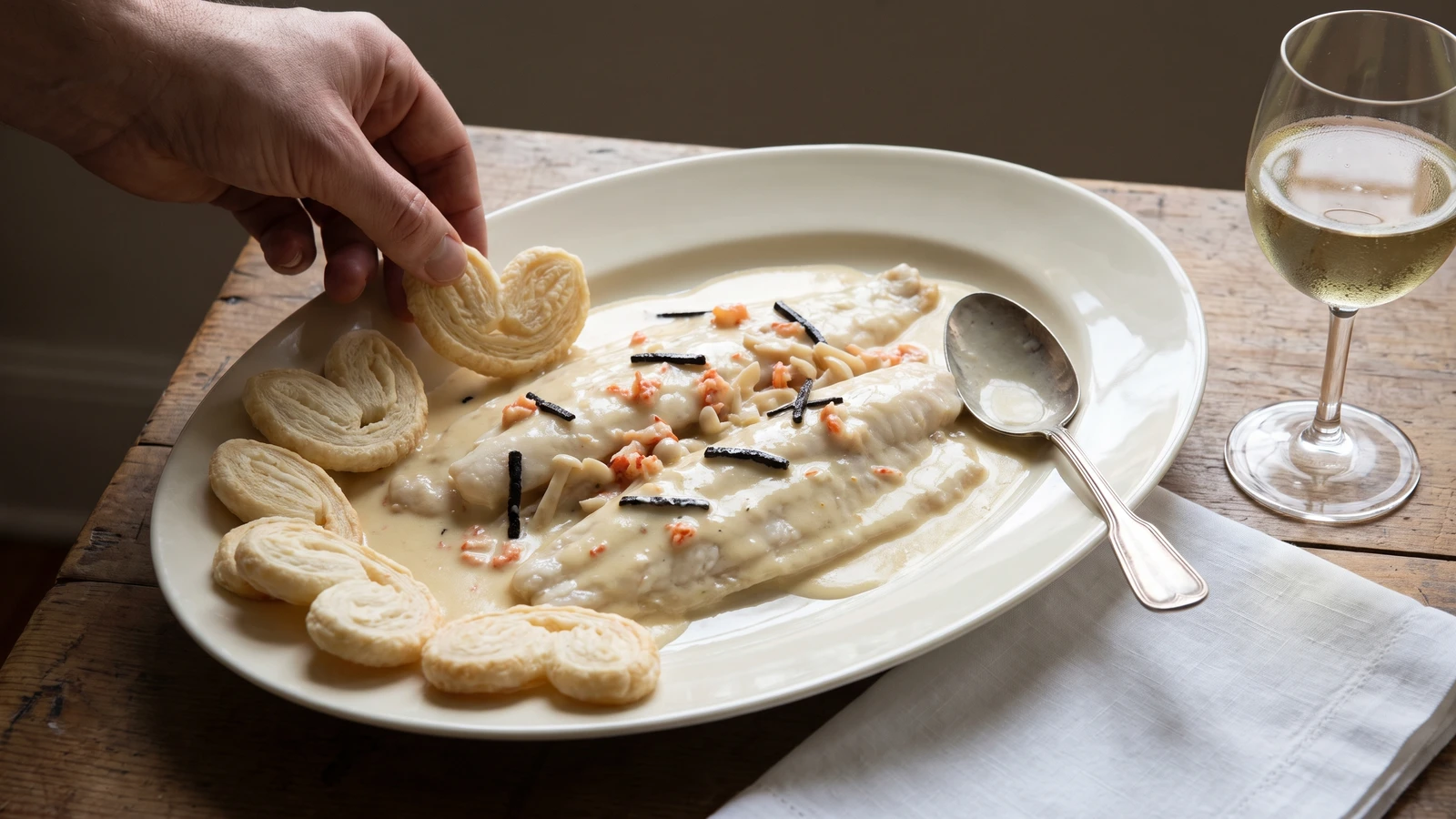
Sole Montgolfier makes timing the luxury: delicate sole, glossy sauce au vin blanc, and a precise julienne of lobster, mushroom, and black truffle, all framed by pale, crisp palmettes.
Sole Montgolfier (white-wine-poached sole with lobster, mushroom, black truffle, and pale puff-pastry palmettes) teaches coordination. The fish is delicate, the sauce is built, and the pastry waits for neither; the luxury lies less in complication than in bringing all three to the platter at their best. One true thing before you touch a pan: the poaching liquid must barely tremble. A boil tightens sole before the sauce is ready.
The original formula assumed a saucier with sauce au vin blanc (white-wine sauce) at hand, mushroom cooking liquor and fish stock never off the fire, a pastry station cutting palmettes, and a service line with a salamander. The salamander has no useful work here because the pastry must remain pale. At home, purchased all-butter puff pastry replaces the pastry station, a small blond roux and good fish stock build only the sauce needed tonight, and one shallow pan supplies the reduced cooking liquor. Four skinless fillets cook evenly in that pan. The brigade scaffolding goes; the equal measure of wine and mushroom liquor, the fine julienne, the pale palmettes, and the coating of sauce stay. One cook, one stove, one evening.
Bake the palmettes first, make the sauce base second, then poach the sole and finish the sauce with its reduced liquor. The sauce can wait a few minutes and can be rescued; the sole cannot be uncooked. The step that decides Sole Montgolfier is the gentle poach, so watch the surface, not the clock.
Sole Montgolfier belongs to the Parisian grand-kitchen repertoire rather than a coastal regional table, where named garnitures allowed the dining room and brigade to recognize a fixed assembly at once. The name invokes the Montgolfier brothers and their balloons, but the dish's culinary identity rests on its prescribed garnish: lobster, mushroom, and black truffle in white-wine sauce, bordered by pale puff-pastry palmettes.
Quantity
1 sheet (8 ounces / 225 g)
thawed but kept cold
Quantity
3 tablespoons (45 ml / 24 g)
divided between dusting and roux
Quantity
5 tablespoons (75 ml / 70 g)
divided
Quantity
1 cup loosely packed (240 ml / 55 g)
cut julienne-fashion into fine matchsticks
Quantity
3/4 cup (180 ml / 180 g)
Quantity
1/2 cup (120 ml / 120 g)
Quantity
3/4 cup (180 ml / 180 g)
Quantity
1/3 cup (80 ml / 80 g)
kept cold, with 1 tablespoon reserved
Quantity
4 fillets (about 1 1/4 pounds / 560 g total)
pin bones removed
Quantity
1 1/2 tablespoons (22 ml / 18 g)
cut julienne-fashion into fine matchsticks
Quantity
1 tablespoon (15 ml / 8 g)
cut julienne-fashion into fine matchsticks
Quantity
1 teaspoon (5 ml / 5 g)
divided
Quantity
1/4 teaspoon (1 ml / 0.5 g)
| Ingredient | Quantity |
|---|---|
| all-butter puff pastrythawed but kept cold | 1 sheet (8 ounces / 225 g) |
| all-purpose flourdivided between dusting and roux | 3 tablespoons (45 ml / 24 g) |
| unsalted butterdivided | 5 tablespoons (75 ml / 70 g) |
| small white button mushroomscut julienne-fashion into fine matchsticks | 1 cup loosely packed (240 ml / 55 g) |
| water | 3/4 cup (180 ml / 180 g) |
| dry white wine | 1/2 cup (120 ml / 120 g) |
| unsalted fish stock | 3/4 cup (180 ml / 180 g) |
| heavy creamkept cold, with 1 tablespoon reserved | 1/3 cup (80 ml / 80 g) |
| skinless Dover sole filletspin bones removed | 4 fillets (about 1 1/4 pounds / 560 g total) |
| cooked spiny lobster tail meatcut julienne-fashion into fine matchsticks | 1 1/2 tablespoons (22 ml / 18 g) |
| very black truffle, fresh or whole preservedcut julienne-fashion into fine matchsticks | 1 tablespoon (15 ml / 8 g) |
| fine sea saltdivided | 1 teaspoon (5 ml / 5 g) |
| ground white pepper | 1/4 teaspoon (1 ml / 0.5 g) |
Heat the oven to 375°F (190°C). Dust the work surface with 1 tablespoon of the flour and roll the cold puff pastry about 1/8 inch (3 mm) thick. Cut 12 palmettes, palm-shaped pieces about 2 1/2 inches (6 cm) long, with a sharp knife. Score a central vein and shallow diagonal ribs without cutting through. Transfer them to a parchment-lined sheet pan and chill for 15 minutes; cold pastry rises in clean layers instead of sagging.
Bake the palmettes until fully risen, dry through the layers, and still pale ivory, 12 to 16 minutes. Judge them by their set sides, not by browning. If the tips begin taking color before the centers are baked, cover them loosely with clean parchment and lower the oven to 325°F (165°C). Catch them while they are pale and ça se rattrape. Cool on a rack and leave the oven on low if they will need a brief warming before service.
Put the mushrooms, water, 1 teaspoon of the butter, and a pinch of salt in a small saucepan. Cover and simmer gently for 8 minutes, just until the mushrooms are tender and have given their flavor to the liquid. Strain without pressing, which would cloud the sauce. Measure exactly 1/2 cup (120 ml) mushroom cooking liquor, reducing it briefly if there is too much or adding a little hot water if there is too little. Reserve 1 1/2 tablespoons of the cooked mushroom julienne for the sauce; keep the remainder for an omelet or soup.
Melt 2 tablespoons of the butter in a small saucepan over gentle heat. Add the remaining 2 tablespoons flour and stir for 2 minutes to make a blond roux, cooking away the raw flour taste without allowing it to color. Whisk in the fish stock a little at a time, letting each addition become smooth before the next. Simmer for 6 to 8 minutes, stirring often, until the velouté coats the back of a spoon. If small lumps remain, pass it through the fine-mesh strainer. Hold it over the lowest heat.
Butter a wide shallow pan with 2 teaspoons of the butter. Season the sole lightly on both sides with salt and white pepper, then arrange the fillets in one layer. Pour in the white wine and the measured 1/2 cup mushroom cooking liquor, keeping their equal proportion. Cover with a buttered parchment round or a close-fitting lid and bring the liquid only to a tremble. Poach for 4 to 6 minutes, until the thickest part is just opaque and separates under gentle pressure. If the liquid begins to boil, pull the pan from the heat for 30 seconds and lower the flame before returning it; ça se rattrape before the flesh tightens. Lift the fillets carefully onto a warm platter and cover loosely.
Strain the sole's cooking liquor into a clean saucepan and boil it briskly until reduced to 1/3 cup (80 ml), about 6 to 9 minutes. Whisk the reduction into the velouté, add all but the reserved tablespoon of cream, and simmer gently until the sauce is glossy and nappant, thick enough to coat the fish without sliding away. Remove it from the heat and whisk in the remaining 2 tablespoons cold butter a little at a time. Fold in the measured lobster, cooked mushroom, and black truffle julienne. Do not boil again. If the sauce is too thick, loosen it with fish stock; if it is thin, reduce it before adding the butter. If the butter separates, whisk the reserved cold cream in a clean warm saucepan, then add the split sauce spoonful by spoonful. Ça se rattrape.
Arrange the sole fillets down the center of a warmed oval platter. Spoon over the sauce so the fish is nappé, coated with a clinging layer, distributing the lobster, mushroom, and truffle julienne across the surface. Surround the sole with the 12 pale palmettes, three for each serving, and take the platter straight to the table. À table!
1 serving (about 270g)
Culinary guides, cultural storytelling, and the editorial depth that makes cooking meaningful.
Discover Culinary ExplorerChef Juliette
John Dory has the delicacy of sole and the firmness of turbot. A light flouring, a quick butter sauté, and nut-brown beurre noisette show exactly why looks never mattered.

Chef Juliette
Fresh haddock proves its delicacy in the meunière pan: a fine flour crust, moist pearly flakes, and beurre noisette sharpened with lemon and parsley, ready from one skillet in half an hour.

Chef Juliette
Éperlans à l’Anglaise turns small fish into a lesson in disciplined coating: boned smelts under a close, crisp crumb, pan-fried in clarified butter and finished with bright, half-melted maître d’hôtel butter.

Chef Juliette
Tiny smelts, shallot, mushrooms, white wine, gratin sauce, and fine bread raspings meet a fierce oven, where the fish must turn tender in the same breath the buttered crust bronzes.