
Chef Juliette
Smelt (Éperlans)
Tiny éperlans, lightly floured and fried until their tails stand crisp, arrive in a generous heap on a napkin with fried parsley and grooved lemon, a weeknight lesson in heat and restraint.
A cooking platform built around craft, culture, and the stories behind what we eat.
Created by Chef Juliette
Based on No. 815a, Ondines aux Crevettes Roses, from Le Guide Culinaire (1907) by Auguste Escoffier
Cold trout mousses cradle pink prawn tails beneath a clear, quivering fish jelly, a lesson in keeping the mousse cold and the aspic barely melted so every surface stays bright.
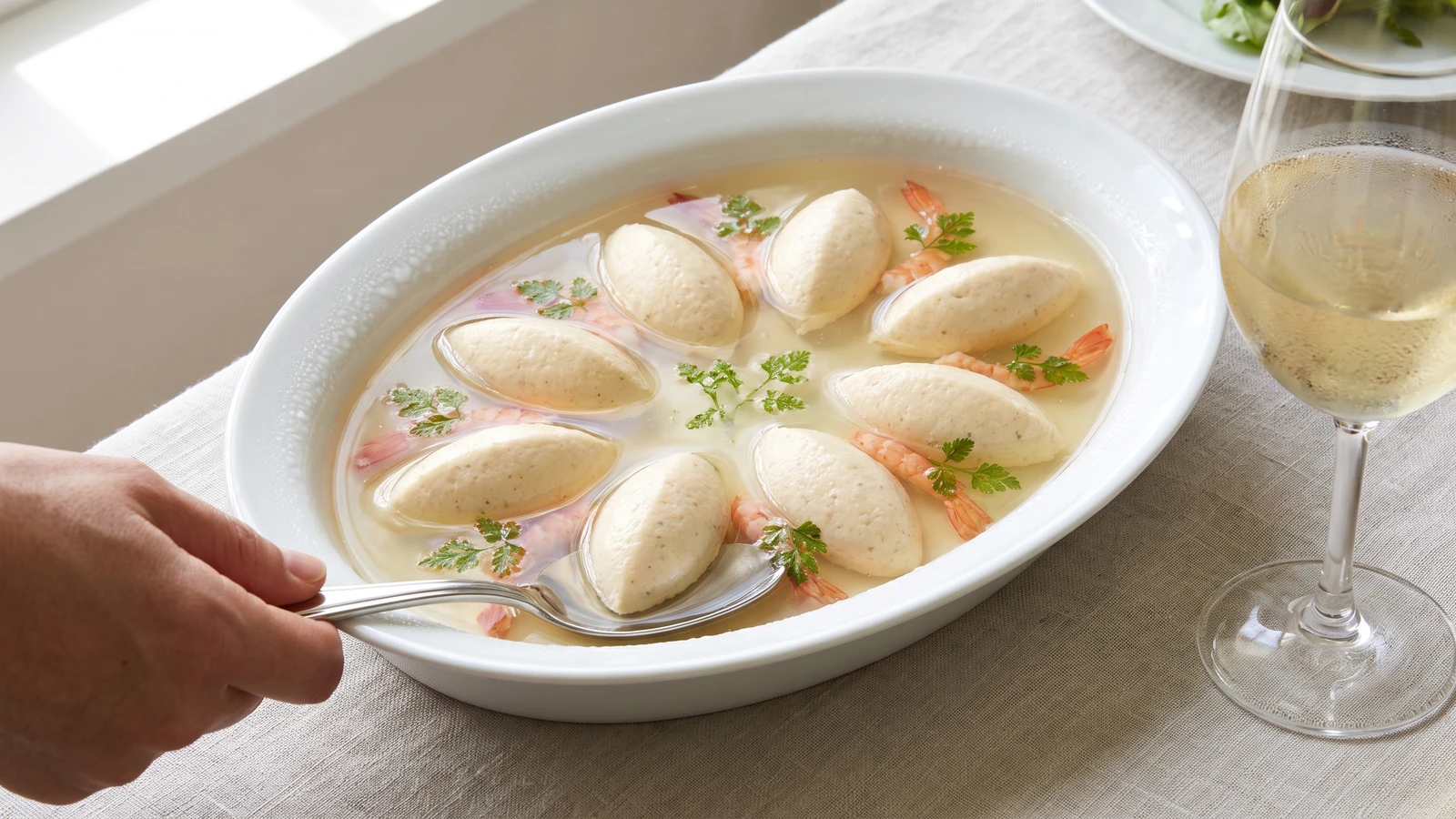
Ondines aux Crevettes Roses (delicate trout mousses with pink prawns in clear jelly) teach one governing lesson: cold controls delicacy. The farce mousseline, a fine trout forcemeat enriched with cream, must stay cold enough to remain smooth, and the aspic must be barely melted when it touches the set mousses. Control those two temperatures and the dish gleams, pale trout and coral prawns held beneath perfectly clear jelly.
The classical kitchen assumed a garde-manger, the cold-kitchen cook, working beside a saucier, excellent jelly waiting from stock that never went cold, a tamis for the trout, and a bank of egg moulds ready for service. At home, a processor followed by a fine sieve replaces the mortar and tamis, while clear fish stock and measured gelatin provide the reliable set that a small household stockpot cannot. The brigade quantity becomes eight ondines for four people. The extra hands are scaffolding and may go; the cold mousse, gentle bain-marie, and gradual coating are the dish and must stay.
The finished dish should be generous rather than fussy: oval mousses in a deep serving dish, pink prawns tucked between them, chervil suspended here and there, and enough clear jelly to cover everything. The step that matters most comes at the end. Spoon the barely fluid jelly over the mousses in stages, anchoring them before you fill the dish; if you flood them at once, they float and their surfaces dull.
Ondines aux Crevettes Roses belongs to the Parisian grand-kitchen repertoire of cold entrées, where fish mousses were shaped in egg moulds and presented beneath clear savory jelly for formal service. The name invokes ondines, water spirits, fitting trout and prawns into the fanciful language of the cold table rather than tying the dish to a particular French region. The jelly is not decoration alone: it protects the delicate mousse from drying and allows the dish to be prepared ahead without surrendering its clean surface.
Quantity
10 ounces (280 g)
cut into small pieces and thoroughly chilled
Quantity
3/4 cup (180 ml / 180 g)
thoroughly chilled
Quantity
1
chilled
Quantity
1 teaspoon (5 ml / 6 g)
Quantity
1/8 teaspoon (0.6 ml / 0.3 g)
Quantity
1 tablespoon (15 ml / 14 g)
softened, for the moulds
Quantity
24 (about 12 ounces / 340 g in their shells)
chilled
Quantity
3 cups (720 ml / 720 g)
well strained and lightly seasoned
Quantity
1/2 cup (120 ml / 120 g)
Quantity
2 tablespoons (30 ml / 18 g)
Quantity
12
| Ingredient | Quantity |
|---|---|
| skinless, pin-boned trout filletcut into small pieces and thoroughly chilled | 10 ounces (280 g) |
| heavy creamthoroughly chilled | 3/4 cup (180 ml / 180 g) |
| large egg whitechilled | 1 |
| fine sea salt | 1 teaspoon (5 ml / 6 g) |
| ground white pepper | 1/8 teaspoon (0.6 ml / 0.3 g) |
| unsalted buttersoftened, for the moulds | 1 tablespoon (15 ml / 14 g) |
| small cooked pink prawnschilled | 24 (about 12 ounces / 340 g in their shells) |
| clear fish stockwell strained and lightly seasoned | 3 cups (720 ml / 720 g) |
| cold water | 1/2 cup (120 ml / 120 g) |
| unflavored powdered gelatin | 2 tablespoons (30 ml / 18 g) |
| small chervil sprigs | 12 |
Chill the processor bowl, blade, mixing bowl, and fine sieve for at least twenty minutes. Butter eight 2-ounce (60 ml) egg moulds lightly and set them in the cold. Peel all the prawns and remove any dark veins. Trim eight tails into neat compact ovals for the centres of the mousses, leaving the remaining sixteen whole to arrange between them. Keep everything cold while you make the jelly.
Sprinkle the gelatin evenly over the cold water and leave it for ten minutes, until every granule is swollen. Warm 1 cup (240 ml) of the fish stock until hot but not boiling, then remove it from the heat and stir in the bloomed gelatin until completely dissolved. Add the remaining cold stock, pass the mixture through damp cheesecloth or a very fine sieve without pressing, and pour it into a shallow container. Chill for about two hours, until fully set. This first setting matters because the jelly will later be barely remelted, giving it the cool, coating consistency the ondines require.
Put the chilled trout, salt, and white pepper in the cold processor and pulse until the fish becomes a smooth, sticky paste. Add the egg white and process only until absorbed. Press the mixture through the chilled fine sieve into the bowl set over ice; this replaces the classical tamis and removes every fibre that would disturb the mousse. Work in the cold cream gradually with a firm spatula, holding back the final tablespoon until you see the texture. The farce mousseline should be glossy, smooth, and thick enough to hold a soft ridge. If it turns loose, shiny, or grainy, it has become warm. Stop immediately, nest the bowl in ice for ten minutes, then work in the reserved cold cream a teaspoon at a time. Ça se rattrape.
Poach a teaspoon of the mousse in barely simmering water for two minutes, cool it briefly, and taste. Cold service mutes seasoning, so correct the salt or white pepper now. Spoon mousse halfway into each buttered mould, pressing it against the sides so no air pockets remain. Place one trimmed prawn tail in the centre of each, then cover with the remaining mousse and smooth the tops. Tap each mould once against a folded towel to settle the mixture without knocking out its lightness.
Heat the oven to 300°F (150°C). Arrange the moulds in a roasting pan, cover them loosely with buttered parchment or foil, and pour hot water into the pan until it reaches halfway up their sides. This bain-marie, a gentle water bath, sets the mousse without toughening its edges. Cook for 14 to 18 minutes, until the centres reach 145°F (63°C) and spring back softly when touched. The water should tremble but never boil. If it begins bubbling, add a little cold water to the pan. Overcooked mousse shrinks and grows coarse; if one surface cracks, chill it and trim the rough edge before turning that side downward in the serving dish.
Lift the moulds from the bain-marie and cool them for fifteen minutes, then cover and chill for at least two hours. To unmould, dip each mould in warm water for two or three seconds, dry the outside, and invert it quickly onto a cold tray. If an ondine clings, don't pry at it. Return the mould to the warm water for another two seconds and try again. Work speedily so the mousse stays firm and its surface remains smooth.
Arrange the ondines in a chilled deep entrée dish, leaving room between them, then place the remaining peeled prawns in the spaces and tuck the chervil sprigs here and there. Spoon the set jelly into a bowl and stand it over barely warm water, stirring gently, until it is only half-melted and flows like unbeaten egg white. The bowl should still feel cool. Spoon a thin layer over each mousse and around its base, then chill the dish for ten minutes to anchor everything. Repeat once before adding the remaining jelly little by little, until the ondines are completely covered. If one begins to float, stop pouring and chill the dish until the base layer firms. If the jelly sets in the bowl, warm it briefly again; if it feels warm, cool it over ice before it touches the mousse.
Chill the completed dish for at least two further hours, or until the jelly quivers cleanly and holds the ondines in place. Keep it covered and cold until serving. Bring the whole dish to the table and serve two ondines to each person with several prawns and a generous spoonful of the clear jelly. Cooking well is not cooking fancy. À table!
1 serving (about 375g)
Culinary guides, cultural storytelling, and the editorial depth that makes cooking meaningful.
Discover Culinary ExplorerChef Juliette
Tiny éperlans, lightly floured and fried until their tails stand crisp, arrive in a generous heap on a napkin with fried parsley and grooved lemon, a weeknight lesson in heat and restraint.

Chef Juliette
Brandade de Morue turns salt cod, warm olive oil, and milk into a pale, silky emulsion: keep everything warm and add the oil slowly, then crown the generous dome with butter-fried bread.

Chef Juliette
Salt cod worked warm with cream, one patient spoonful at a time, until the rough flakes become a glossy Nîmes paste, domed generously and ringed with butter-fried croutons for the table.

Chef Juliette
Wine-poached char packed in its earthenware crock beneath butter gold: a make-ahead first course that turns careful cooling, thorough boning, and one unbroken seal into quiet abundance.