
Chef Juliette
John Dory (St. Pierre)
John Dory has the delicacy of sole and the firmness of turbot. A light flouring, a quick butter sauté, and nut-brown beurre noisette show exactly why looks never mattered.
A cooking platform built around craft, culture, and the stories behind what we eat.
Created by Chef Juliette
Based on No. 790, Darne de Saumon Chambord, from Le Guide Culinaire (1907) by Auguste Escoffier
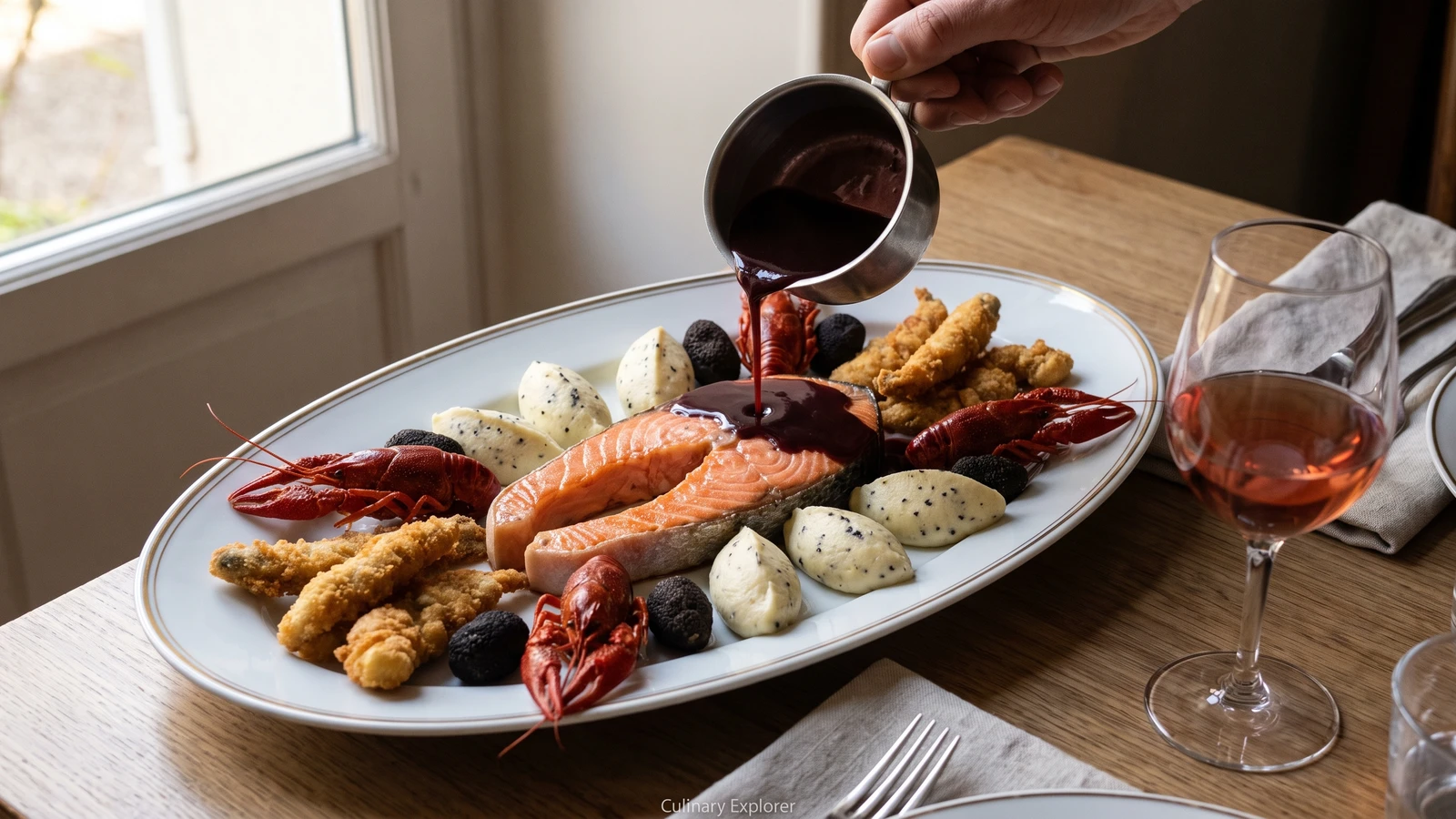
A noble salmon darne learns restraint in red wine: braised gently, glazed from its own liquor, then ringed with truffled quenelles, crisp smelts, crayfish, and the wine-dark gloss of Genevoise sauce.
Darne de saumon Chambord (a middle-cut salmon braised in red wine and dressed with its full classical garnish) teaches one severe, useful lesson: the pan must fit the fish. The wine and fumet should rise only two-thirds up the darne, so the lower flesh braises while the exposed crown takes its glaze. Drown it and you lose that distinction; use a pan too wide and the liquor reduces before the salmon is ready.
The original kitchen assumed a saucier on staff, fish stock never off the fire, a fish kettle with its own drainer, a salamander, and several hands shaping mousseline de poisson, the fine fish forcemeat used for the quenelles. Your equivalents are a just-fitting oval braiser, prepared light fish stock, two broad spatulas, and a brief pass beneath the household broiler. I keep every edible part of the Chambord garnish and scale it for four. The hatelets, ornamental skewers intended for vertical display, go entirely because they are brigade scaffolding, not flavor. One cook, one stove, one evening.
What stays is the dish itself: two parts red wine to one part fumet, a barely trembling braise, sauce Genevoise built from the reduced cooking liquor, truffled quenelles, Villeroy-coated fried garnishes, crayfish, and the last-minute glaze. Before you apply heat, settle the darne in its pan and check the liquid level. That simple fitting decides everything that follows.
Darne de saumon Chambord belongs to the grand-service table of the French classical kitchen. Its name borrows the prestige of Château de Chambord in the Loire, yet the composition is a formal garniture title rather than a household specialty of the region: salmon, truffled quenelles, fried Villeroy-coated fish, crayfish, and truffles arranged around a red-wine Genevoise. As the dish traveled to smaller dining rooms and home tables, hatelets and monumental ornament fell away, while the red-wine braise, generous edible garnish, and separately served sauce remained its identifying practice.
Quantity
1 cut, about 2 lb (900 g), for The Braising of Fish (No. 780)
Quantity
2 teaspoons (10 ml / 12 g)
divided
Quantity
½ teaspoon (2.5 ml / 1 g)
divided
Quantity
2 cups (475 ml / 475 g)
Quantity
1 cup (240 ml / 240 g)
for braising
Quantity
2 tablespoons (30 ml / 28 g)
for the sauce Villeroy
Quantity
3 tablespoons (45 ml / 24 g)
for the sauce Villeroy
Quantity
¾ cup (180 ml / 180 g)
for the sauce Villeroy
Quantity
¼ cup (60 ml / 60 g)
for the sauce Villeroy
Quantity
1
Quantity
1½ cups diced (350 ml / 225 g)
thoroughly chilled
Quantity
1
Quantity
⅔ cup (160 ml / 160 g)
thoroughly chilled
Quantity
2 small, about 1¾ oz (50 g) drained
trimmed into olive shapes with all trimmings reserved
Quantity
¾ cup pieces (180 ml / 120 g)
cut into 8 medallions
Quantity
8, about 8½ oz (240 g)
cleaned and dried
Quantity
½ cup (120 ml / 60 g)
for breading
Quantity
¾ cup (180 ml / 185 g) Anglaise (for Egg-and-bread-crumbing) (No. 174)
chilled
Quantity
1½ cups (355 ml / 90 g)
Quantity
3 cups (710 ml / 650 g)
Quantity
4, about 7 oz (200 g)
cooked in court-bouillon and drained
Quantity
½ cup (120 ml / 120 g)
for warming and sauce adjustments
Quantity
1 tablespoon (15 ml / 14 g)
softened for the beurre manié
Quantity
1 tablespoon (15 ml / 8 g)
for the beurre manié
Quantity
4 tablespoons (60 ml / 57 g)
divided between the Genevoise sauce and glaze
| Ingredient | Quantity |
|---|---|
| middle-cut, bone-in salmon darne | 1 cut, about 2 lb (900 g), for The Braising of Fish (No. 780) |
| fine sea saltdivided | 2 teaspoons (10 ml / 12 g) |
| ground white pepperdivided | ½ teaspoon (2.5 ml / 1 g) |
| dry, light-bodied red wine | 2 cups (475 ml / 475 g) |
| light fish stockfor braising | 1 cup (240 ml / 240 g) |
| unsalted butterfor the sauce Villeroy | 2 tablespoons (30 ml / 28 g) |
| all-purpose flourfor the sauce Villeroy | 3 tablespoons (45 ml / 24 g) |
| light fish stockfor the sauce Villeroy | ¾ cup (180 ml / 180 g) |
| heavy creamfor the sauce Villeroy | ¼ cup (60 ml / 60 g) |
| large egg yolk | 1 |
| skinless firm white fish, such as codthoroughly chilled | 1½ cups diced (350 ml / 225 g) |
| large egg white | 1 |
| heavy creamthoroughly chilled | ⅔ cup (160 ml / 160 g) |
| whole preserved black trufflestrimmed into olive shapes with all trimmings reserved | 2 small, about 1¾ oz (50 g) drained |
| laitance (fish milt), or firm monkfishcut into 8 medallions | ¾ cup pieces (180 ml / 120 g) |
| small whole smeltscleaned and dried | 8, about 8½ oz (240 g) |
| all-purpose flourfor breading | ½ cup (120 ml / 60 g) |
| prepared egg coatingchilled | ¾ cup (180 ml / 185 g) Anglaise (for Egg-and-bread-crumbing) (No. 174) |
| fine fresh breadcrumbs | 1½ cups (355 ml / 90 g) |
| neutral frying oil | 3 cups (710 ml / 650 g) |
| whole crayfishcooked in court-bouillon and drained | 4, about 7 oz (200 g) |
| additional light fish stockfor warming and sauce adjustments | ½ cup (120 ml / 120 g) |
| unsalted buttersoftened for the beurre manié | 1 tablespoon (15 ml / 14 g) |
| all-purpose flourfor the beurre manié | 1 tablespoon (15 ml / 8 g) |
| cold unsalted butterdivided between the Genevoise sauce and glaze | 4 tablespoons (60 ml / 57 g) |
Melt the 2 tablespoons butter in a small heavy saucepan. Whisk in the 3 tablespoons flour and cook gently for 2 minutes without letting the roux color. Add the ¾ cup fish stock in four additions, whisking each one smooth before the next, then add the ¼ cup cream. Simmer, stirring, until sauce Villeroy, the thick fish velouté coating, holds a deep track when the spoon crosses the pan. Take it off the heat, temper the yolk with a spoonful of sauce, then whisk it back in with a pinch each of salt and white pepper. If the sauce is lumpy, pass it through a fine sieve; if it runs from the spoon, return it to gentle heat before adding the yolk and reduce it further. Ça se rattrape. Spread it in a shallow dish, cover its surface, and chill until firm.
Trim the truffles into 8 small olive shapes, then finely chop every trimming. Keep the fish, cream, egg white, and processor bowl very cold. Process the white fish with 1 teaspoon of the salt until tacky, add the egg white, then pour in the cold cream gradually while pulsing. Stop as soon as the mousseline is smooth and holds a soft peak; fold in the chopped truffle. Poach a teaspoonful in water held just below a simmer. If it spreads, chill the mixture for 20 minutes; if it looks grainy, chill it thoroughly and pulse in the final spoonful of reserved cream. Mold 6 small quenelles and 2 larger ones between wet spoons, marking the larger pair with shallow decorative grooves. Poach at about 180°F (82°C), 4 to 5 minutes for the small quenelles and 7 to 8 minutes for the large, until firm and 145°F (63°C) at the center. Drain and cover.
Bring the additional fish stock and an equal amount of water to a bare simmer. Poach the milt or monkfish medallions for 2 minutes, just until their surfaces set, then cool and dry them thoroughly. Leave the small smelts whole. Coat every medallion and smelt with a thin, complete layer of chilled Villeroy sauce and refrigerate for 15 minutes to set it. Roll each piece lightly in the ½ cup flour, dip it into the Anglaise (for Egg-and-bread-crumbing) (No. 174), and coat it in the fine breadcrumbs. Chill on a rack until the last moment. If the coating slips, the fish was wet or the Villeroy too warm; dry the bare patch, rechill the sauce, and coat it again.
Heat the oven to 325°F (165°C). Season the salmon with the remaining salt and a little white pepper, then set it flat in a lidded oval braiser or deep sauté pan that fits it closely. Following The Braising of Fish (No. 780), pour the 2 cups red wine and 1 cup fish stock around the darne in their exact two-to-one proportion. The liquor should reach about two-thirds of the fish's depth and never higher. If it rises too far, remove some wine and stock together in the same proportion and reserve them. A close-fitting pan controls both the liquid level and the speed of reduction.
Bring the liquor just to the boil on the stovetop, spooning it over the exposed crown, then cover the pan with the lid left slightly ajar and transfer it to the oven. Braise gently for 18 to 25 minutes, basting every 6 minutes. The liquor should tremble but never roll; hard boiling tightens the salmon and clouds the sauce. Lift the darne when the thickest flesh reaches about 135°F (57°C), as the final glaze will carry it farther. Transfer it with two broad spatulas to a broiler-safe tray and cover loosely.
Strain the braising liquor into a saucepan, let it stand for 10 minutes, and skim away the fat. Boil it steadily until reduced to about 1¼ cups (300 ml) and the red-wine flavor tastes concentrated but not harsh. Knead the softened tablespoon of butter with the tablespoon of flour to make a beurre manié, then whisk it into the reduction a little at a time and simmer for 2 minutes. Remove the pan from the heat and whisk in 3 tablespoons of the cold butter until the sauce Genevoise is glossy and nappant, meaning it coats the back of a spoon. If it becomes too thick, add warm fish stock by the spoonful. If the butter separates, whisk a tablespoon of cold stock in a clean pan, then add the broken sauce gradually. Ça se rattrape. Mix 2 tablespoons of Genevoise with the final tablespoon of butter, brush it over the salmon, and place it briefly beneath a hot broiler until the surface catches a dark garnet glaze. Watch without turning away. Hold the remaining Genevoise warm, never boiling, for the sauceboat.
Heat the frying oil to 350°F (175°C) in a deep, heavy pan filled no more than one-third full. Fry the breaded milt or monkfish and the smelts in small batches until evenly golden, crisp outside, and cooked through, about 2 to 3 minutes; the fish should reach 145°F (63°C). Drain on a rack and season lightly. Meanwhile, warm the quenelles and court-bouillon-cooked crayfish for 2 to 3 minutes in barely simmering diluted fish stock, then drain them carefully. Do not boil the crayfish or they turn tight.
Set the glazed darne in the center of a warmed oval platter. Place the 2 large ornamented quenelles at its ends, arrange the 6 smaller quenelles along the sides, and interleave the fried milt or monkfish pieces and smelts. Set the 4 crayfish at the quarters and tuck the olive-shaped truffles between the garnishes. Bring the Genevoise sauce separately in a warm sauceboat, as the original service requires. The hatelets have gone, but nothing edible has been surrendered. À table!
1 serving (about 580g)
Culinary guides, cultural storytelling, and the editorial depth that makes cooking meaningful.
Discover Culinary ExplorerChef Juliette
John Dory has the delicacy of sole and the firmness of turbot. A light flouring, a quick butter sauté, and nut-brown beurre noisette show exactly why looks never mattered.

Chef Juliette
Fresh haddock proves its delicacy in the meunière pan: a fine flour crust, moist pearly flakes, and beurre noisette sharpened with lemon and parsley, ready from one skillet in half an hour.

Chef Juliette
Éperlans à l’Anglaise turns small fish into a lesson in disciplined coating: boned smelts under a close, crisp crumb, pan-fried in clarified butter and finished with bright, half-melted maître d’hôtel butter.

Chef Juliette
Tiny smelts, shallot, mushrooms, white wine, gratin sauce, and fine bread raspings meet a fierce oven, where the fish must turn tender in the same breath the buttered crust bronzes.