Chef Juliette
Bouillabaisse à la Marseillaise
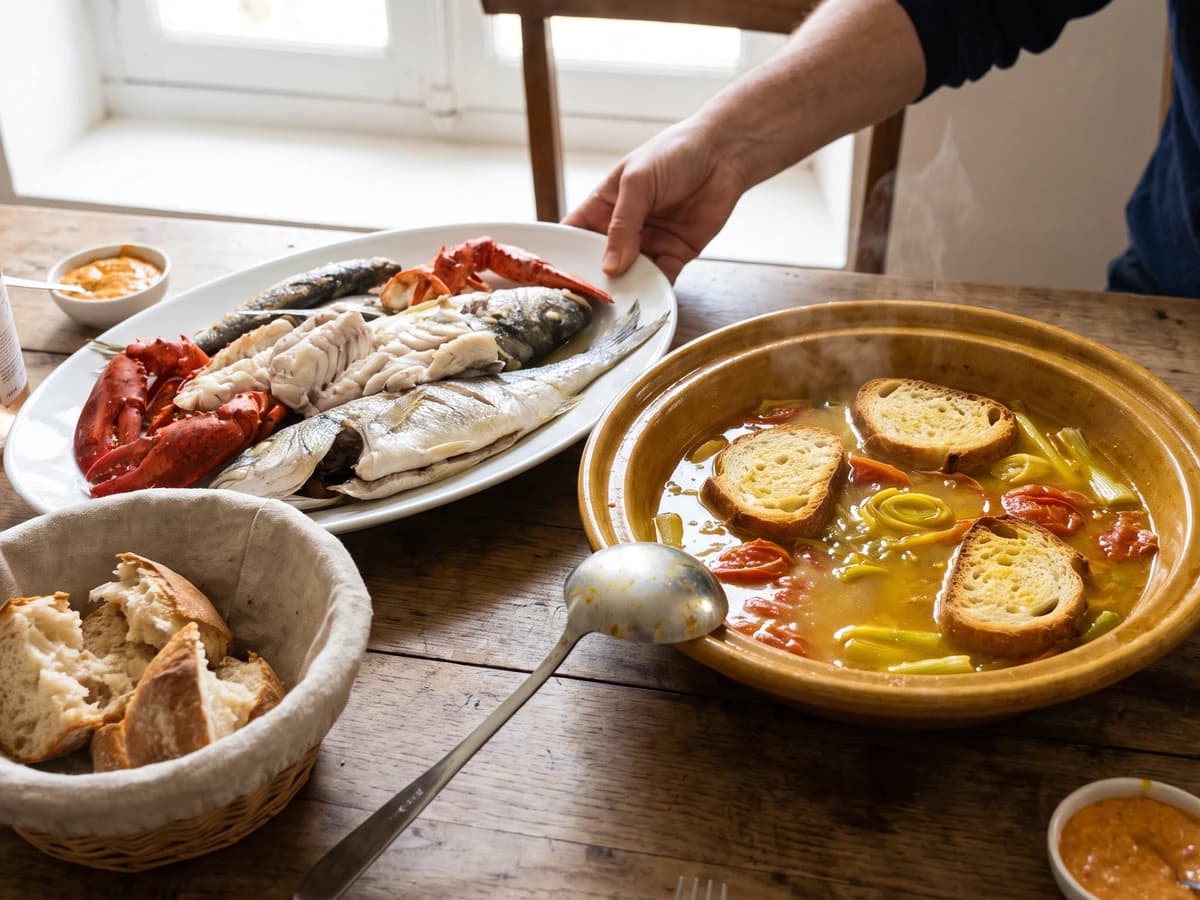
Marseille's great fish stew, saffron-gold and garlic-scented, proves that a hard boil can be the careful choice: it binds olive oil into broth before the whole pot meets bread.
A cooking platform built around craft, culture, and the stories behind what we eat.

Created by Chef Juliette
Based on No. 701, Crème de Cerfeuil Bulbeux, otherwise Chevreuse, from Le Guide Culinaire (1907) by Auguste Escoffier
A rare root, slowly butter-stewed and passed to silk, becomes an ivory Chevreuse enriched with Béchamel, white consommé, cream, chicken, and black truffle julienne for the first course.
Crème de Cerfeuil Bulbeux, ou Chevreuse (cream of tuberous-root chervil), teaches the quiet discipline behind every pale cream soup: coax out flavor without taking color. The root has the sweetness of chestnut and a faint herbal perfume. Brown it and you exchange that delicacy for roast flavor, pleasant enough, but no longer Chevreuse.
The original entry assumed a saucier, prepared Béchamel, white consommé never far from the fire, a tammy cloth, and enough hands to cut separate chicken and truffle juliennes. At home, a heavy saucepan does the saucier's work, while a blender followed by a fine-mesh sieve replaces the tammy. I have retained the source ratio of one pound of root to one and one-quarter imperial pints of Béchamel, then measured the sufficient consommé as a practical range because each batch of roots carries a different amount of starch. The separate sauce and garnish stations are brigade scaffolding and can go. The butter stew, slow cooking in Béchamel, sieving, and last-minute cream finish are the dish, so they stay.
Finished properly, Chevreuse is ivory and satin-smooth, fluid enough to leave the ladle in one broad ribbon, with fine threads of chicken and black truffle appearing through the pale soup. Before the roots meet the pan, settle the heat low and keep it there. They must soften in butter without acquiring even a brown edge.
Crème de Cerfeuil Bulbeux, also called Chevreuse, belongs to the Parisian classical service repertoire, supplied by the market gardens of Île-de-France and shaped into a formal cream soup through Béchamel, consommé, and careful sieving. The service name points toward Chevreuse and its valley southwest of Paris, but the preparation is not a rustic valley pot; its chicken and truffle julienne mark it as a soup for a finely set table. The title uses cerfeuil bulbeux, while French markets more often label the root cerfeuil tubéreux; neither means the familiar leafy chervil herb.
Quantity
about 3 cups (710 ml / 454 g)
peeled and evenly minced
Quantity
1/4 cup (60 ml / 57 g)
Quantity
3 cups (710 ml / about 735 g)
warmed
Quantity
2 1/2 to 3 cups (600 to 710 ml / 600 to 710 g)
warmed
Quantity
3/4 cup (180 ml / 180 g)
kept cold
Quantity
1 tablespoon (15 ml / 12 g)
cut into a very fine julienne
Quantity
1 tablespoon (15 ml / 10 g)
cut into a very fine julienne
Quantity
up to 1 teaspoon (5 ml / 6 g)
only if needed
| Ingredient | Quantity |
|---|---|
| tuberous-root chervilpeeled and evenly minced | about 3 cups (710 ml / 454 g) |
| unsalted butter | 1/4 cup (60 ml / 57 g) |
| prepared Béchamelwarmed | 3 cups (710 ml / about 735 g) |
| prepared white consomméwarmed | 2 1/2 to 3 cups (600 to 710 ml / 600 to 710 g) |
| heavy creamkept cold | 3/4 cup (180 ml / 180 g) |
| cooked chicken breastcut into a very fine julienne | 1 tablespoon (15 ml / 12 g) |
| black truffle, fresh or good preserved whole trufflecut into a very fine julienne | 1 tablespoon (15 ml / 10 g) |
| fine salt (optional)only if needed | up to 1 teaspoon (5 ml / 6 g) |
Peel the tuberous chervil thinly, trim away any woody ends, and mince the roots into even pieces about 1/4 inch (6 mm) across. Uniform pieces soften together, which matters when the soup must pass perfectly smooth. Cut the cooked chicken and truffle en julienne, into very fine matchstick rods, measure one tablespoon of each, cover them, and hold them for serving.
Melt the butter over low heat in a heavy 3 to 4-quart saucepan. Add the minced roots and turn them until every piece gleams with butter, then cover and étuver, meaning stew gently in their own moisture and butter, for 12 to 15 minutes. Stir every few minutes. The roots should soften around the edges but remain entirely pale. If the butter begins to brown, lift the roots into a clean saucepan immediately and leave the browned solids behind; add a small spoonful of pale butter if the pan looks dry. A little color can be contained, but don't scrape it into the soup.
Fold the warm Béchamel into the buttered roots and bring the mixture only to the faintest tremble. Cook uncovered over very low heat for 25 to 35 minutes, stirring across the bottom and into the corners often, until a root piece crushes to a smooth paste between two fingers. The flour and milk in Béchamel make scorching the chief danger. If the bottom catches, stop stirring, pour the unburned soup into a clean saucepan, and leave the stuck layer untouched. The clean upper portion is entirely recoverable.
Blend the root and Béchamel mixture until completely smooth. With a countertop blender, work in batches, fill the jar no more than halfway, vent the lid, and begin at low speed before increasing it. Press the purée through a fine-mesh sieve with a flexible spatula, leaving only dry fibers behind. This replaces the classical tammy without abandoning its purpose. If the purée remains gritty, the roots were not tender enough; return it to low heat with 1/2 cup of the measured white consommé for 10 minutes, then blend and sieve again.
Return the sieved purée to the clean saucepan and whisk in 2 1/2 cups of the warm white consommé gradually. Heat gently for 5 minutes, then judge the body: Chevreuse should coat a spoon with a thin satin film and pour in an unbroken ribbon, never sit like mashed roots. If it is too thick, add the remaining consommé a few tablespoons at a time. If it is thin, let it reduce at a bare simmer before the cream goes in. Ça se rattrape. Taste and add salt only if the Béchamel and consommé have not already supplied enough.
Warm the soupière or individual soup bowls. Take the saucepan completely off the heat and whisk in all but 2 tablespoons of the cold cream, then add the reserved cream once the surface is smooth. If oily beads appear because the pan was too hot, wait one minute and whisk the reserved cold cream in vigorously until the soup returns to a satin finish. Never boil it after the cream is added. Place the chicken and truffle juliennes in the warmed vessel, pour the Chevreuse over them, and serve at once. À table!
1 serving (about 245g)
Culinary guides, cultural storytelling, and the editorial depth that makes cooking meaningful.
Discover Culinary ExplorerChef Juliette
Marseille's great fish stew, saffron-gold and garlic-scented, proves that a hard boil can be the careful choice: it binds olive oil into broth before the whole pot meets bread.
Chef Juliette
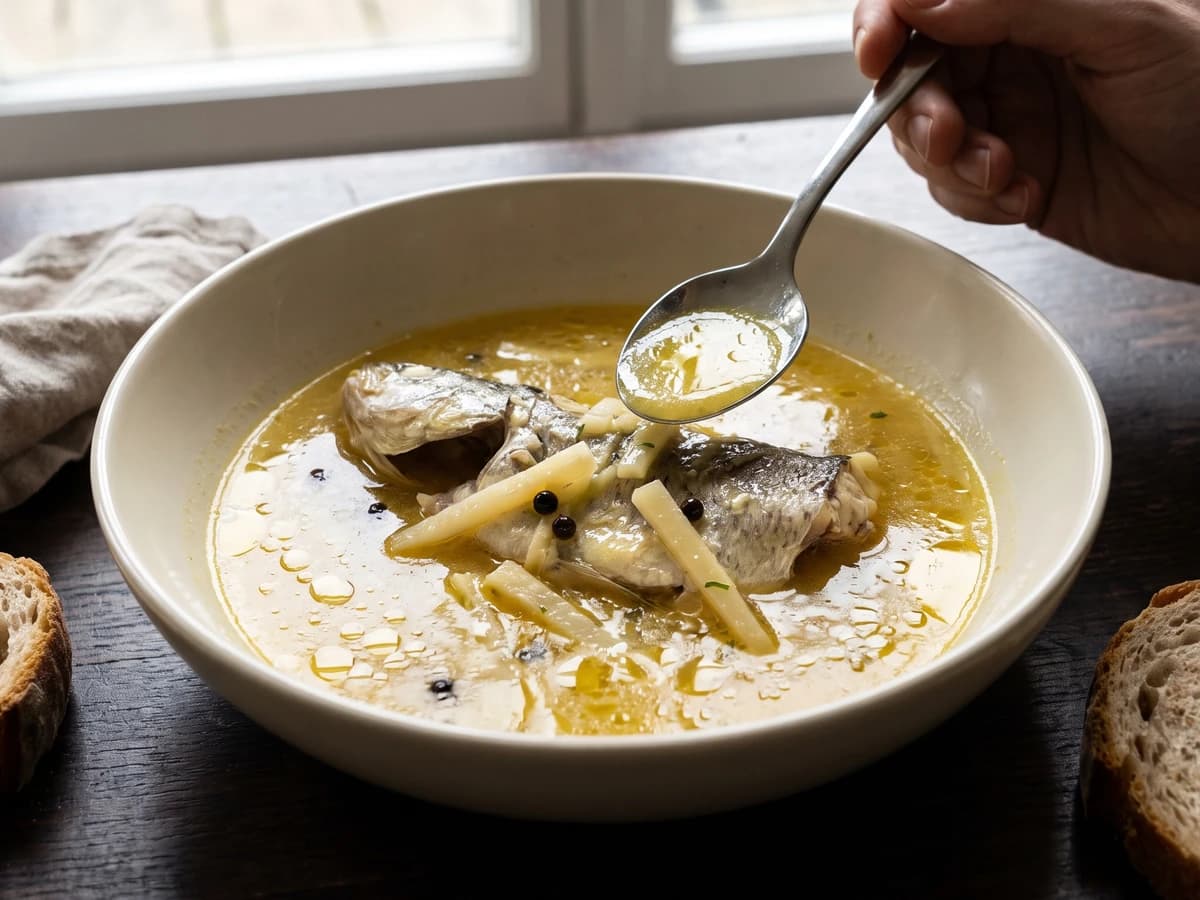
Waterzoi asks fresh, bone-in river fish to thicken its own buttery broth, with parsley root and pepper for company. No flour, no stockpot, just a brisk simmer watched closely.
Chef Juliette
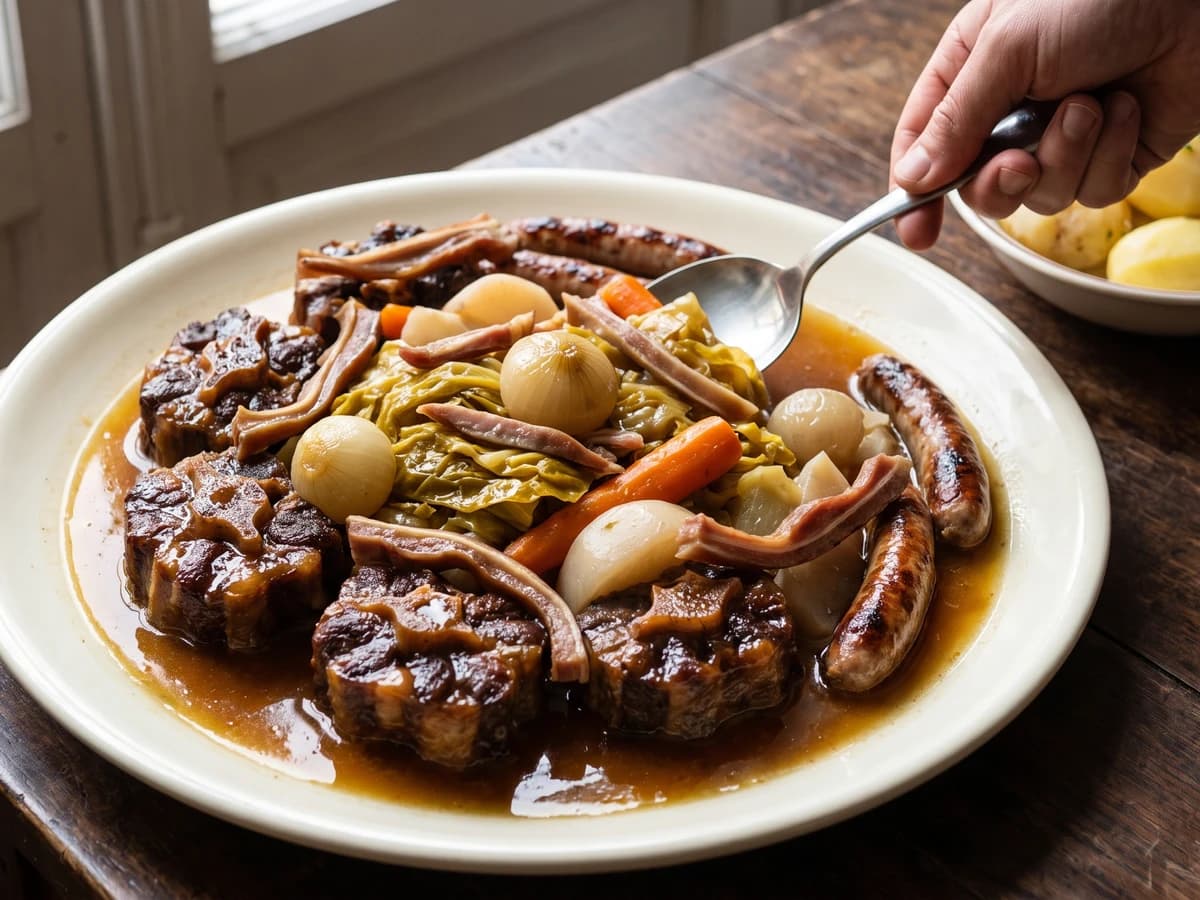
Queue de Bœuf en Hochepot gathers oxtail, pig's trotter and ear, cabbage, roots, and grilled chipolatas around a clear, gelatin-rich broth whose quiet simmer keeps every piece tender and distinct.
Chef Juliette
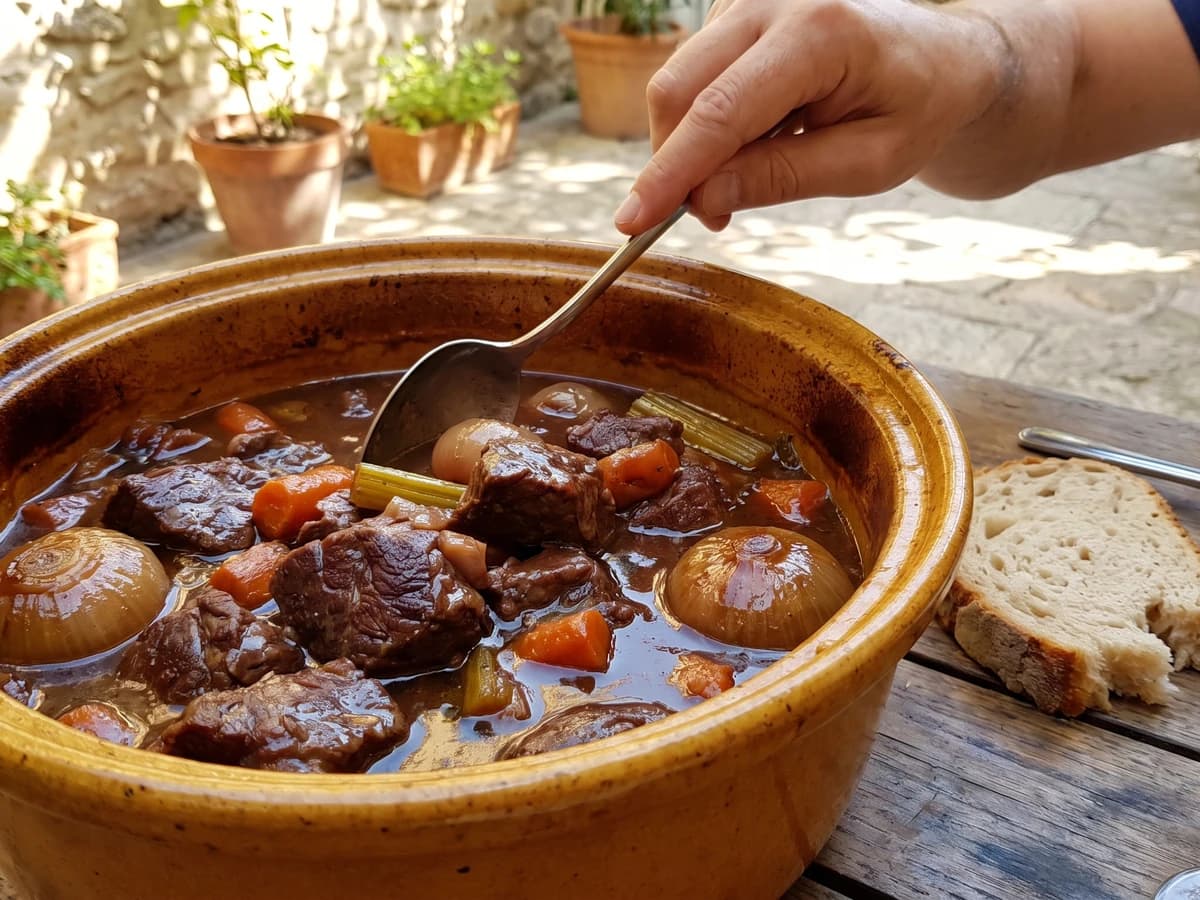
Beef shoulder larded with bacon, sharpened by red wine and vinegar, then sealed with garlic, vegetables, and dry lemon peel until the low oven turns it yielding and the gravy darkly glossy.