Culinary Explorer

A cooking platform built around craft, culture, and the stories behind what we eat.
Discover Culinary Explorer
Velouté aux Huîtres

Velouté aux Huîtres

Created by Chef Juliette

Based on No. 690, Velouté aux Huîtres, from Le Guide Culinaire (1907) by Auguste Escoffier

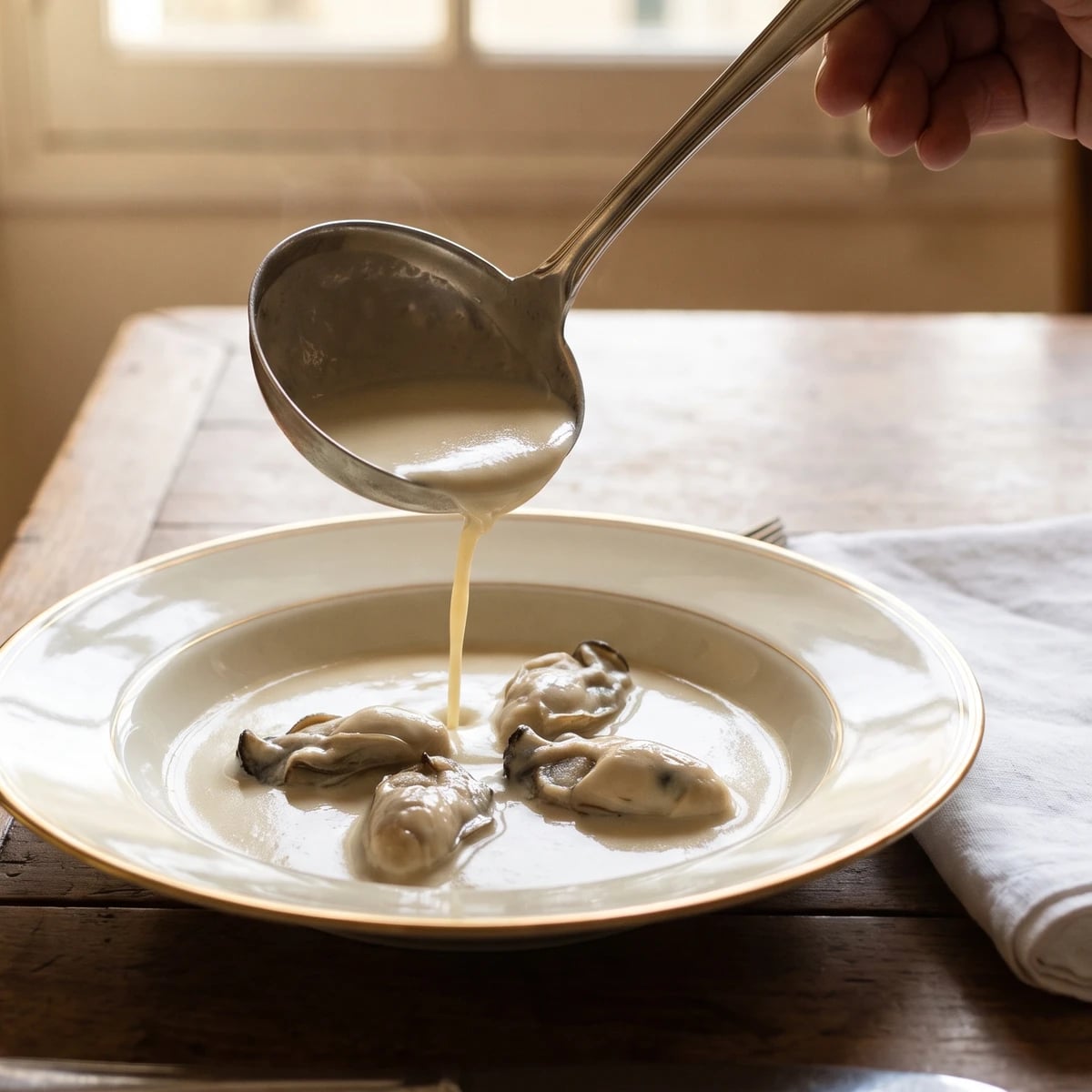
Velouté aux Huîtres turns a delicate fish base into an ivory, oyster-bright first course, enriched at the last moment with yolks, cream, and butter, with four tender oysters waiting in every bowl.

Soups & Stews
French
Dinner Party
Special Occasion
30 min
Active Time
15 min cook45 min total
YieldAbout 1¼ quarts, 6 first-course servings

Velouté aux Huîtres teaches one true thing before you touch a pan: speed here means readiness, never high heat. The soup should reach the table ivory-pale and satin-glossed, carrying the clean salinity of oyster liquor, with four plump oysters in every bowl. Its liaison (a yolk-and-cream binding) gives silk without heaviness, provided you finish and serve it without delay.

The original assumed a saucier on staff, a very delicate fish velouté already hot from a stockpot never off the fire, and six bowls able to leave together. At home, the honest equivalent is a prepared base reheated in one saucepan, the liaison whisked before the oysters open, and your guests already seated. The one-quart base and twenty-four oysters already make a civil home batch, so I have kept them intact. Keeping several pots alive is brigade scaffolding and can go; the strained liquor, four barely poached oysters per bowl, liaison, and final butter are the dish, and they stay. One cook, one stove, one evening.

Once the oyster liquor enters, the velouté must never wait on a hot burner. Temper the liaison slowly and never let the finished soup boil. That is the step that decides the bowl.

Velouté aux Huîtres belongs to the classical Parisian dining room, supplied by the oyster beds of Normandy and Brittany but organized through the sauce families of the grand urban kitchen. It is a velouté, not a bisque: its body comes from delicate fish velouté and a liaison of yolks and cream, while the oyster liquor supplies marine depth without browned shells or forceful spices. The four-oyster garnish is not decoration but substance, preserving the oyster as a tender mouthful rather than dissolving it into the soup.

The technique, the tradition, and the story behind every dish.

Discover Culinary Explorer

Ingredients

prepared very delicate fish velouté

Quantity

4 cups (960 ml / about 960 g)

medium live oysters in the shell

Quantity

24 oysters

well scrubbed; liquor reserved and strained after shucking

large egg yolks

Quantity

3 egg yolks

heavy cream

Quantity

½ cup (120 ml / 120 g)

chilled

cold unsalted butter

Quantity

4 tablespoons (60 ml / 56 g)

cut into small pieces

Equipment Needed

  • Oyster knife and cut-resistant glove
  • Fine-mesh sieve and damp cheesecloth
  • Heavy 2-quart saucepan
  • Small nonreactive saucepan
  • Whisk
  • Instant-read thermometer
  • Six shallow soup bowls

Instructions

  1. 1

    Arrange the service

    Warm six shallow soup bowls with hot water, then set out the ladle, sieve, and whisk. Reserve 1 tablespoon (15 ml / 15 g) of the measured cream in the cold as insurance. Whisk the remaining cream with the egg yolks until completely smooth, then keep the liaison chilled. Cut the butter and return it to the cold. The speed this velouté asks for comes from having everything ready before the pan is hot.

    Seat your guests before you temper the liaison. The finished velouté cannot wait politely while everyone finds the table.
  2. 2

    Shuck and strain

    Set a fine-mesh sieve lined with damp cheesecloth over a bowl. Wearing a cut-resistant glove or holding each oyster in a folded towel, shuck the oysters over the sieve so every drop of liquor is collected without shell grit. Slide the meats into a separate chilled bowl, trim away their coarse frilled beards, and keep them covered over ice without submerging them. Discard any oyster with a broken shell, one that remained open after a firm tap before shucking, or one that smells sour after opening.

  3. 3

    Heat the velouté

    Put the prepared fish velouté in a heavy 2-quart saucepan and bring it gradually to a bare simmer over medium-low heat, whisking often. It should flow in a broad ribbon and lightly coat the back of a spoon, never sit like paste. If a skin or small lumps have formed during reheating, pass it through the fine sieve into a clean pan. Ça se rattrape. Hold it only at the faintest tremble while the oysters poach.

  4. 4

    Poach the oysters

    Pour the strained oyster liquor into a small nonreactive saucepan and bring it just to a quiver. If the liquor is too shallow to bathe the oysters, add one ladleful of the hot velouté, never water. Add the oysters in two batches and poach them gently, turning once, until they plump, their edges begin to curl, and their centres reach 145°F (63°C), about 45 to 90 seconds depending on size. Lift them immediately into a warm covered bowl. Pour the poaching liquor through the sieve into the velouté, bring it back to a bare simmer once, then lower the heat. Boiling makes oysters small, firm, and cross, and no sauce can flatter them afterward.

  5. 5

    Temper the liaison

    Whisk about 1 cup (240 ml / about 240 g) of the hot velouté into the cold liaison in a thin, steady stream. Pour the tempered liaison back into the saucepan while whisking, then stir continuously over the gentlest heat until the soup becomes slightly fuller and reaches about 165°F (74°C). Do not let a bubble break the surface. If tiny curds appear, pull the pan off the heat at once, whisk in the reserved cold cream, and strain the soup into a clean warm pan. Ça se rattrape, provided you catch it before a boil.

  6. 6

    Mount with butter

    Take the pan completely off the heat. Whisk in the cold butter a few pieces at a time, letting each addition disappear before adding the next, until the velouté has a quiet satin gloss. If yellow beads begin floating on the surface, stop adding butter and whisk in a teaspoon of cold water before continuing off the heat. Taste only now; the oyster liquor usually supplies all the salt the soup needs. We don't apologize for butter, but we do make it behave.

  7. 7

    Fill and serve

    Drain and dry the warm bowls. Place exactly four poached oysters in each, then ladle the finished velouté over them and carry the bowls straight to the table. Do not return the soup to the burner, cover it for later, or allow it to boil. Standing turns its clean oyster flavour heavy and its silken liaison coarse. À table!

Chef Tips

  • The fish velouté must be genuinely delicate. A pale base made from lean white-fish bones lets the oysters speak; salmon, mackerel, or an aggressively reduced commercial stock will bury them.
  • Ask the fishmonger for medium oysters rather than enormous specimens. You need twenty-four tender mouthfuls, four per bowl, and every drop of their liquor. If the oysters are shucked for you, insist that the liquor be packed with them and use them the same day.
  • Season only after the strained oyster liquor has entered. Its salinity varies from oyster bed to oyster bed, and a velouté that tasted restrained beforehand may need no salt at all afterward.
  • Serve small first-course portions. A dry Muscadet Sèvre-et-Maine has the clean edge for the oysters, while the yolks, cream, and butter provide all the richness the bowl requires.
  • For guests at heightened risk from shellfish, use commercially post-harvest-treated oysters and cook them until firm and fully opaque. The texture will be less delicate, but safety takes precedence.

Advance Preparation

  • Prepare the delicate fish velouté up to one day ahead, cool it promptly, and keep it covered in the cold. Reheat it gently and strain if a skin has formed.
  • The oysters may be shucked up to one hour before service. Keep the meats and strained liquor in separate covered containers over ice, never submerged in melting water.
  • The liaison can be whisked thirty minutes ahead and kept cold. Do not add it, the oyster liquor, or the butter until your guests are seated; the finished velouté is not a make-ahead soup.

Frequently Asked Questions

Nutrition Information

1 serving (about 200g)

Calories
300 calories
Total Fat
26 g
Saturated Fat
15 g
Trans Fat
1 g
Unsaturated Fat
10 g
Cholesterol
155 mg
Sodium
380 mg
Total Carbohydrates
9 g
Dietary Fiber
0 g
Sugars
1 g
Protein
7 g

Note: Chef personas and recipes are created with AI assistance. Cook with care: follow safe food-handling practices, check doneness with a thermometer when needed, and adapt for allergies and your kitchen.

Where cooking meets culture.

Culinary guides, cultural storytelling, and the editorial depth that makes cooking meaningful.

Discover Culinary Explorer

More from Soups - Thick Soups

Browse the full collection