Culinary Explorer

A cooking platform built around craft, culture, and the stories behind what we eat.
Discover Culinary Explorer
Velouté d’Éperlans Joinville

Velouté d’Éperlans Joinville

Created by Chef Juliette

Based on No. 681, Velouté d’Éperlans Joinville, from Le Guide Culinaire (1907) by Auguste Escoffier

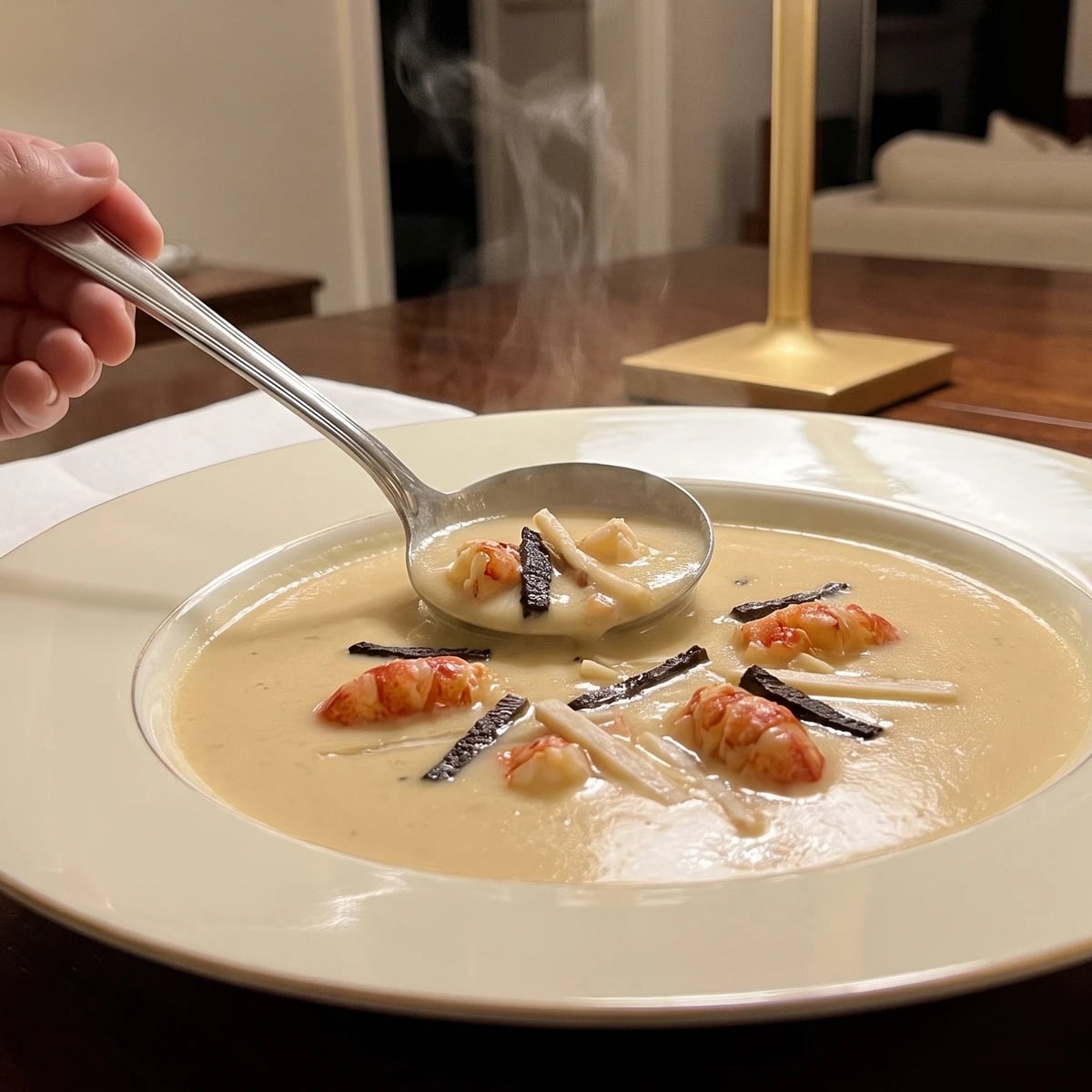
A silken smelt velouté enriched at the last moment with shrimp butter, crayfish, truffle, and mushroom: a lesson in keeping fish flavor precise, luxurious, and never loud.

Soups & Stews
French
Dinner Party
Special Occasion
15 min
Active Time
10 min cook25 min total
YieldAbout 2 quarts (8 first-course servings)

Velouté d’Éperlans Joinville (smelt velouté finished with shrimp butter, crayfish, truffle, and mushroom) teaches restraint before richness. The one true thing to know is that smelt must remain no more than one-third of the fish in the underlying Velouté d’Éperlans (No. 680). Its character is forceful. The mild fish in the base gives that character room to speak without letting it shout.

The original formula assumed a saucier at his station, a stockpot never cold, the smelt base already passed through a tammy, and shrimp butter waiting beside the stove. Here the brigade scaffolding goes: no station handoffs, no prolonged holding, and no professional sieve. A finished batch of the referenced base, a fine-mesh sieve, a whisk, and an instant-read thermometer give one cook the same control. This version makes about two quarts, enough for eight first-course bowls, while keeping the book’s sequence and proportions intact. One cook, one stove, one evening.

What must stay is the last-minute finish. The liaison, the egg-yolk-and-cream binding, may thicken over gentle heat but must never boil, and the shrimp butter goes in only after the pan leaves the fire. Guard that one moment and the velouté arrives ivory-soft, faintly coral, and generous with crayfish and truffle.

Velouté d’Éperlans Joinville belongs to the Parisian classical repertory, where the name Joinville signals a formal shellfish finish of crayfish, truffle, mushrooms, and crustacean butter rather than a regional smelt soup from the town of Joinville. It brings an assertive, humble fish into grand-kitchen grammar by tempering it with neutral white fish in the underlying velouté, then placing the luxury at service rather than overloading the base. From formal dining rooms it passed naturally to the bourgeois special-occasion table, where a small tureen can still announce company without requiring a brigade.

The technique, the tradition, and the story behind every dish.

Discover Culinary Explorer

Ingredients

Velouté d’Éperlans

Quantity

7 cups (1.65 L / about 1.7 kg) Velouté d’Éperlans (No. 680)

freshly made and hot

large egg yolks

Quantity

4 (1/4 cup / about 72 g)

heavy cream

Quantity

1 cup (240 ml / 240 g)

divided and kept cold

shrimp butter

Quantity

3 tablespoons (45 ml / 42 g)

chilled and cut into small pieces

cooked crayfish tails

Quantity

6 (about 1/3 cup / 55 g)

each cut into four pieces

preserved black truffle

Quantity

1 1/2 teaspoons (7.5 ml / 4 g)

cut into short julienne

cooked button mushroom caps

Quantity

1 1/2 teaspoons (7.5 ml / 6 g)

cut into short julienne

fine salt

Quantity

as needed

cold water (optional)

Quantity

1 tablespoon (15 ml / 15 g)

for rescuing the emulsion

Equipment Needed

  • 4-quart heavy-bottomed saucepan
  • Large heatproof mixing bowl
  • Balloon whisk
  • Fine-mesh sieve
  • Instant-read thermometer
  • Warmed soup tureen or 8 shallow soup plates

Instructions

  1. 1

    Ready the hot base

    Have the Velouté d’Éperlans (No. 680) freshly finished and hot in a heavy 4-quart saucepan. Keep it over the lowest heat, with only an occasional movement at the surface. Do not let it reduce or wait on the stove while the table is being arranged. Fish veloutés lose their clean flavor when held, so everything that follows should be ready before the liaison begins.

    Warm the soup plates or tureen with hot water, then dry them. The velouté must not return to high heat merely because a cold vessel stole its warmth.
  2. 2

    Cut the garnish

    Cut each crayfish tail crosswise into four neat pieces. Cut the truffle and mushroom caps en julienne, into short match-shaped rods, and combine them. Keep the garnish covered at room temperature while you finish the soup. It needs to lose its chill, not cook again.

  3. 3

    Temper the liaison

    Reserve 2 tablespoons of the cold cream. Whisk the yolks with the remaining cream in a large heatproof bowl until completely smooth. Ladle in about 1 cup of the hot Velouté d’Éperlans (No. 680) in a thin stream, whisking without pause, then slowly whisk this tempered liaison back into the saucepan. Stir over very low heat until the soup lightly coats a spoon and reaches about 170°F (77°C). Never let it simmer. If tiny grains appear, lift the pan from the heat immediately and whisk in the reserved cold cream. Pass the soup through a fine-mesh sieve into a clean pan. Ça se rattrape.

    The thermometer replaces the saucier’s practiced hand. Once the yolks enter, gentle heat is discipline, not timidity.
  4. 4

    Mount the shrimp butter

    Take the saucepan completely off the heat. Monter au beurre, whisk in the shrimp butter off the fire, adding one cold piece at a time and letting each disappear before the next. The velouté should become glossy, faintly coral, and slightly fuller on the spoon. If beads of fat collect at the surface, the soup was too hot. Whisk in the optional cold water a teaspoon at a time until the emulsion closes again. Do not return it to a boil.

  5. 5

    Garnish and serve

    Fold in the crayfish pieces and the short julienne of truffle and mushroom. Cover the pan off the heat for 1 minute, just long enough for the garnish to warm through without toughening the crayfish or surrendering the truffle’s perfume. Taste and correct the salt only if needed. Ladle immediately into the warmed tureen or soup plates, distributing the garnish generously. À table!

Chef Tips

  • When preparing the Velouté d’Éperlans (No. 680), hold firmly to its proportion of no more than one part smelt to two parts neutral white fish. More smelt does not make a finer soup. It makes an oily, aggressive one.
  • Shrimp butter means real butter carrying the concentrated flavor and coral color of crustacean shells. Paprika-tinted butter and shrimp paste cannot perform the same work. Prepare or obtain the proper butter before beginning the last-minute finish.
  • A sound preserved black truffle is the classical pantry’s honest answer when fresh truffle is unavailable. Drain it well and cut it with a knife. Truffle oil floods the velouté and obscures the crayfish, so it has no place here.
  • Serve modest first-course portions. The soup is silken but rich, and six ounces per guest is ample before a dinner. A mineral Chablis or a dry Champagne carries the shellfish and cream without making the table heavy.
  • This velouté dislikes reheating. If leftovers are unavoidable, chill them promptly and keep them for no more than one day. Reheat over the gentlest heat while stirring constantly, stopping well before a simmer.

Advance Preparation

  • The shrimp butter may be prepared up to 3 days ahead and kept tightly covered in the cold. Cut it into small pieces only when beginning the soup.
  • The crayfish may be cooked and shelled, and the truffle and mushroom garnish cut, up to 4 hours ahead. Cover and chill them, then bring them toward room temperature before finishing.
  • The Velouté d’Éperlans (No. 680) is not a make-ahead base. Prepare it when the guests and garnish are nearly ready, then complete the Joinville finish immediately. The combined fish-velouté work should move briskly and should not be held beyond about 30 minutes.

Frequently Asked Questions

Nutrition Information

1 serving (about 265g)

Calories
345 calories
Total Fat
27 g
Saturated Fat
16 g
Trans Fat
1 g
Unsaturated Fat
10 g
Cholesterol
205 mg
Sodium
680 mg
Total Carbohydrates
11 g
Dietary Fiber
1 g
Sugars
2 g
Protein
14 g

Note: Chef personas and recipes are created with AI assistance. Cook with care: follow safe food-handling practices, check doneness with a thermometer when needed, and adapt for allergies and your kitchen.

Where cooking meets culture.

Culinary guides, cultural storytelling, and the editorial depth that makes cooking meaningful.

Discover Culinary Explorer

More from Soups - Thick Soups

Browse the full collection