Chef Juliette
Bouillabaisse à la Marseillaise
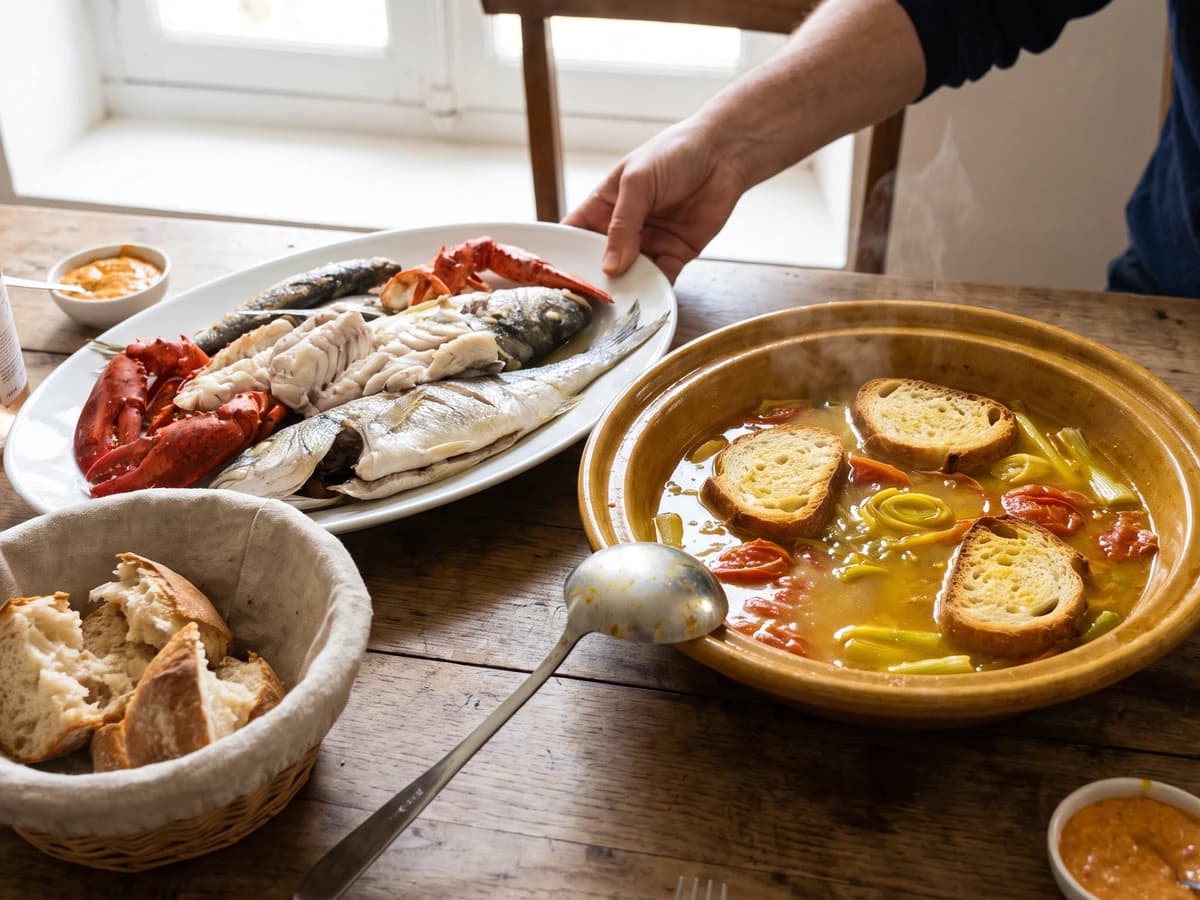
Marseille's great fish stew, saffron-gold and garlic-scented, proves that a hard boil can be the careful choice: it binds olive oil into broth before the whole pot meets bread.
A cooking platform built around craft, culture, and the stories behind what we eat.
Created by Chef Juliette
Based on No. 633, Purée de Choux de Bruxelles, otherwise Flamande, from Le Guide Culinaire (1907) by Auguste Escoffier
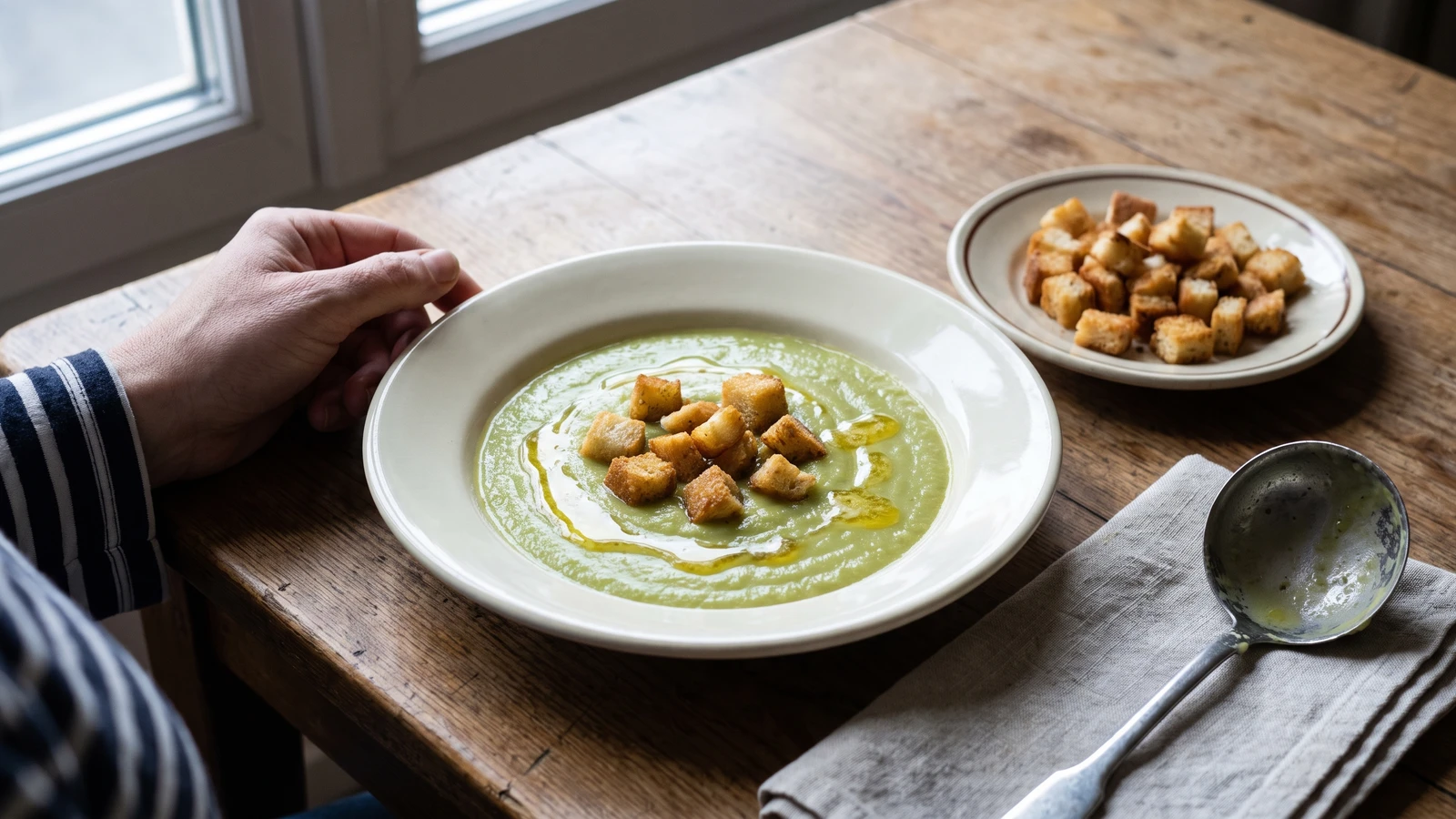
A pale-green Flamande purée built on fresh Brussels sprouts, butter, white consommé, and potato, passed smooth and milk-finished, with crisp bread dice for the necessary bite.
Purée de Choux de Bruxelles, dite Flamande (Brussels sprout purée, Flemish style) teaches the discipline behind every green vegetable purée: freshness first, gentle heat second, machinery last. The one true thing to know before touching the pan is that no sieve can restore a tired sprout. Begin with compact, bright heads, parboil them briefly, and the finished soup will be silken, pale green, and sweet with butter rather than loud with cabbage.
The original assumes a stock never off the fire, a saucier on staff, a tammy for passing the vegetables, and another hand free to skim the pot. At home, prepared white chicken consommé, a food mill or brief immersion blending, and a fine-mesh sieve do the same honest work. Its one-pound formula already finishes at a sensible home scale, about two quarts, so the proportions remain intact; only the milk, finishing butter, and bread garnish have been measured where the entry trusted the saucier's hand. One cook, one stove, one evening.
A dedicated skimmer is brigade scaffolding; skimming the soup clean is not. The brief parboil, the butter stew, the potato liaison, and the milk finish are the dish itself, and all four stay. Guard that first cooking closely, because bright sprouts can be cooked tender later, but olive sprouts never turn green again.
Purée de Choux de Bruxelles à la Flamande belongs to the northern edge of the French classical repertoire, looking toward Brussels and Flanders, where the sprout became an everyday market vegetable. In this formula, Flamande is a classical kitchen name rather than proof that every Flemish household served the identical pot: the grand kitchen took the region's sprout and gave it a butter stew, potato liaison, white consommé, and milk. For all its place among cream soups, it contains no cream and no roux; the potatoes supply its body.
Quantity
4 cups (454 g / 1 lb)
trimmed, with large sprouts halved
Quantity
6 tablespoons (90 ml / 85 g / 3 oz)
Quantity
2⅓ cups (560 ml / 560 g)
prepared to full strength
Quantity
2 medium (about 2 cups / 340 g)
peeled and quartered
Quantity
2½ to 3 cups (600 to 720 ml / 620 to 745 g)
Quantity
2 cups (120 g / 4¼ oz)
crusts removed and cut into ⅓-inch (8 mm) dice
Quantity
3 tablespoons (45 ml / 42 g)
Quantity
2 tablespoons (30 ml / 28 g)
cut into small cubes
Quantity
½ to 1 teaspoon (2.5 to 5 ml / 3 to 6 g)
as needed
| Ingredient | Quantity |
|---|---|
| very fresh Brussels sproutstrimmed, with large sprouts halved | 4 cups (454 g / 1 lb) |
| unsalted butter for stewing | 6 tablespoons (90 ml / 85 g / 3 oz) |
| white chicken consomméprepared to full strength | 2⅓ cups (560 ml / 560 g) |
| medium Yukon Gold potatoespeeled and quartered | 2 medium (about 2 cups / 340 g) |
| whole milk | 2½ to 3 cups (600 to 720 ml / 620 to 745 g) |
| day-old white breadcrusts removed and cut into ⅓-inch (8 mm) dice | 2 cups (120 g / 4¼ oz) |
| unsalted butter for frying the bread dice | 3 tablespoons (45 ml / 42 g) |
| chilled unsalted butter for finishingcut into small cubes | 2 tablespoons (30 ml / 28 g) |
| fine sea saltas needed | ½ to 1 teaspoon (2.5 to 5 ml / 3 to 6 g) |
Pull away every yellowed or loose outer leaf, trim only the dry end of each stalk, and halve any sprout much larger than a walnut. Peel and quarter the potatoes, keeping the pieces close in size so they finish together. This purée has nowhere to hide a tired vegetable; the sprouts should be compact, bright green, and clean-smelling.
Bring a large saucepan of water to a vigorous boil. Add the sprouts and parboil for 4 minutes, just until their green brightens and the outer leaves begin to soften while the cores remain firm. Drain immediately and spread them out in the colander so their heat can escape. Do not leave them sitting in hot water; that is how a fresh green purée becomes olive and cabbagy.
Wipe the saucepan dry and melt the 6 tablespoons of butter over low heat. Return the drained sprouts, cover, and stew them gently for 8 minutes, turning twice so every surface meets the butter. They should soften without taking colour. If the butter begins to brown, lift the pan from the heat and add a spoonful of the consommé to arrest it; browned butter would pull this pale northern soup in the wrong direction.
Add the white chicken consommé and the quartered potatoes. Bring the liquid just to a simmer, partially cover the pan, and cook for 20 to 25 minutes. Keep only a quiet tremble at the surface. The sprouts are ready when a knife passes through their cores without resistance, and the potatoes should be tender enough to collapse under the back of a spoon. The potatoes are the liaison, the binding, so no roux or cream belongs here.
While everything is still hot, pass the vegetables and their liquid through a food mill fitted with its fine disk into a heatproof bowl, then press the purée through a fine-mesh sieve with a flexible spatula. A short pass with an immersion blender can replace the food mill, but stop as soon as the sprouts are smooth; prolonged blending makes the potato elastic. If the mixture begins to look tacky, stop working it. The milk added next will loosen it.
Rinse the saucepan, return the purée to it, and whisk in 2½ cups of the milk. Bring it slowly to the barest simmer and cook for 5 minutes, skimming away grey-green foam while leaving the butter-gold sheen alone. This is dépouiller, to skim the soup clean. If the milk catches, do not scrape the bottom. Ça se rattrape: pour the upper soup immediately into a clean saucepan, leaving the scorched layer behind.
Melt the 3 tablespoons of butter in a wide skillet over medium heat. Add the bread dice in one layer and fry for 6 to 8 minutes, tossing often, until crisp and evenly golden on several faces. Season them with a small pinch of salt and turn them onto a plate. Keep them away from the soup until serving, or their necessary crispness disappears.
Judge the purée before finishing. It should pour in a broad, silken ribbon rather than sit like mashed potato; if it is too thick, whisk in the remaining milk a little at a time. If it is thin, simmer briefly before proceeding. Take the pan off the heat and monter au beurre, finish by whisking in the chilled butter cube by cube until the surface gleams. Taste before adding salt because consommé carries its own. Ladle into warm bowls and scatter the butter-fried bread dice over each serving. À table!
1 serving (about 250g)
Culinary guides, cultural storytelling, and the editorial depth that makes cooking meaningful.
Discover Culinary ExplorerChef Juliette
Marseille's great fish stew, saffron-gold and garlic-scented, proves that a hard boil can be the careful choice: it binds olive oil into broth before the whole pot meets bread.
Chef Juliette
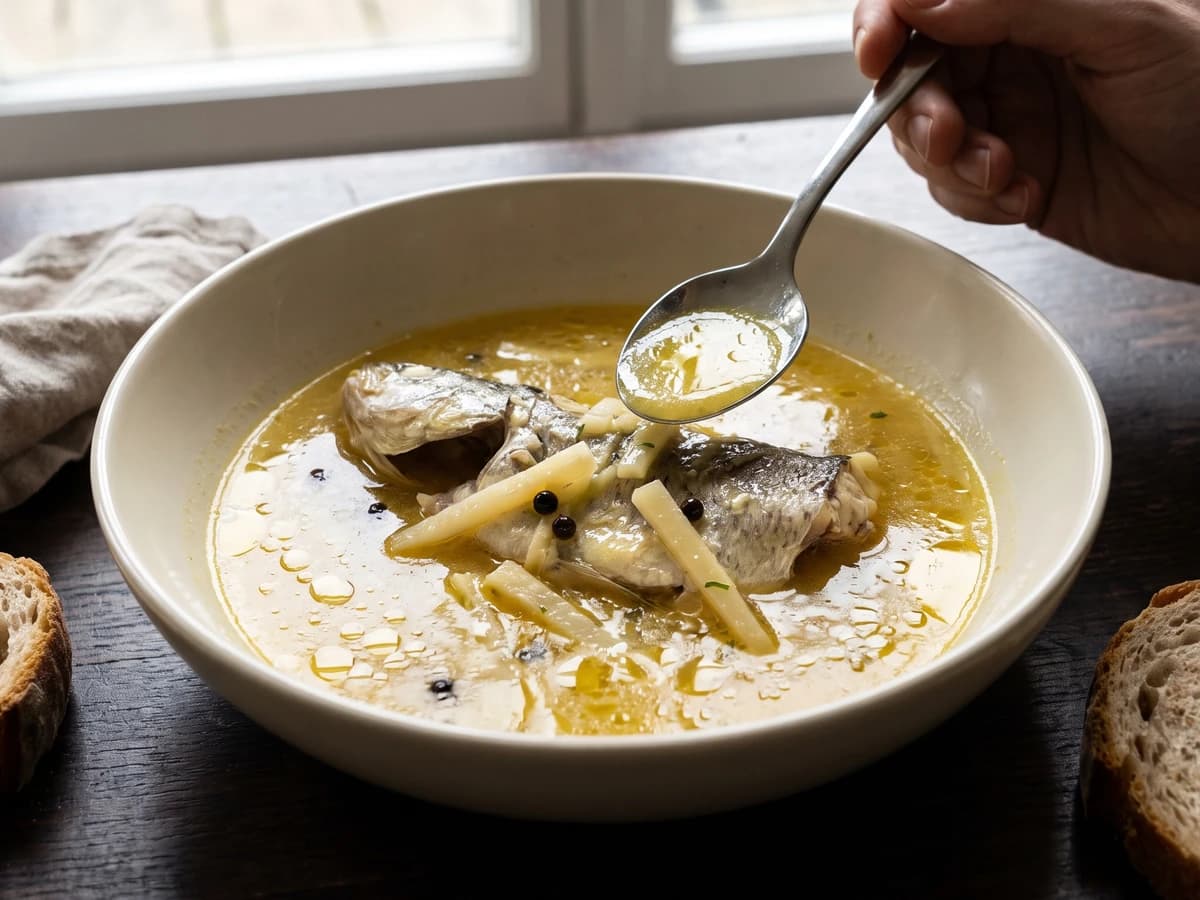
Waterzoi asks fresh, bone-in river fish to thicken its own buttery broth, with parsley root and pepper for company. No flour, no stockpot, just a brisk simmer watched closely.
Chef Juliette
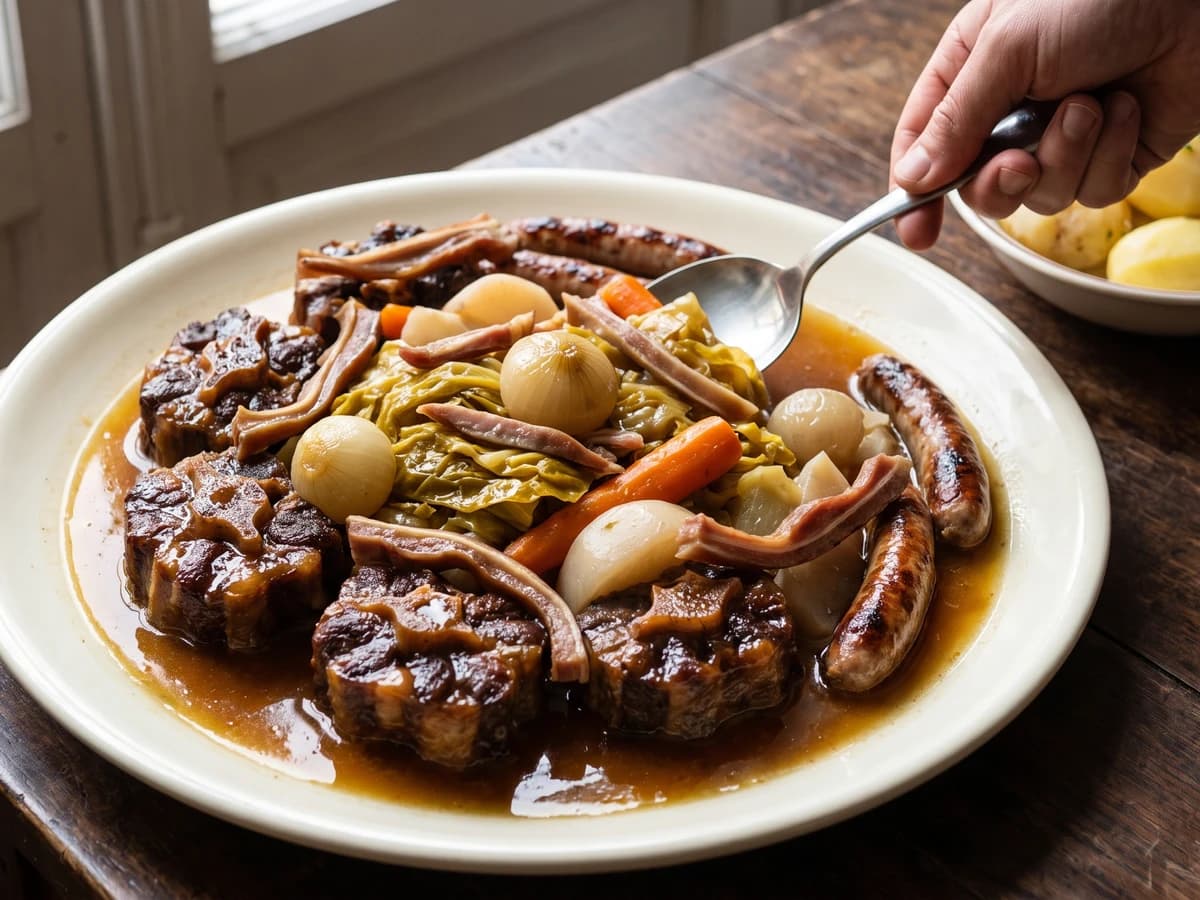
Queue de Bœuf en Hochepot gathers oxtail, pig's trotter and ear, cabbage, roots, and grilled chipolatas around a clear, gelatin-rich broth whose quiet simmer keeps every piece tender and distinct.
Chef Juliette
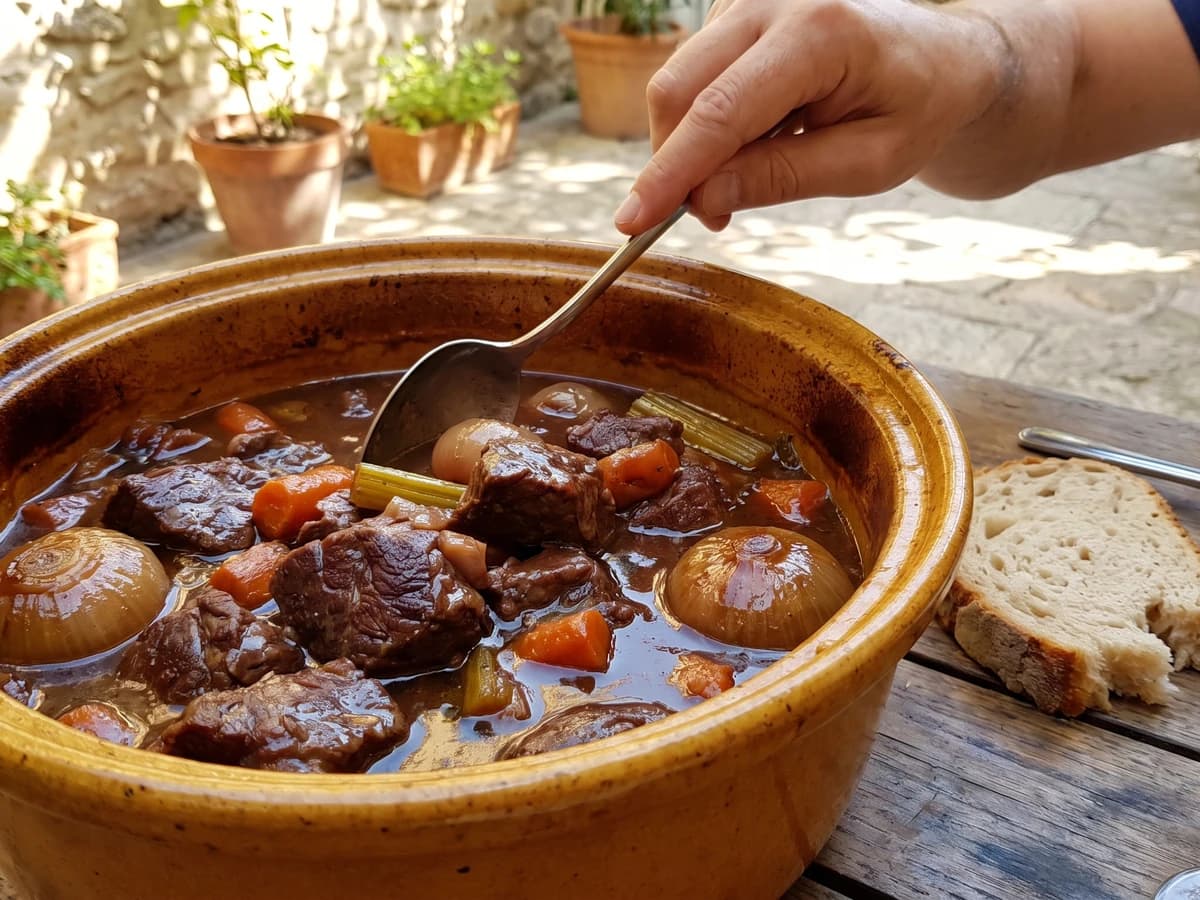
Beef shoulder larded with bacon, sharpened by red wine and vinegar, then sealed with garlic, vegetables, and dry lemon peel until the low oven turns it yielding and the gravy darkly glossy.