Culinary Explorer

A cooking platform built around craft, culture, and the stories behind what we eat.
Discover Culinary Explorer
Consommé Girondine

Consommé Girondine

Created by Chef Juliette

Based on No. 571, Consommé Girondine, from Le Guide Culinaire (1907) by Auguste Escoffier

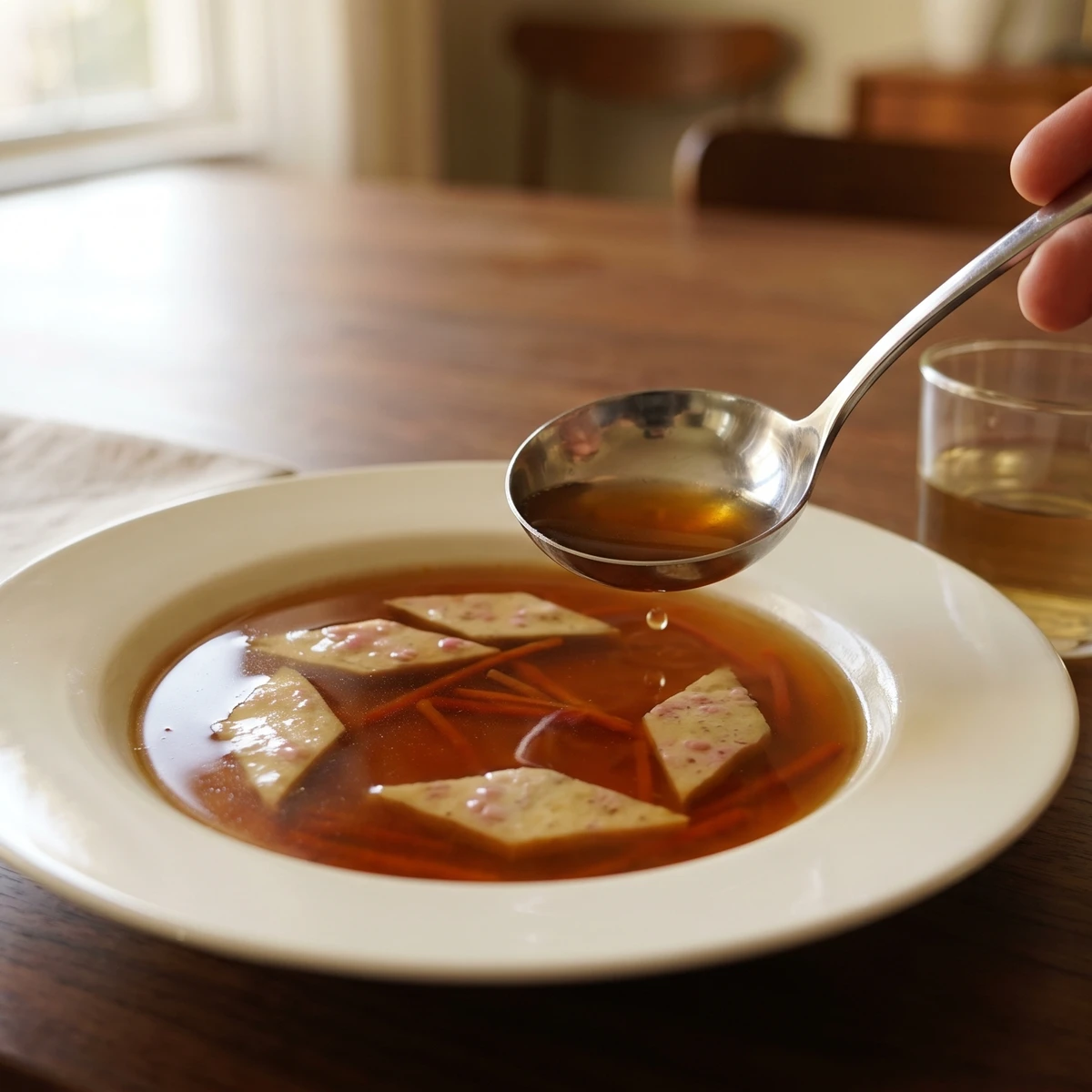
Clear beef consommé carries pale ham royale lozenges and butter-bright carrot in perfect suspension, a disciplined first course proving that clarity, seasoning, and precise knife work are the whole dish.

Soups & Stews
French
Dinner Party
Special Occasion
Make Ahead
30 min
Active Time
45 min cook1 hr 45 min total
YieldAbout 2 quarts (6 to 8 first-course servings)

Consommé Girondine (clear beef broth with ham custard and carrot) teaches one true thing: every garnish must remain distinct in a broth transparent enough to show it. The royale should be tender but cleanly cut, the carrot vividly red-orange, and the consommé seasoned with enough conviction to carry both.

The original assumed a saucier on staff, a stockpot never off the fire, and a row of little baba-moulds ready for service. At home, one shallow ovenproof dish replaces those moulds because the custard will be cut into lozenges anyway. Rather than repeat the book's one-quart service batch throughout an evening, this version doubles its exact proportions once to fill a two-quart home tureen. One cook, one stove, one evening.

The individual moulds and separate kitchen stations were brigade scaffolding, so they can go. What stays is the dish: whole-egg royale, lean ham, carrot cut julienne-fashion, butter, and the final pour of boiling consommé. Keep the royale below a boil in its bain-marie; a fine, tender custard makes clean lozenges, and that quiet heat is the step that decides everything.

The name Girondine points to Gironde, the department surrounding Bordeaux, but the preparation belongs to the composed consommés of the French classical table rather than to a documented household soup of Bordeaux. The surprising absence is wine: the source formula identifies the soup through its garnish of ham royale and red carrot, not through a bottle from the region. In classical service, such garnishes gave closely related clear soups their individual names and characters.

The technique, the tradition, and the story behind every dish.

Discover Culinary Explorer

Ingredients

prepared highly seasoned beef consommé

Quantity

8 cups (1.9 L / 1.9 kg)

divided

large eggs

Quantity

4

lean cooked ham

Quantity

4 tablespoons (60 ml / 45 g)

very finely chopped

red-orange outer carrot flesh

Quantity

6 tablespoons loosely packed (90 ml / 55 g)

cut julienne-fashion

unsalted butter

Quantity

1 tablespoon (15 ml / 14 g)

softened and divided

fine salt (optional)

Quantity

to taste, only if needed

Equipment Needed

  • Shallow 1-quart ovenproof dish
  • Deep roasting pan for the bain-marie
  • Fine-mesh sieve
  • Small sauté pan with lid
  • Thin, sharp knife
  • 3-quart saucepan
  • 2-quart soup tureen

Instructions

  1. 1

    Prepare the bain-marie

    Heat the oven to 300°F (150°C). Lightly butter a shallow 1-quart ovenproof dish with about 1 teaspoon of the butter and set it inside a deep roasting pan. This bain-marie, a hot-water bath, gives the royale the gentle heat once provided by individual baba-moulds.

  2. 2

    Mix the ham royale

    Measure 1 cup (240 ml / 240 g) of the cool consommé into a bowl. Break in the eggs and whisk only until completely blended; vigorous whisking traps bubbles that become holes in the finished royale. Pass the mixture through a fine sieve, stir in the finely chopped ham, and pour it into the buttered dish. Skim away any bubbles floating on the surface.

    Use lean, unsmoked cooked ham such as jambon de Paris. Smoke and heavy curing overwhelm the clear beef broth, while large pieces tear the custard when it is cut.
  3. 3

    Poach the royale gently

    Pour just-boiled water into the roasting pan until it reaches halfway up the outside of the custard dish. Bake for 25 to 35 minutes, until the edges are set and the centre gives one faint wobble when nudged. It must not brown, puff, or bubble. If the edges begin to swell, lower the oven to 275°F (135°C) and add a cup of cool water to the bath. Ça se rattrape: any porous edge can be trimmed after chilling, while the smooth centre still gives excellent lozenges.

  4. 4

    Cut the carrot julienne

    Peel the carrots, then cut broad slabs from the strongly coloured outer flesh, stopping before the paler, firmer core. Cut those slabs into pieces about 1½ inches (4 cm) long, then into fine, even matchsticks about 1⁄16 inch (1.5 mm) wide. This is julienne-fashion. Measure 6 loosely packed tablespoons after cutting; equal rods cook together and remain distinct in the clear soup.

  5. 5

    Stew the carrots

    Melt the remaining butter over low heat in a small sauté pan. Add the carrot julienne, cover, and stew gently for about 4 minutes, tossing once, until the rods bend slightly but take no brown colour. Add ½ cup (120 ml / 120 g) of the measured consommé and cook at the barest simmer for another 3 to 5 minutes, until tender but still intact. If the butter begins to brown, add a spoonful of consommé and lower the heat at once; the carrot should taste sweet and buttery, never toasted. Lift out the carrots with a slotted spoon and strain their cooking liquor back into the remaining consommé.

  6. 6

    Cut regular lozenges

    Lift the royale from its water bath and cool for 15 minutes, then chill until firm enough to cut, about 30 minutes. Loosen the edge with a thin knife and invert it onto a board. If it clings, stand the bottom of the dish in warm water for 5 seconds rather than prying. Cut parallel diagonal strips in both directions to make large, regular lozenges about 1¼ inches (3 cm) long, wiping the knife between cuts.

  7. 7

    Heat and assemble

    Warm a soup tureen and the serving bowls with hot water, then dry them. Bring the remaining consommé and the strained carrot liquor to a brisk boil and taste; highly seasoned means vivid, not salty. If it is too strong, correct it with boiling water a tablespoon at a time. Arrange the royale lozenges and carrot julienne in the warm tureen, then pour the boiling consommé over them just before serving. Do not simmer the garnish in the pot, or the royale will roughen and the carrot will lose its colour. À table!

Chef Tips

  • Begin with a finished, clarified beef consommé. If it sets to a soft gel when cold, the foundation has enough body; skim away every trace of chilled fat before reheating so the broth stays clear.
  • The source's red carrot means the deeply coloured outer flesh, not a special modern variety. Avoid the pale woody core, which cooks more slowly and brings little colour to the tureen.
  • A shallow ovenproof dish is the honest home equivalent of four little baba-moulds. The individual moulds helped a brigade portion its work, but they add nothing once the royale is cut into lozenges.
  • Serve this as the first course of a dinner, with a dry white Bordeaux if wine is wanted. A heavy red crowds the consommé before the rest of the meal has even arrived.

Advance Preparation

  • Prepare the beef consommé up to three days ahead, chill it promptly, and remove the hardened surface fat before using. The recipe time begins with this finished component ready.
  • Bake the royale up to one day ahead and refrigerate it whole and covered. Cut the lozenges while cold, shortly before assembling the soup.
  • The carrot may be cut up to four hours ahead and kept covered in the refrigerator. Stew it in butter and complete its cooking in consommé within 20 minutes of serving so its colour remains lively.
  • Keep broth, royale, and carrot separate until the table is ready. The final boiling pour warms the garnishes without overcooking them.

Frequently Asked Questions

Nutrition Information

1 serving (about 265g)

Calories
75 calories
Total Fat
5 g
Saturated Fat
2 g
Trans Fat
0 g
Unsaturated Fat
3 g
Cholesterol
100 mg
Sodium
900 mg
Total Carbohydrates
1 g
Dietary Fiber
0 g
Sugars
0 g
Protein
7 g

Note: Chef personas and recipes are created with AI assistance. Cook with care: follow safe food-handling practices, check doneness with a thermometer when needed, and adapt for allergies and your kitchen.

Where cooking meets culture.

Culinary guides, cultural storytelling, and the editorial depth that makes cooking meaningful.

Discover Culinary Explorer