
Chef Juliette
Eggs on the Dish
Œufs sur le plat teach the whole art of egg cookery in minutes: hot butter below, a light baste above, and the nerve to pull milky whites before the soft yolks set.
A cooking platform built around craft, culture, and the stories behind what we eat.
Created by Chef Juliette
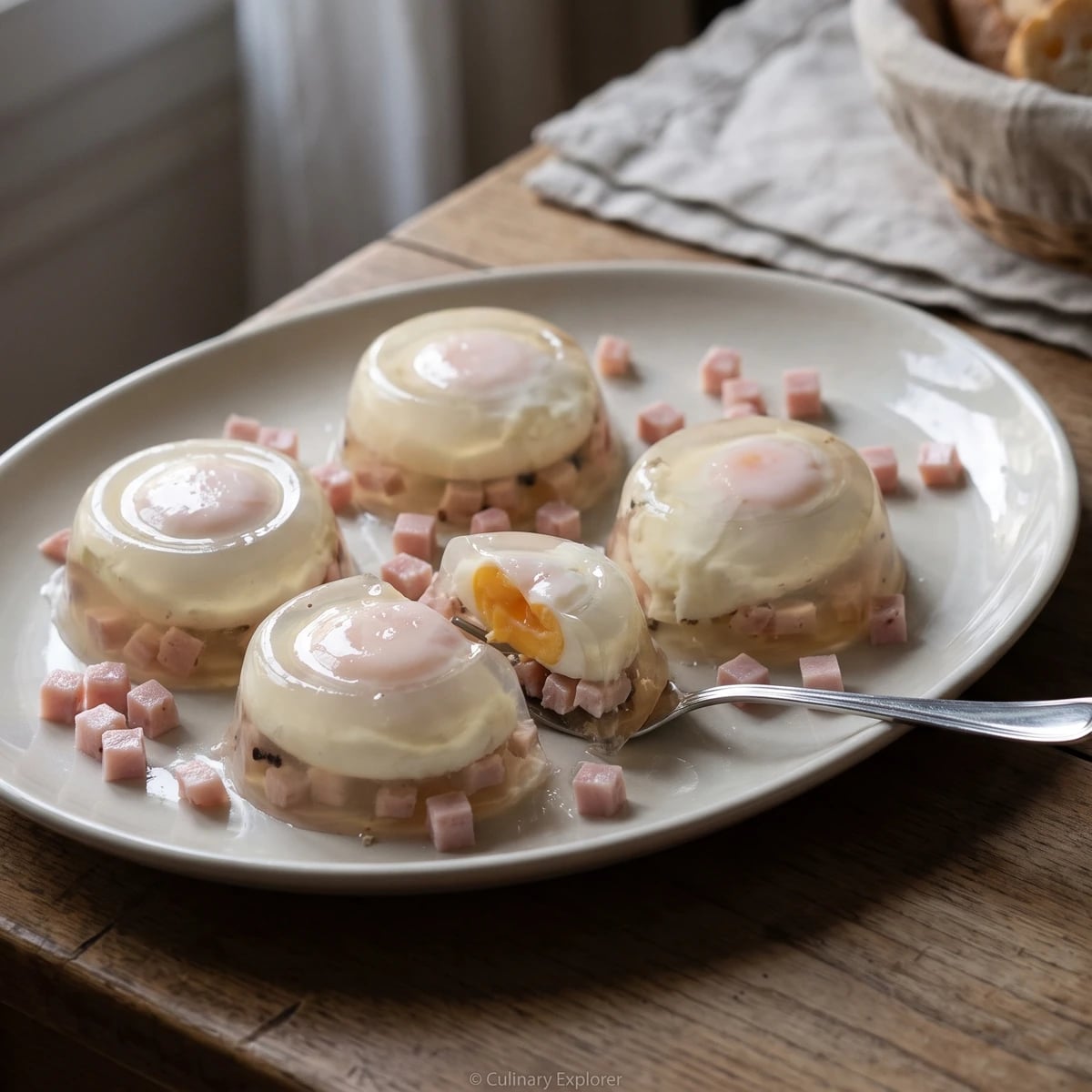
Four glossy Œufs froids Polignac suspended in clear white aspic, turned out cold and bordered with blush-pink jelly dice: precise moulding made practical for one cook and a generous dinner-party table.
Œufs froids Polignac (cold Polignac eggs in white aspic) teach one exact lesson: cold must meet cool. The moulded eggs must be thoroughly chilled, while the aspic must remain liquid but feel cool and lightly syrupy. Warm aspic softens the eggs and turns cloudy; aspic allowed to set can't surround them cleanly.
The brigade formula assumed a saucier tending a naturally gelatinous white stock, a cold larder, and ranks of matching metal moulds. Your honest equivalent is clear white chicken stock strengthened with measured gelatin, four larger dariole moulds, and a refrigerator shelf. The measured gelatin replaces the uncertain strength of the perpetual stockpot, while the smaller batch turns a service preparation into one cook, one stove, one evening.
Clarifying great kettles and holding dozens of moulds were brigade scaffolding, and they can go. The double moulding cannot: cooled eggs à la Polignac, a set foundation of white aspic, a second clear casing, and the border of faintly coloured jelly dice are the dish itself. The step that decides everything is cooling the aspic until it pours like thin syrup before it touches the eggs.
Œufs froids Polignac belongs to the Parisian grand-kitchen canon, where a moulded egg preparation moved from hot service to the cold supper table by being enclosed in aspic. Polignac is an honorific title rather than a claim to a regional egg style; the preparation is defined by its underlying moulded eggs and formal second moulding. The book's white jelly means pale, clear aspic made from unbrowned stock, not an opaque cream jelly, while the tinted dice display the precise work of the cold kitchen.
Quantity
4
completely cooled
Quantity
3 cups (710 ml / 710 g)
cold and well seasoned
Quantity
2 tablespoons (30 ml / 18 g)
Quantity
1 teaspoon (5 ml / 5 g)
Quantity
1 drop
Quantity
as needed
| Ingredient | Quantity |
|---|---|
| eggs à la Polignac, prepared as explained under “Moulded Eggs”completely cooled | 4 |
| clear white chicken stockcold and well seasoned | 3 cups (710 ml / 710 g) |
| unflavoured powdered gelatin | 2 tablespoons (30 ml / 18 g) |
| cold water | 1 teaspoon (5 ml / 5 g) |
| red food colouring | 1 drop |
| fine salt (optional) | as needed |
Prepare four eggs à la Polignac as explained under “Moulded Eggs.” Let them lose their surface heat, then refrigerate until completely cold and firm enough to handle, about 1 hour. Turn them carefully from their cooking moulds and keep them covered in the cold. A warm centre will loosen the surrounding aspic, so don't hurry this cooling.
Pour 1 cup (240 ml / 240 g) of the cold stock into a bowl and sprinkle the gelatin evenly over it. Leave it undisturbed for 10 minutes, until every granule has swollen. Heat the remaining 2 cups (470 ml / 470 g) of stock just until it begins to quiver, then remove it from the heat and stir in the bloomed gelatin until perfectly dissolved. Don't boil it. If you see gelatin threads or small lumps, warm the mixture again over the lowest heat and strain it; ça se rattrape.
Strain the dissolved aspic through a dampened fine cloth or a very fine sieve without pressing. Pour 1¼ cups (300 ml / 300 g) into a shallow dish. Dilute the red colouring in the cold water, then add it to this portion a drop at a time until the aspic carries only the faintest rose blush. The source asks for faintly coloured jelly, not ruby jelly. Refrigerate until firm, about 1½ hours.
Rinse four smooth 5-fluid-ounce (150 ml) dariole moulds with cold water and shake them dry without wiping. Measure ½ tablespoon, which is 1½ teaspoons (7.5 ml / 7.5 g), of the remaining white aspic into each mould, exactly preserving the book's first layer. Refrigerate for 8 to 10 minutes, until the aspic is firm enough to support an egg but still slightly tacky.
Cool the remaining white aspic over a bowl of ice until it pours like thin syrup. Place one cold egg à la Polignac in the centre of each larger mould, then pour the aspic slowly down the inside wall so it fills the space without striking the egg. Fill each mould to cover the egg completely. If an egg floats or the aspic clouds around it, the jelly is too warm and thin: lift out the egg, chill the aspic a few minutes longer, and begin again. Nothing is lost.
Cover the filled moulds without touching their surfaces and refrigerate for at least 3 hours, preferably 4, until the aspic is firm all the way through. Don't freeze them. Frozen aspic releases water as it thaws and loses the clear, close texture this dish requires.
Cut the faintly coloured jelly into neat ¼-inch (6 mm) dice with a thin knife dipped in hot water and wiped dry. Press a warm, damp towel around one mould for 3 to 5 seconds, loosen the upper rim with a fingertip, and invert it onto a chilled platter. Repeat with the others. If one refuses to release, warm the mould for another 2 seconds; if its surface begins to soften, return it to the refrigerator and let it reset. Arrange the rose jelly dice as a generous border around the mouldings and serve at once. À table!
1 serving (about 230g)
Culinary guides, cultural storytelling, and the editorial depth that makes cooking meaningful.
Discover Culinary Explorer
Chef Juliette
Œufs sur le plat teach the whole art of egg cookery in minutes: hot butter below, a light baste above, and the nerve to pull milky whites before the soft yolks set.

Chef Juliette
Œufs Bercy turns a buttered baking dish into a lesson in timing: set whites, glossy yolks, one grilled sausage between them, and just enough tomato sauce to draw a bright red thread.

Chef Juliette
Œufs au beurre noir teach the narrow, glorious distance between browned and burned: tender baked eggs, nearly black butter, and vinegar added last for a supper finished before the toast cools.

Chef Juliette
Tender eggs sur le plat, quickly sautéed chicken livers, and a glossy mushroom, shallot, white wine, and tomato sauce meet at the last moment, each still properly itself.