Culinary Explorer

A cooking platform built around craft, culture, and the stories behind what we eat.
Discover Culinary Explorer
Omelet Maxim

Omelet Maxim

Created by Chef Juliette

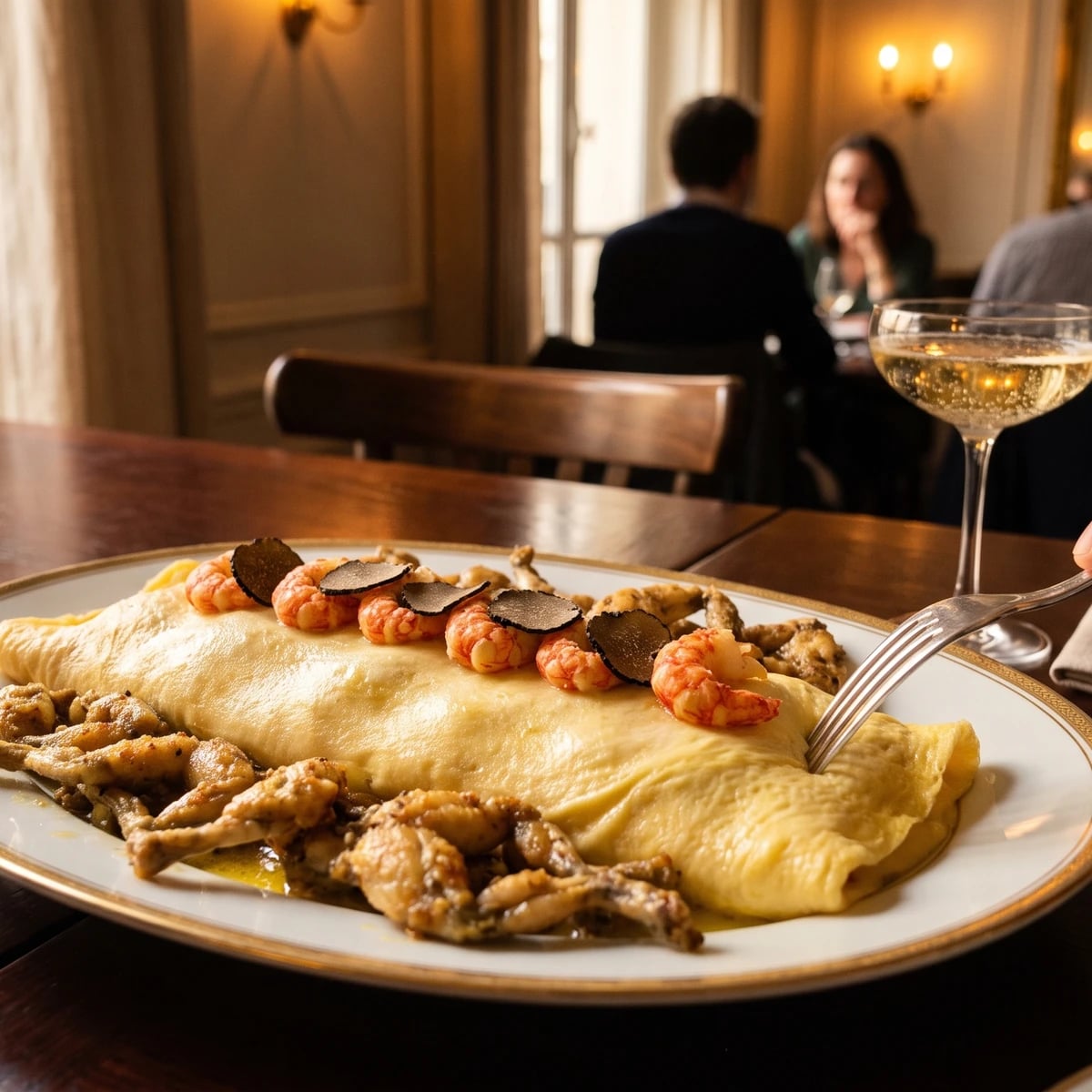
Omelette Maxim turns tender eggs into a Paris supper centerpiece, with coral crayfish, black truffle, and a gilded border of frogs' legs meunière. The luxury is visible, but timing makes it work.

Breakfast & Brunch
French
Dinner Party
Special Occasion
Romantic
35 min
Active Time
20 min cook55 min total
Yield4 servings

Omelette Maxim (a soft French omelette crowned with crayfish and truffle, bordered by frogs' legs meunière, seasoned, floured, and sautéed in butter) teaches timing under ornament. The one true thing is simple: every garnish must be ready before the eggs touch the pan, because an omelette waits for no one.

The original gives only a handful of commands because it assumes a brigade, with cooked crayfish tails at hand, trimmed frogs' legs, a commis working the sauté pan, and a hot platter moving directly to the dining room. It calls for neither a saucier on staff, a stockpot kept on the fire, nor a salamander; adding them would be pomp, not fidelity. At home, prepared tail meat, trimmed legs, a low oven, and a warmed platter do the same work. The separate hands were scaffolding. The tender omelette, alternate rows of crayfish and truffle, and the butter-gilded border are the dish and must stay.

Because the source gives no quantities, this version sets the table honestly for four: four crayfish tails and four frogs' legs per person, one small truffle, and an eight-egg omelette. It preserves the intended abundance without producing brigade leftovers. One cook, one stove, one evening.

The finished platter should be unapologetically lavish, with pale butter-gold eggs, coral tails, black truffle, and a bronze ring of meunière. Warm the platter and plan the rows first. Once the eggs meet the pan, tenderness is the only clock that matters.

Omelette Maxim belongs to the grand Paris supper-room repertoire, where the quick, everyday omelette was dressed as a late-evening centerpiece with costly garnishes. Its ordered rows of crayfish and truffle, plus the border of frogs' legs, show the classical habit of turning a simple egg preparation into a composed dish without changing the omelette itself. Meunière here names the method, not a separate sauce: the raw legs are seasoned, floured, sautéed in butter, and gilded.

The technique, the tradition, and the story behind every dish.

Discover Culinary Explorer

Ingredients

large eggs

Quantity

8

cooked, peeled crayfish tails

Quantity

16 (about 5 oz / 140 g)

drained, dried, and brought to room temperature

fresh black truffle

Quantity

1 small (about 1 oz / 25 g)

very thinly sliced

small raw frogs' legs

Quantity

16 (about 1 lb / 450 g)

skinned, trimmed, and patted dry

all-purpose flour

Quantity

½ cup (120 ml / 60 g)

unsalted butter

Quantity

8 tablespoons (120 ml / 113 g)

divided

fine sea salt

Quantity

1¼ teaspoons (6 ml / 7 g)

divided

finely ground white pepper

Quantity

½ teaspoon (2.5 ml / 1 g)

divided

Equipment Needed

  • 12-inch / 30 cm heavy skillet for the frogs' legs
  • 11-inch / 28 cm nonstick omelette skillet
  • Large oven-safe oval serving platter
  • Wire rack and small sheet pan
  • Flexible heatproof spatula
  • Truffle slicer or very sharp paring knife

Instructions

  1. 1

    Prepare the service

    Heat the oven to 200°F / 95°C and set a wire rack over a small sheet pan for holding the cooked frogs' legs. Warm a large oval serving platter in the oven, provided it is oven-safe, or fill it with hot water and dry it just before plating. Bring the crayfish tails to room temperature for about 20 minutes, slice the truffle, measure the seasonings, and set everything within reach. Once the omelette begins, there is no useful pause.

  2. 2

    Flour the legs

    Season the dry frogs' legs with ¾ teaspoon of the salt and ¼ teaspoon of the white pepper. Spread the flour in a shallow dish. Working with only as many legs as the skillet will hold comfortably, roll each one lightly in the flour and shake off every loose patch. Flour them immediately before cooking; if they sit coated, the flour absorbs moisture and turns gummy instead of gilding.

  3. 3

    Sauté the meunière

    Heat a 12-inch / 30 cm skillet over medium to medium-high heat. Add 2½ tablespoons of the butter and wait until it foams vigorously and begins to subside. Lay in half the frogs' legs without crowding and sauté for 2 to 3 minutes per side, adjusting the heat so the flour becomes evenly golden while the butter smells nutty, never scorched. Cook until the flesh is opaque, separates easily near the joint, and reaches 145°F / 63°C at its thickest point. Transfer the legs to the rack in the low oven and repeat with another 2½ tablespoons butter. Hold them for no longer than 10 minutes.

    If the butter blackens before the legs are cooked, lift them out, wipe the skillet carefully, and continue with fresh butter over gentler heat. Ça se rattrape. Black butter left in the pan will make the next batch bitter.
    Discard the flour remaining in the dish after it has touched the raw frogs' legs.
  4. 4

    Beat the eggs

    Crack the eggs into a bowl and add the remaining ½ teaspoon salt and ¼ teaspoon white pepper. Beat with a fork only until the whites and yolks are completely joined, with no ropy streaks remaining. Don't whip in a cap of bubbles. A French omelette gains tenderness from quick, controlled cooking, not from incorporated air.

  5. 5

    Cook the omelette

    Heat an 11-inch / 28 cm nonstick skillet over medium-high heat and add the remaining 3 tablespoons butter. When the butter foams without browning, pour in the eggs. Stir rapidly with a flexible spatula while shaking the pan, scraping the base and drawing the setting egg into small, moist curds. After 20 to 30 seconds, stop stirring and smooth the curds into an even layer. When the base is set but the surface remains glossy and softly moist, lift the pan from the heat. Fold the far third toward the center, then fold the near third over it to make a broad oval. If the eggs begin setting into a flat sheet before you can form the curds, take the pan completely off the heat and stir firmly until they loosen into small pieces. Ça se rattrape. Return the pan only long enough to finish the fold.

  6. 6

    Build the platter

    Turn the omelette seam-side down onto the warm oval platter, tucking the ends underneath with the spatula if necessary. Across its top, arrange narrow alternating rows of crayfish tails and overlapping truffle slices, repeating the pattern from one end to the other. Set the frogs' legs meunière closely around the omelette to make a complete border, keeping their gilded sides facing upward. Serve immediately, while the eggs remain tender and the butter still gleams. À table!

Chef Tips

  • Frozen frogs' legs are the honest home answer when fresh ones aren't available. Thaw them slowly in the refrigerator, drain them thoroughly, and pat every joint dry. Chicken is not a substitute here; the border of frogs' legs is part of the identity of Omelette Maxim.
  • Choose plain cooked crayfish tail meat without garlic, cayenne, or the seasoning from a seafood boil. Frozen tails are perfectly respectable if they were packed cleanly and taste sweet. Drain them well and let them lose their refrigerator chill before they meet the omelette.
  • Fresh black truffle gives the finest perfume, but a whole preserved black truffle is the classical pantry's useful answer outside the season. Drain it, dry it, and slice it thinly. Truffle oil brings a different, blunt aroma and does not replace the slices.
  • Serve Omelette Maxim with brut Champagne or a taut white Burgundy. The wine needs enough acidity to clear the butter, but not so much perfume that it quarrels with the truffle.
  • This dish does not improve through holding or reheating. If anything remains, refrigerate it promptly and eat it within a day, accepting that the omelette will be firmer and the meunière coating softer.

Advance Preparation

  • Frozen frogs' legs and crayfish tails can be thawed overnight in the refrigerator. Keep them covered and separate, then drain and dry them thoroughly before cooking.
  • The frogs' legs may be trimmed and dried up to 4 hours ahead, then refrigerated in a single layer. Do not season or flour them until the skillet is heating.
  • Set out the platter, flour, pans, rack, and measured seasonings before guests sit down. Slice the truffle and bring the crayfish tails to room temperature about 20 minutes before cooking.
  • Cook the frogs' legs immediately before the omelette and hold them in the low oven for no more than 10 minutes. The completed platter must go directly to the table.

Frequently Asked Questions

Nutrition Information

1 serving (about 215g)

Calories
460 calories
Total Fat
33 g
Saturated Fat
18 g
Trans Fat
1 g
Unsaturated Fat
13 g
Cholesterol
510 mg
Sodium
900 mg
Total Carbohydrates
10 g
Dietary Fiber
1 g
Sugars
1 g
Protein
29 g

Note: Chef personas and recipes are created with AI assistance. Cook with care: follow safe food-handling practices, check doneness with a thermometer when needed, and adapt for allergies and your kitchen.

Where cooking meets culture.

Culinary guides, cultural storytelling, and the editorial depth that makes cooking meaningful.

Discover Culinary Explorer