Culinary Explorer

A cooking platform built around craft, culture, and the stories behind what we eat.
Discover Culinary Explorer
Scrambled Eggs, Georgette

Scrambled Eggs, Georgette

Created by Chef Juliette

Œufs brouillés Georgette turns soft eggs, crayfish butter, and sweet crayfish tails into the filling for crisp baked potato shells, a lesson in gentle heat and exact timing made for the table.

Breakfast & Brunch
French
Dinner Party
Special Occasion
Comfort Food
20 min
Active Time
1 hr cook1 hr 20 min total
Yield4 servings

Œufs brouillés Georgette (soft scrambled eggs with crayfish in hot baked potato shells) teaches the discipline beneath every French scrambled egg: stop before they look finished. The curds should flow softly from the spoon, because the hot saucepan, the crayfish butter, and the potato shells will carry them the last few degrees. Fully set in the pan means overcooked at the table.

The source entry assumed prepared crayfish butter, a hot holding station, and another pair of hands to hollow potatoes while the eggs were stirred. A saucier on staff, a stock never off the fire, and a salamander would add nothing here; the brigade advantage was parallel hands and hot holding. Your honest equivalent is a low oven for the shells and one heavy saucepan for the eggs. That holding arrangement is scaffolding. The cool butter folded in away from the fire, the soft curd, and the crayfish tails are the dish. One cook, one stove, one evening.

The source offers three large or six small potatoes. For four people, four small potatoes become individual shells, its 1½ ounces of crayfish butter becomes 1 ounce, and eight to ten tails become six; six eggs provide a generous filling because the source leaves its usual scrambled-egg batch unstated. The step that matters is the last minute over low heat: take the eggs off while they are glossy and looser than you think proper.

Œufs brouillés Georgette belongs to the codified grand-kitchen repertory of Parisian hotel and dining-room service rather than to a regional household tradition; its proper name identifies a fixed composition, not a place called Georgette. Baked potato shells served as edible caisses (cases), while crayfish butter and tails brought coral color and concentrated shellfish savor to a composed egg first course. The combination passed readily to bourgeois home tables because its only demanding point is timing, not specialized equipment.

The technique, the tradition, and the story behind every dish.

Discover Culinary Explorer

Ingredients

small floury baking potatoes

Quantity

4 (about 24 oz / 680 g total)

unsalted butter

Quantity

1 tablespoon (15 ml / 14 g)

large eggs

Quantity

6

fine sea salt

Quantity

1/2 teaspoon (2.5 ml / 3 g)

divided

finely ground white pepper

Quantity

1/8 teaspoon (0.6 ml / 0.3 g)

prepared crayfish butter

Quantity

2 tablespoons (30 ml / 28 g)

chilled and cut into small pieces

cooked shelled crayfish tails

Quantity

6 (about 1/4 cup / 60 ml / 35 g)

thawed if frozen, drained and patted dry

Equipment Needed

  • Small rimmed baking tray
  • Teaspoon or small melon baller
  • 8-inch (20 cm) heavy saucepan
  • Heatproof flexible spatula
  • Four small ramekins, optional for supporting torn shells
  • Warmed oval platter and clean folded napkin

Instructions

  1. 1

    Bake the potatoes

    Heat the oven to 425°F (220°C). Scrub and dry the potatoes, then prick each three or four times. Bake them directly on the oven rack, with a tray beneath, until the skins are crisp and a narrow knife passes through the centres without resistance, 45 to 55 minutes. Choose potatoes of equal size so they finish together; the eggs cannot wait for a stubborn potato.

  2. 2

    Hollow and hold

    Lower the oven to 250°F (120°C). Let the potatoes stand only until they can be handled, about 5 minutes. Cut a neat oval lid from the top of each, then scoop out the pulp with a teaspoon, leaving a wall about 1/4 inch (6 mm) thick so the skin keeps its shape. Season the interiors with one quarter of the measured salt and return the empty shells, open side up, to the low oven. If a shell tears, set it inside a small ramekin for support. Ça se rattrape. Reserve the potato pulp for another preparation.

  3. 3

    Ready the filling

    Set the drained crayfish tails near the stove while the shells are hollowed so they lose their deep chill, but do not leave them out longer than needed. Crack the eggs into a bowl, add the remaining salt and the white pepper, and beat with a fork only until the whites and yolks unite. Do not whip in air; œufs brouillés should be close and custardy, not puffed.

  4. 4

    Scramble over low heat

    Melt the unsalted butter in an 8-inch (20 cm) heavy saucepan over low heat without letting it color. Add the eggs and stir continuously with a flexible spatula, sweeping the base and corners in slow figure eights. Cook until very small, tender curds form and the eggs mound briefly before flowing back together, about 6 to 8 minutes. They must still look wet. If the curds begin racing or a firm skin forms on the pan floor, lift the saucepan from the burner, set it on a cool damp cloth, and keep stirring. Ça se rattrape while the eggs remain moist; browned eggs cannot be unbrowned.

    Low heat gives you time to see the change. The correct moment is closer to a loose custard than to firm breakfast curds.
  5. 5

    Finish away from fire

    Remove the saucepan from the heat while the eggs are still loose. Stir in the chilled crayfish butter one piece at a time until it melts into the curds and gives them a coral-gold gloss; this cool butter arrests the cooking while forming the finish the source requires. Fold in the crayfish tails and let the residual heat warm them for 30 seconds. If yellow butter begins pooling, transfer everything immediately to a cool bowl and stir steadily until it comes back together. Do not return it to the burner.

  6. 6

    Fill and serve

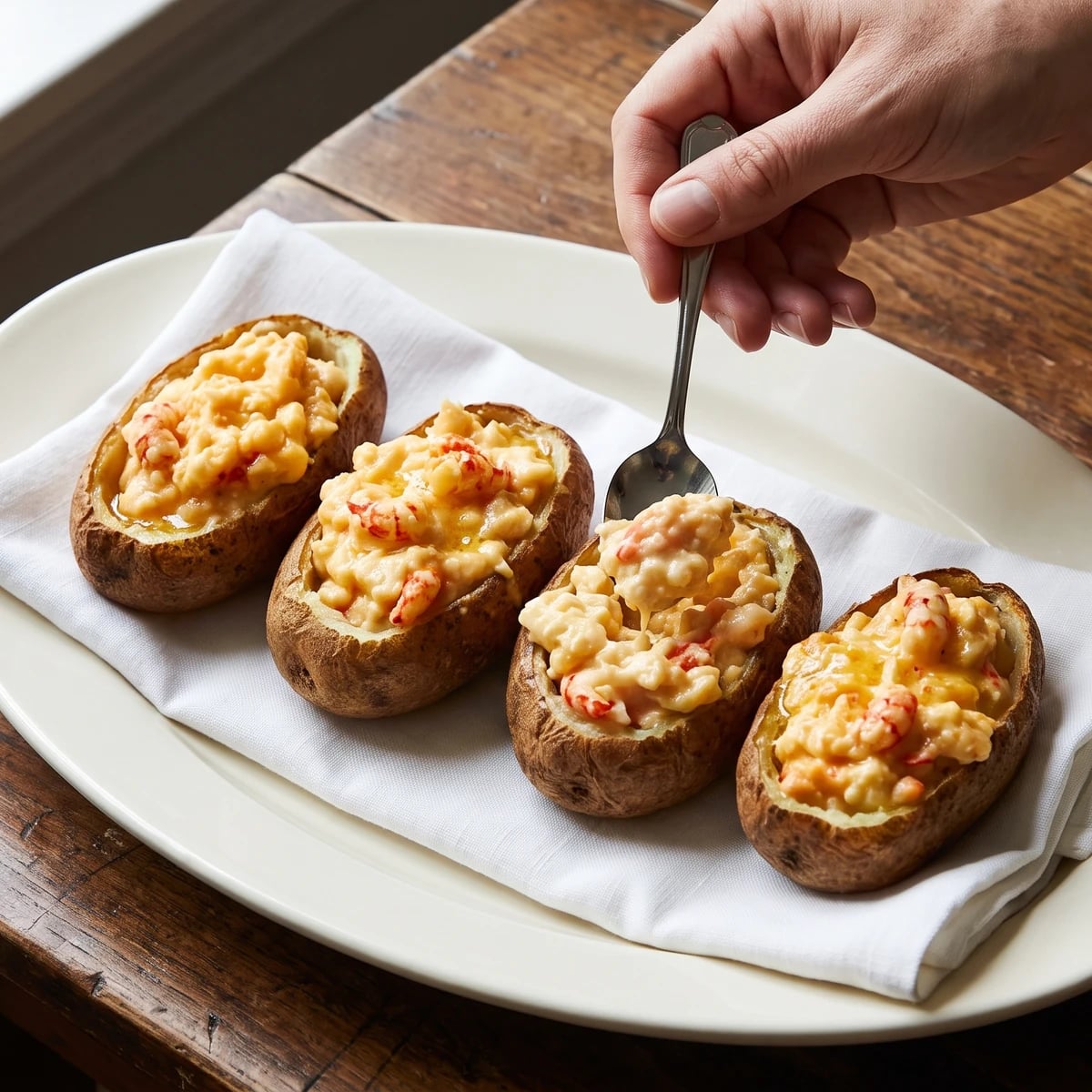
    Arrange the hot potato shells on a warmed oval platter lined with a clean folded napkin, the source's practical way of stopping them from rolling. Divide the scrambled eggs among the shells, heaping the filling just above the openings and making sure each receives crayfish tails. Carry them straight to the table. No reheating and no waiting, because either would finish cooking the eggs. À table!

Chef Tips

  • Crayfish butter is butter infused with cooked crayfish shells, then strained and chilled. Its coral color and concentrated shell flavor are the foundation of Georgette, not decoration; plain butter with chopped tail meat stirred through is not the same preparation.
  • Frozen cooked crayfish tails are the honest preserved choice when fresh crayfish are unavailable. Thaw them in the refrigerator, drain them thoroughly, and pat them dry, because brine left clinging to the tails loosens the eggs and dulls the butter.
  • Use pasteurized shell eggs if serving anyone who should avoid lightly cooked egg. The proper texture remains soft and glossy.
  • Save the scooped potato pulp. While still warm, it can become pommes duchesse, enrich a leek soup, or take its place beside tomorrow's roast.
  • For a special first course, pour a dry Champagne or crémant. Its acidity clears the richness of butter, egg, and potato without crowding the crayfish.

Advance Preparation

  • Prepare or source the crayfish butter ahead. It keeps for up to 3 days under refrigeration or 2 months frozen in a tightly wrapped portion; thaw it in the refrigerator before using.
  • The potatoes may be baked and hollowed up to 30 minutes before serving. Hold the shells in a 250°F (120°C) oven for no more than 20 minutes, since longer holding makes their edges dry and brittle.
  • Thaw, drain, and dry the crayfish tails earlier in the day and keep them covered in the refrigerator. Measure the remaining ingredients before guests sit down.
  • Do not scramble the eggs in advance. The finished filling must go directly from saucepan to hot shells to table.

Frequently Asked Questions

Nutrition Information

1 serving (about 150g)

Calories
250 calories
Total Fat
16 g
Saturated Fat
8 g
Trans Fat
0 g
Unsaturated Fat
7 g
Cholesterol
310 mg
Sodium
440 mg
Total Carbohydrates
14 g
Dietary Fiber
2 g
Sugars
1 g
Protein
13 g

Note: Chef personas and recipes are created with AI assistance. Cook with care: follow safe food-handling practices, check doneness with a thermometer when needed, and adapt for allergies and your kitchen.

Where cooking meets culture.

Culinary guides, cultural storytelling, and the editorial depth that makes cooking meaningful.

Discover Culinary Explorer