
Chef Juliette
Eggs on the Dish
Œufs sur le plat teach the whole art of egg cookery in minutes: hot butter below, a light baste above, and the nerve to pull milky whites before the soft yolks set.
A cooking platform built around craft, culture, and the stories behind what we eat.
Created by Chef Juliette
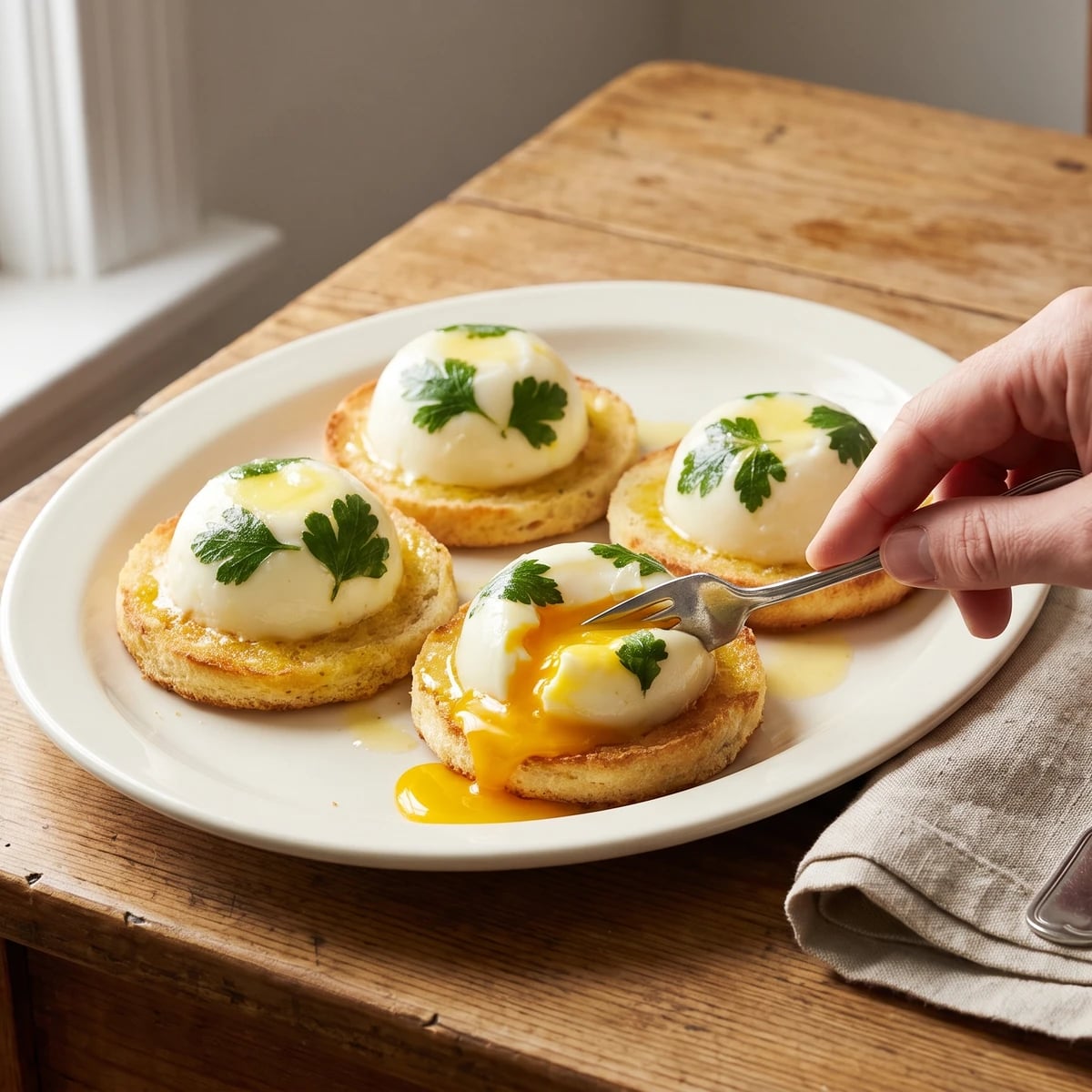
Butter every curve, poach the eggs gently in a bain-marie, then let them settle before turning them onto toast. Œufs moulés make precision look generous, with tender whites and soft golden yolks.
Œufs moulés (moulded eggs) teach the quiet discipline of release: the egg comes out beautifully only if the mould was prepared beautifully. Before you touch a pan, know this one true thing. Butter every curve more generously than seems necessary. The bain-marie can cook the white tenderly and the short rest can settle it, but neither can repair a dry patch where egg has welded itself to metal. When the mould lifts cleanly, you get an ivory dome on butter-gold toast, with a parsley leaf showing through and a yolk that runs at the first cut.
The old recipe assumed a drawer of ornamental dariole and timbale moulds, plus enough kitchen hands to decorate and poach a whole ring of eggs for service. Your honest equivalent is four small metal moulds or straight-sided ramekins, one roasting tin, and toast cut with the same rim. Of the two modes the entry permits, direct raw eggs or raw eggs combined with scrambled eggs, this version uses the direct-broken egg because it keeps the lesson clear and the centre soft. The many shapes and elaborate inlays are brigade scaffolding; they can go. Liberal buttering, the bain-marie, the full ten to twelve minutes, the settling rest, and the toast are the dish, so all of them stay. One cook, one stove, one evening.
Set two flat parsley leaves inside each mould, enough ornament to show the method without turning breakfast into upholstery. Then watch the water, not the clock alone: it should barely tremble around the moulds. If it boils, cool it at once and lower the oven; ça se rattrape. The step that matters most is still the first one. Soft butter, worked into every millimetre.
Œufs moulés belong to the classical Parisian grand-house and hotel repertoire, where dariole and timbale moulds turned the breakfast egg into an ornamental luncheon or first course. Unlike decoration added at the plate, their patterns were built inside the buttered mould before cooking, with herbs or other garnishes chosen to suit the preparation. The method spread through professional kitchens but remained less common at home because moulding and unmoulding each egg took longer than poaching or soft-boiling, exactly the practical preference recorded in the canon.
Quantity
3 tablespoons (45 ml / 42 g)
softened and divided
Quantity
8 small leaves
washed and completely dry
Quantity
4
at cool room temperature
Quantity
1/4 teaspoon (1.25 ml / 1.5 g)
Quantity
1/8 teaspoon (0.6 ml / 0.3 g)
Quantity
4 slices
cut into rounds slightly wider than the moulds
Quantity
About 6 cups (1.4 L / 1.4 kg), or enough to reach two-thirds up the moulds
| Ingredient | Quantity |
|---|---|
| unsalted buttersoftened and divided | 3 tablespoons (45 ml / 42 g) |
| flat-leaf parsley leaveswashed and completely dry | 8 small leaves |
| large eggsat cool room temperature | 4 |
| fine salt | 1/4 teaspoon (1.25 ml / 1.5 g) |
| ground white pepper | 1/8 teaspoon (0.6 ml / 0.3 g) |
| firm white bread (pain de mie)cut into rounds slightly wider than the moulds | 4 slices |
| very hot water for the bain-marie | About 6 cups (1.4 L / 1.4 kg), or enough to reach two-thirds up the moulds |
Set a rack in the centre of the oven and heat it to 325°F (165°C). Place four 3- to 4-fluid-ounce (90 to 120 ml) dariole moulds or straight-sided ramekins in a deep roasting tin, checking that they stand level. Heat the water until very hot but no longer boiling. A bain-marie is a hot-water bath that protects the eggs from fierce direct heat; the gentler the water, the more tender the finished whites.
Use about 2 tablespoons (30 ml / 28 g) of the softened butter to coat the inside of each mould lavishly. Brush from base to rim, then turn the mould and inspect it under the light; no metal or ceramic should show through. Press two dry parsley leaves flat against the butter at the base of each mould, smooth sides facing outward so they will appear on top after turning. Soft butter clings where it is put. Melted butter runs to the bottom and leaves the sides exposed, which is precisely where an egg sticks.
Break one egg directly into each prepared mould, taking care not to disturb the parsley or pierce the yolk. Divide the salt and white pepper lightly among them. Work promptly once the eggs are in place so the salt does not sit on the surface and mark the whites. If a piece of shell falls in, lift it with a larger piece of shell rather than chasing it with your fingers.
Pour the very hot water into the roasting tin until it reaches two-thirds up the sides of the moulds, keeping every drop out of the eggs. Tent the tin loosely with foil and transfer it carefully to the oven. Poach for 10 to 12 minutes, checking at ten: the whites should be opaque and set at the edges, with a delicate tremble at the centre, while the yolks remain soft. The water should barely quiver. If it begins bubbling, pull the tin forward, add a little cool water, and lower the oven to 300°F (150°C). Ça se rattrape, provided you calm the bain-marie before the outer whites turn rubbery.
While the eggs poach, spread the remaining 1 tablespoon (15 ml / 14 g) butter thinly over both sides of the bread rounds. Brown them in a dry skillet over medium heat for 2 to 3 minutes per side, until evenly butter-gold and crisp at the edges. Hold them on a rack rather than a flat plate so their undersides remain crisp.
Lift the moulds from the bain-marie with a folded towel or tongs and dry their outsides. Leave them upright and untouched for 3 minutes; this settling is part of the original method, not idle waiting. Run the tip of a thin knife only around the upper rim. Centre one toast round over each mould, hold the two together, and invert them in one decisive movement. Wait five seconds, then lift the mould straight upward. If an egg refuses to release, do not force it. Dip the base of the mould back into the hot water for 3 to 5 seconds, loosen the rim once more, and try again. Ça se rattrape.
Arrange the four toast rounds in a circle on a warmed platter, parsley-patterned eggs facing upward. Serve immediately, while the toast is crisp and the yolks are still soft enough to run into it at the first cut. No sauce is required; butter, tender egg, and toast are the complete preparation. À table!
1 serving (about 88g)
Culinary guides, cultural storytelling, and the editorial depth that makes cooking meaningful.
Discover Culinary Explorer
Chef Juliette
Œufs sur le plat teach the whole art of egg cookery in minutes: hot butter below, a light baste above, and the nerve to pull milky whites before the soft yolks set.

Chef Juliette
Œufs Bercy turns a buttered baking dish into a lesson in timing: set whites, glossy yolks, one grilled sausage between them, and just enough tomato sauce to draw a bright red thread.

Chef Juliette
Œufs au beurre noir teach the narrow, glorious distance between browned and burned: tender baked eggs, nearly black butter, and vinegar added last for a supper finished before the toast cools.

Chef Juliette
Tender eggs sur le plat, quickly sautéed chicken livers, and a glossy mushroom, shallot, white wine, and tomato sauce meet at the last moment, each still properly itself.