Culinary Explorer

A cooking platform built around craft, culture, and the stories behind what we eat.
Discover Culinary Explorer
Parmentier Eggs

Parmentier Eggs

Created by Chef Juliette

A floury baked potato becomes both shell and silken purée, cradling an egg under cream until the white sets and the yolk trembles: classical economy made for one oven and tonight's table.

Breakfast & Brunch
French
Weeknight
Comfort Food
Dinner Party
20 min
Active Time
1 hr 15 min cook1 hr 35 min total
Yield4 servings

Œufs Parmentier (eggs baked in potato shells) teach one of the canon's most useful lessons: one ingredient can be both vessel and filling. The one true thing to know before you touch the oven is that the potatoes must bake completely through, dry and floury, because only then will their flesh pass through a sieve into a smooth purée while the skins remain strong enough to cradle the eggs.

The old kitchen needed neither a saucier nor a stockpot kept constantly on the fire for this dish, and its second cooking happened in the oven rather than under a salamander. What it did assume was a supply of evenly sized fine Dutch potatoes, an oval fancy-cutter, a sieve, and hands available to route the surplus purée elsewhere. Large floury baking potatoes are the honest home equivalent, chosen because their dry flesh sieves cleanly; a paring knife replaces the cutter, and a warm platter replaces the napkin. The cutter and napkin were service scaffolding, so they go. The sieving, the half-filled shell, the whole egg, the cream, and the second bake are the dish, so every one stays. One cook, one stove, one evening.

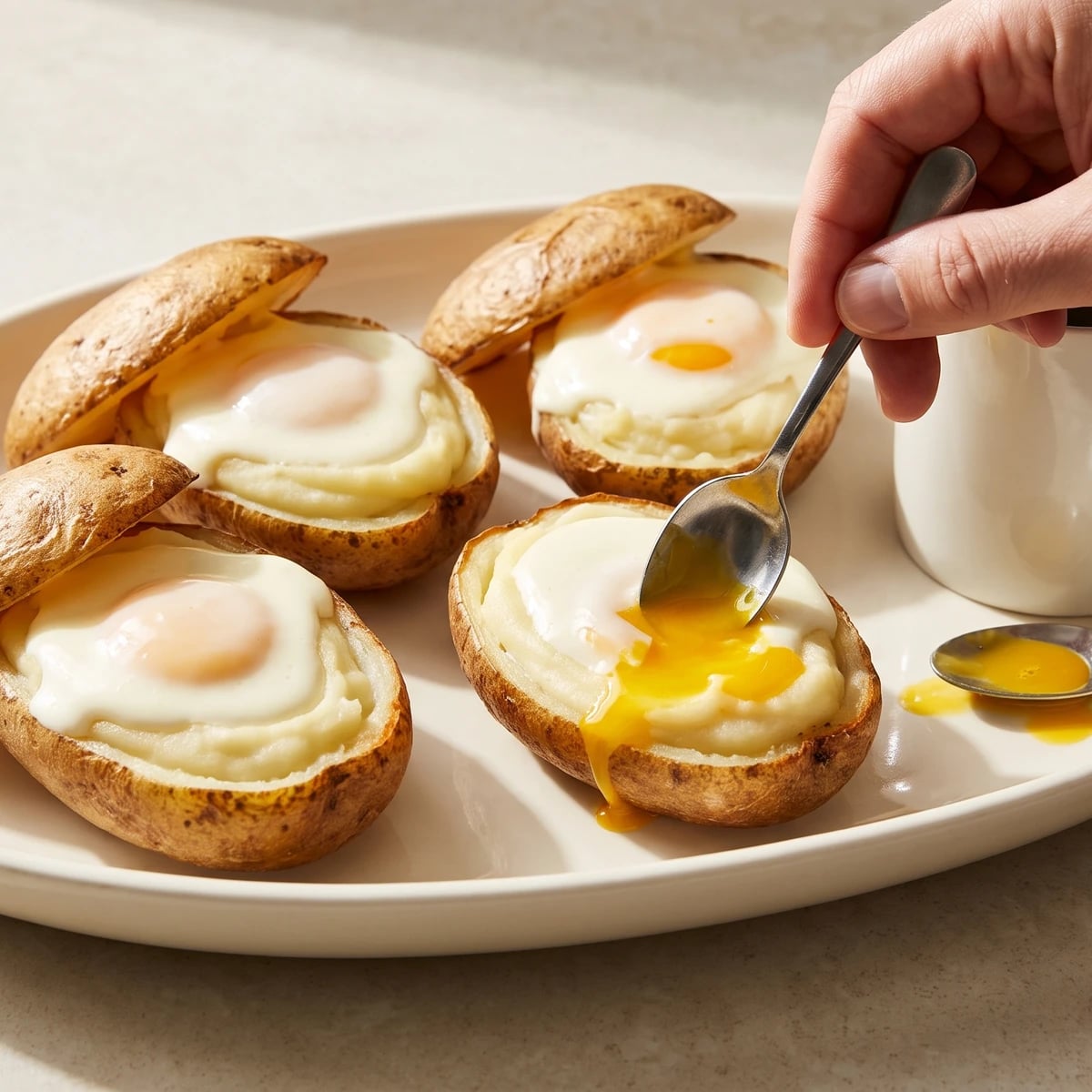
When the Œufs Parmentier are right, each crisp-skinned potato opens beneath its little lid to reveal ivory purée, a tender white, and a yolk that runs into the cream at the first spoonful. Give the potatoes their full first bake. Everything good in the dish follows from that dry, yielding flesh.

Œufs Parmentier belong to the Parisian classical repertoire, where Parmentier identifies a preparation centered on potatoes, honoring the pharmacist and agronomist Antoine-Augustin Parmentier and his work securing the tuber's place at the French table. The dish passed naturally from the codified grand kitchen into bourgeois home cooking because its refinement rests on thrift: the potato provides both the edible case and the purée cushioning the egg. Despite its formal name and oval lid, it is not a regional farmhouse specialty but a composed egg dish from the national canon.

The technique, the tradition, and the story behind every dish.

Discover Culinary Explorer

Ingredients

large floury baking potatoes, such as russets

Quantity

4 large (about 12 oz / 340 g each; 3 lb / 1.36 kg total)

unsalted butter

Quantity

2 tablespoons (30 ml / 28 g)

heavy cream

Quantity

¼ cup (60 ml / 60 g)

divided

fine salt

Quantity

1 teaspoon (5 ml / 6 g)

divided

ground white pepper

Quantity

¼ teaspoon (1.25 ml / 0.5 g)

large eggs

Quantity

4

at room temperature

Equipment Needed

  • Rimmed baking sheet
  • Small paring knife
  • Sturdy teaspoon
  • Fine-mesh sieve or potato ricer
  • Medium mixing bowl
  • 4 small cups for cracking the eggs
  • Aluminum foil for optional support rings

Instructions

  1. 1

    Bake the potatoes

    Heat the oven to 425°F (220°C) with a rack in the middle and a rimmed baking sheet beneath it. Scrub the potatoes, dry them thoroughly, and prick each twice with the tip of a knife. Set them directly on the rack and bake for 50 to 65 minutes, until the skins feel dry and a slender knife passes through the centers without resistance. If the center offers even a little firmness, give it another five minutes; an underbaked potato makes grainy purée and tears when hollowed.

    Choose potatoes of equal size so they finish together. Floury flesh matters more than pedigree here; waxy potatoes turn dense when worked and make weak shells.
  2. 2

    Cut and hollow

    Lower the oven to 375°F (190°C). Let the potatoes stand for five minutes, only until you can handle them safely. With a small paring knife, cut an oval lid from the top of each potato, angling the blade slightly inward so the lid does not fall through. Lift off the lids and scoop the hot flesh into a bowl, leaving a wall about ¼ inch (6 mm) thick around the sides and base. Work gently near the bottom. If a shell splits, press a spoonful of purée over the tear from inside and support the potato in a loose ring of foil. Ça se rattrape.

  3. 3

    Sieve the purée

    While the flesh is still hot, press it through a fine-mesh sieve or potato ricer. Fold in the butter, 2 tablespoons (30 ml / 30 g) of the cream, ¾ teaspoon (3.75 ml / 4.5 g) of the salt, and all the white pepper. Stir only until smooth; a blender or prolonged beating ruptures the starch and turns the purée elastic. If it feels too firm to spread, work in 1 teaspoon of the reserved cream and subtract that amount from the topping. Half-fill each shell with purée, then make a broad, shallow hollow in the center for the egg. Do not force in the surplus purée, because the egg needs room.

  4. 4

    Nest the eggs

    Arrange the filled shells upright on the baking sheet, using loose foil rings if they wobble. Crack each egg into a small cup before slipping it into its potato; this protects the other three if one yolk breaks. If an egg threatens to overflow, hold back the yolk with a spoon and leave a little of the thin white in the cup. Divide the remaining cream over the eggs, about 1½ teaspoons per potato, and sprinkle with the remaining salt.

  5. 5

    Bake to a tremble

    Bake for 9 to 13 minutes. Begin checking at eight: the whites should look opaque around the edges and softly set beside the yolks, while the yolks still tremble when the sheet is nudged and the cream keeps its gloss. If the whites remain translucent when the yolks are nearly ready, lay the potato lids loosely over the yolks to shield them and bake for one or two minutes more. Do not wait for the eggs to look firm throughout, because their heat carries on working after they leave the oven.

  6. 6

    Replace lids and serve

    Rest the potatoes for two minutes, then replace each oval lid slightly askew so the egg remains visible. Transfer them to a warm shallow platter or individual plates and serve immediately. The original napkin supplied grip and ceremony; the platter does the practical work without hiding the crisp skins. Break through yolk, cream, and purée in one spoonful. À table!

Chef Tips

  • Russets are the dependable replacement for the source's fine Dutch potatoes. Their dry, floury interiors make a smooth purée, while their substantial skins survive hollowing and the second bake.
  • Use large eggs rather than extra-large or jumbo. Potato cavities vary, and holding back a spoonful of thin white is better than letting the egg spill down the shell.
  • Surplus purée is expected. A brigade sent it to another preparation; at home, cool it promptly and keep it covered in the refrigerator for up to three days, ready for potato cakes or croquettes.
  • For anyone who should avoid softly cooked eggs, use pasteurized shell eggs or continue baking until both white and yolk are fully set. The texture changes, but the potato and cream remain generous.
  • For dinner, pour a dry Chenin Blanc or a light Beaujolais and add only a simply dressed green salad alongside. The potato needs no decorative garnish.

Advance Preparation

  • The potatoes may be baked, hollowed, lined with purée, and refrigerated for up to four hours. Before adding the eggs, warm the filled shells at 375°F (190°C) for about 10 minutes so a cold potato does not leave the egg white undercooked.
  • Add the eggs and cream only when you are ready for the final bake. Fully cooked Œufs Parmentier do not wait gracefully, because the yolks continue setting inside the hot shells.
  • Bring refrigerated eggs toward room temperature for about 20 minutes before baking. They cook more evenly inside the warm potatoes.

Frequently Asked Questions

Nutrition Information

1 serving (about 325g)

Calories
450 calories
Total Fat
16 g
Saturated Fat
9 g
Trans Fat
0 g
Unsaturated Fat
7 g
Cholesterol
220 mg
Sodium
670 mg
Total Carbohydrates
62 g
Dietary Fiber
4 g
Sugars
3 g
Protein
14 g

Note: Chef personas and recipes are created with AI assistance. Cook with care: follow safe food-handling practices, check doneness with a thermometer when needed, and adapt for allergies and your kitchen.

Where cooking meets culture.

Culinary guides, cultural storytelling, and the editorial depth that makes cooking meaningful.

Discover Culinary Explorer