
Chef Juliette
Ordinary or White Consommé
Beef shin, lean beef, and fowl begin in cold water and rise slowly toward a tremble. Skim before the boil, and you learn the quiet discipline that gives every clear French broth its backbone.
A cooking platform built around craft, culture, and the stories behind what we eat.
Created by Chef Juliette
Consommé de poisson proves that clarity begins with flavor: a strong white fish stock, patient clarification, and no hard boil, served brilliant and clean at the special-occasion table.
Consommé de poisson (clear fish broth) teaches a stern and useful truth: clarification can polish flavor, but it cannot invent it. Before you touch a pan, taste the White Fish Stock (No. 11) cold. It must be clean, distinctly fish-sweet, and a shade stronger than the broth you hope to serve, because the raft will take a little character with the cloudiness.
The brigade formula assumed a saucier on staff, a stockpot never off the fire, and enough volume to forgive what remained in the cloth. A home kitchen needs one tall, heavy pot, a damp cloth-lined sieve, and enough stock to finish about two quarts. What changes is the quantity, not the method. The perpetual stockpot and service-scale handling are scaffolding and can go; the cold start, the fish-and-egg raft, and the slow tremble are the dish, and they stay. One cook, one stove, one evening.
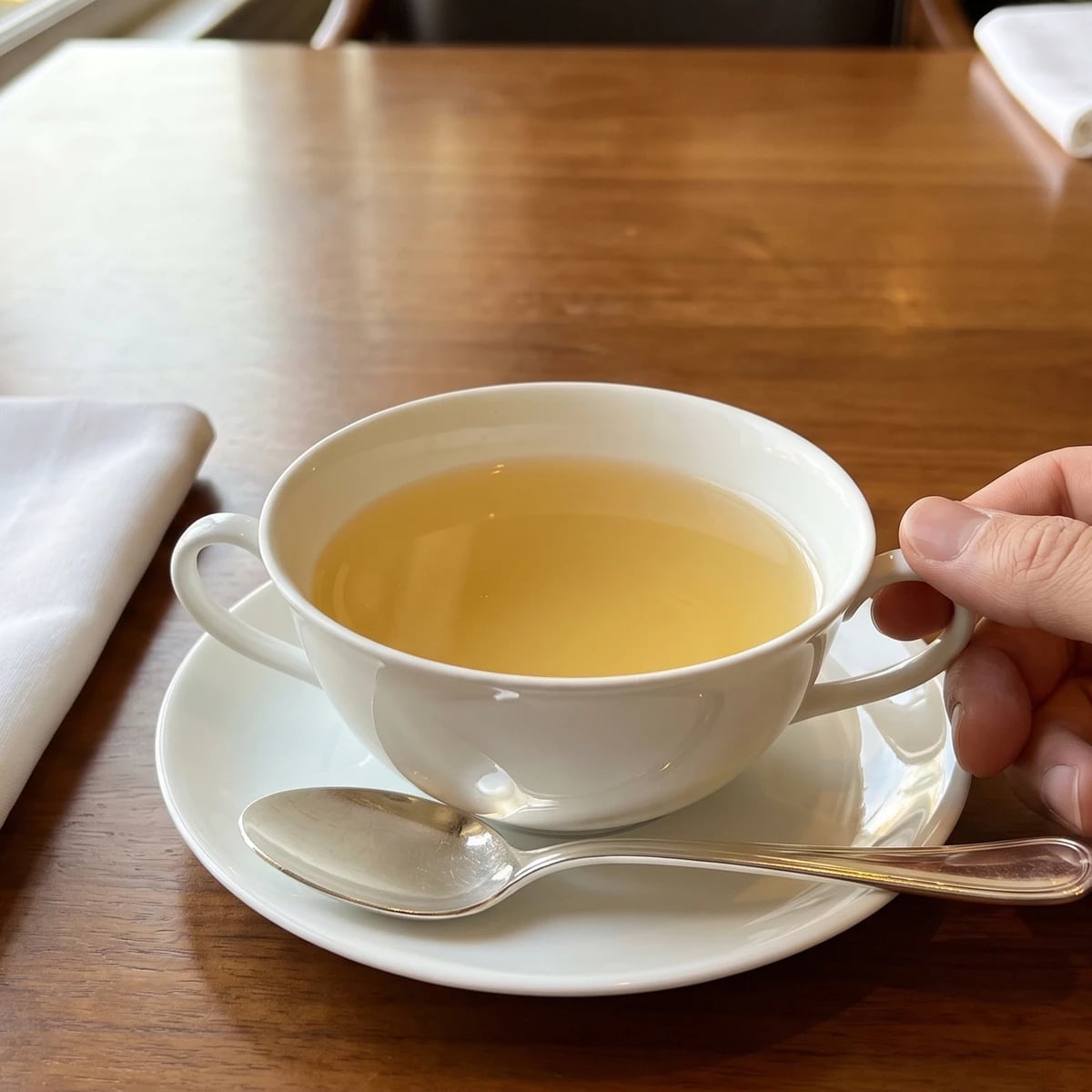
Done well, the consommé is brilliant and pale gold, with the fragrance of the sea but none of its heaviness. The moment that decides it comes as the raft rises: stop stirring, open a chimney through its center, and never let the pot boil.
Consommé de poisson belongs to the French Lenten table and the classical grand kitchen, where cooks needed a clear first course when meat broth was forbidden. Fish fumet, the concentrated essence drawn from bones and trimmings, more often gave its strength to thick soups, where its delicacy had body around it. The canon's own verdict is surprisingly unsentimental: unless a strictly Lenten broth is required, an ordinary consommé finished with essence from sole or whiting bones tastes fuller and less flat.
Quantity
10 cups (2.4 L / 2.4 kg) White Fish Stock (No. 11)
Quantity
2 packed cups (475 ml / 450 g)
kept very cold and finely minced
Quantity
½ cup (120 ml / 120 g), from 4 large eggs
Quantity
¼ cup (60 ml / 60 g), from 2 large eggs
kept cold
Quantity
Up to 1 teaspoon (5 ml / 6 g)
added to taste
| Ingredient | Quantity |
|---|---|
| cold White Fish Stock | 10 cups (2.4 L / 2.4 kg) White Fish Stock (No. 11) |
| skinless sole or whiting filletkept very cold and finely minced | 2 packed cups (475 ml / 450 g) |
| egg whites | ½ cup (120 ml / 120 g), from 4 large eggs |
| egg whites for reclarification (optional)kept cold | ¼ cup (60 ml / 60 g), from 2 large eggs |
| fine sea saltadded to taste | Up to 1 teaspoon (5 ml / 6 g) |
Taste the White Fish Stock (No. 11) while it is cold, when excess salt, stale flavors, and any trace of bitterness cannot hide. It should taste clean and slightly more concentrated than a finished soup. Lift away every scrap of set fat, measure 2 cups into a bowl, and pour the remainder into a tall, heavy pot.
Pulse or mince the cold sole or whiting until it forms a coarse paste. Stir in the 4 egg whites without whipping them into a foam, then loosen the mixture gradually with the reserved 2 cups of stock. Pour this clarification into the pot and stir until it is evenly dispersed. The mixture will look milky and unpromising. It is exactly right.
Set the pot over medium-low heat and stir slowly but constantly, reaching across the entire bottom so nothing catches. As the liquid grows hot, the fish and egg whites will gather the suspended particles and rise into a pale raft. At the first lazy bubble, stop stirring completely. Open a 5 cm chimney through the center with the handle of a spoon. If the pot begins to boil, lift it from the heat at once and lower the flame; if the raft tears, let it settle for 5 minutes, open a fresh chimney, and resume over gentler heat. Do not stir it back together.
Keep the consommé at the faintest tremble for 25 minutes, with small bubbles appearing only inside the chimney. A rolling boil breaks the raft and drives its captured particles back into the broth. Every few minutes, spoon a little clear liquid from the chimney over any part of the raft that looks dry, taking care not to disturb its structure.
Dampen a double layer of cheesecloth with cold water, wring it well, and lay it in a fine sieve over a clean pot. Ladle the consommé through slowly, working from the chimney and leaving the heavy sediment behind. Never pour the entire raft into the sieve and never press it, because pressure returns the very cloudiness you removed. If the strained broth remains hazy, cool it until lukewarm, whisk in the 2 reserved egg whites, and repeat the slow heating, raft, and straining process. Ça se rattrape.
Draw a spoon or a clean piece of absorbent paper lightly across the surface to remove any remaining fat. Reheat the consommé only to a quiet tremble, then add the salt gradually; reduction and clarification concentrate seasoning, so taste before every addition. Ladle it into warmed consommé cups or a warmed soupière without garnish, letting its clarity show. À table!
1 serving (about 240g)
Culinary guides, cultural storytelling, and the editorial depth that makes cooking meaningful.
Discover Culinary Explorer
Chef Juliette
Beef shin, lean beef, and fowl begin in cold water and rise slowly toward a tremble. Skim before the boil, and you learn the quiet discipline that gives every clear French broth its backbone.

Chef Juliette
Break the veal bones small, then give them eight hours at a bare tremble. This pale, gelatinous fond becomes the quiet foundation beneath velouté, blanquette, and every sauce that must stay light.

Chef Juliette
Fumet de poisson blanc turns sole or whiting bones, blanched onion, parsley, lemon, and wine into a pale, delicate foundation in twenty minutes. Cook it longer and you cook the savour straight out.

Chef Juliette
Fumet de poisson au vin rouge draws matching fish bones, onion, garlic, thyme, and a bottle of red for half an hour, yielding the wine-dark foundation that gives matelotes their depth.