Culinary Explorer

A cooking platform built around craft, culture, and the stories behind what we eat.
Discover Culinary Explorer
Stuffed Olives

Stuffed Olives

Created by Chef Juliette

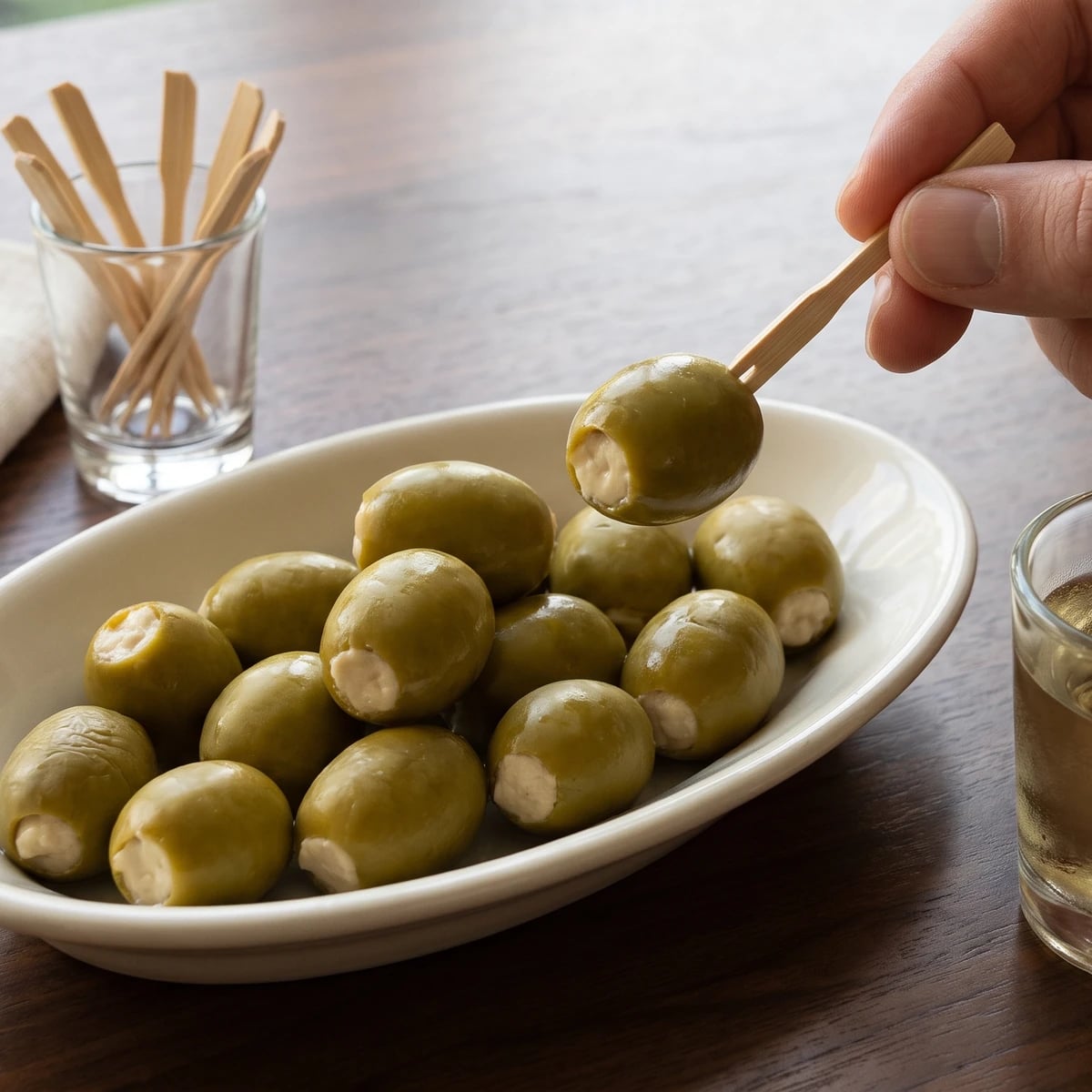
Large Spanish olives spiral-stoned, piped with a cool poultry cream, and briefly tempered before serving, so their flesh stays plump and their oil is left on the towel, not the plate.

Appetizers & Snacks
French
Dinner Party
Make Ahead
Special Occasion
35 min
Active Time
0 min cook1 hr 25 min total
Yield24 olives (6 appetizer servings)

Olives farcies (stuffed olives) teach a small but exact lesson: cold fat and oil move when temperature changes. An olive can be neatly stoned and generously filled, yet if it goes straight from its oil bath to the platter, it releases that oil in front of your guests. Temper first, drain second, plate last. That is the dish.

The original entry assumed a special stoning machine, a cold larder, and bowls of hors-d'œuvre fillings ready for service. At home, an olive pitter or small paring knife replaces the machine, a piping bag replaces a commis's patient spoon, and a snug container keeps twenty-four olives covered without a brigade's basin of oil. This home-scale version chooses Chicken Cream (No. 299) from Butters and Creams (No. 280), leaving that cross-referenced preparation whole while reducing only the amount needed. One cook, one stove, one evening.

The machine and the brigade quantity are scaffolding; they can go. The clean cavity, the cool oil hold, and the final tempering are the dish and must stay. The step that matters most comes at the end: give the olives twenty quiet minutes to release their excess oil before the platter reaches the table.

Olives farcies belong to the cold hors-d'œuvre service of Parisian dining rooms and grand hotels, where small, highly seasoned bites opened the meal and a pantry of compound butters and creams supplied many forms. The call for large Spanish olives is deliberate, not a Provençal claim: their generous cavity and firm flesh made them practical to stone and fill, while Provence kept its own regional olive preparations. From formal service the bite passed easily to the French home apéritif tray, still cool and creamy, and entirely distinct from Italy's breaded, fried stuffed olives.

The technique, the tradition, and the story behind every dish.

Discover Culinary Explorer

Ingredients

large whole Spanish green olives

Quantity

24, about 1½ cups (360 ml / 300 g drained)

unpitted and drained

prepared hors-d'œuvre filling

Quantity

⅓ cup (80 ml / 75 g) from Butters and Creams (No. 280), specifically Chicken Cream (No. 299)

freshly made and cold but pipeable

mild olive oil

Quantity

1 to 1¼ cups (240 to 300 ml / 220 to 275 g)

enough to cover the olives in a snug container

Equipment Needed

  • Olive pitter or 8 cm paring knife
  • Piping bag with 6 mm plain tip
  • 500 ml narrow lidded container
  • Small rack or fine-mesh sieve set over a tray
  • Absorbent kitchen paper

Instructions

  1. 1

    Ready the filling

    Transfer the prepared filling from Butters and Creams (No. 280), specifically Chicken Cream (No. 299), to a piping bag fitted with a 6 mm plain tip. Keep it in the cold while you stone the olives; do not rework or season it here, because its preparation belongs to its own entry. If it becomes too firm to pipe, leave the closed bag at room temperature for three minutes and knead it gently. If it turns slack, chill it for ten minutes.

  2. 2

    Stone the olives

    Pat the olives dry. With a pitter, align each olive along its long axis and press the stone out cleanly. With a paring knife, begin near the stem and rotate the olive against the blade, cutting one continuous spiral around the stone; lift out the stone, then wind the flesh back into its original shape. Keep the walls as even as you can. If a spiral tears, save both pieces and fit them together around the filling with the seam underneath.

  3. 3

    Fill the cavities

    Pipe into one end of each olive until the cream just appears at the opposite opening, then add a final small touch at the first end. Wipe away any excess and keep the olive plump, not swollen. If the flesh begins to split, remove a little filling and press the olive gently back into shape; an overfilled olive is difficult to drain cleanly.

  4. 4

    Chill under oil

    Arrange the filled olives snugly in a small lidded container without crushing them. Pour over enough olive oil to cover them completely, close the container, and refrigerate for at least thirty minutes and no longer than four hours. Keep them properly cold until the final tempering.

  5. 5

    Temper and drain

    Twenty minutes before serving, lift the olives from the oil with a slotted spoon and set them on a rack over a tray in a moderately warm room, about 20 to 22°C, away from the stove. As the chill leaves them, the saturated flesh will release oil. After fifteen minutes, roll them once onto fresh absorbent paper, blot the openings, and leave them for five minutes more. If oil appears on the serving dish, return the olives to fresh paper, wipe the dish, and replate them. Ça se rattrape.

  6. 6

    Plate and serve

    Arrange the olives in one generous layer and serve at once, while the filling remains cool but supple and the skins carry a soft satin sheen. Add neither extra oil nor a reflex garnish; the olive and its cream are complete. À table!

Chef Tips

  • Choose large whole Spanish olives such as Gordal or Queen olives. Their broad cavity and firm flesh matter more than expense; small olives turn this into unnecessary needlework.
  • Buy the olives unpitted if possible. Factory-pitted fruit often has a ragged tunnel and softened walls, while a clean home cut leaves enough flesh to hold the cream.
  • Use the smallest container that holds the olives without crowding. They must remain covered with oil, but a snug container saves you from pouring half a bottle around empty space.
  • Serve with a dry white wine of bright acidity, such as Muscadet, or a dry Crémant. The wine should clear the cream and answer the olive's salt, not compete with either.

Advance Preparation

  • The olives may be stoned up to one day ahead and refrigerated in their original brine. Drain and dry them thoroughly before filling.
  • Fill the olives and hold them under oil for up to four hours on the day of serving. Keep them refrigerated; the poultry cream is at its best freshly prepared.
  • The final twenty-minute tempering and draining must happen shortly before service. Doing it early only lets the olives absorb and release oil again.

Frequently Asked Questions

Nutrition Information

1 serving (about 57g)

Calories
130 calories
Total Fat
13 g
Saturated Fat
2 g
Trans Fat
0 g
Unsaturated Fat
11 g
Cholesterol
10 mg
Sodium
650 mg
Total Carbohydrates
2 g
Dietary Fiber
1 g
Sugars
0 g
Protein
2 g

Note: Chef personas and recipes are created with AI assistance. Cook with care: follow safe food-handling practices, check doneness with a thermometer when needed, and adapt for allergies and your kitchen.

Where cooking meets culture.

Culinary guides, cultural storytelling, and the editorial depth that makes cooking meaningful.

Discover Culinary Explorer

More from Hors-d’Œuvres

Browse the full collection