
Chef Juliette
Butters and Creams
Beurres et crèmes d’hors-d’œuvre prove that cold-table finesse is mostly timing: smooth good dairy, cover it closely, hold it cool, then season only as you dish so every spoonful keeps a clean edge.
A cooking platform built around craft, culture, and the stories behind what we eat.
Created by Chef Juliette
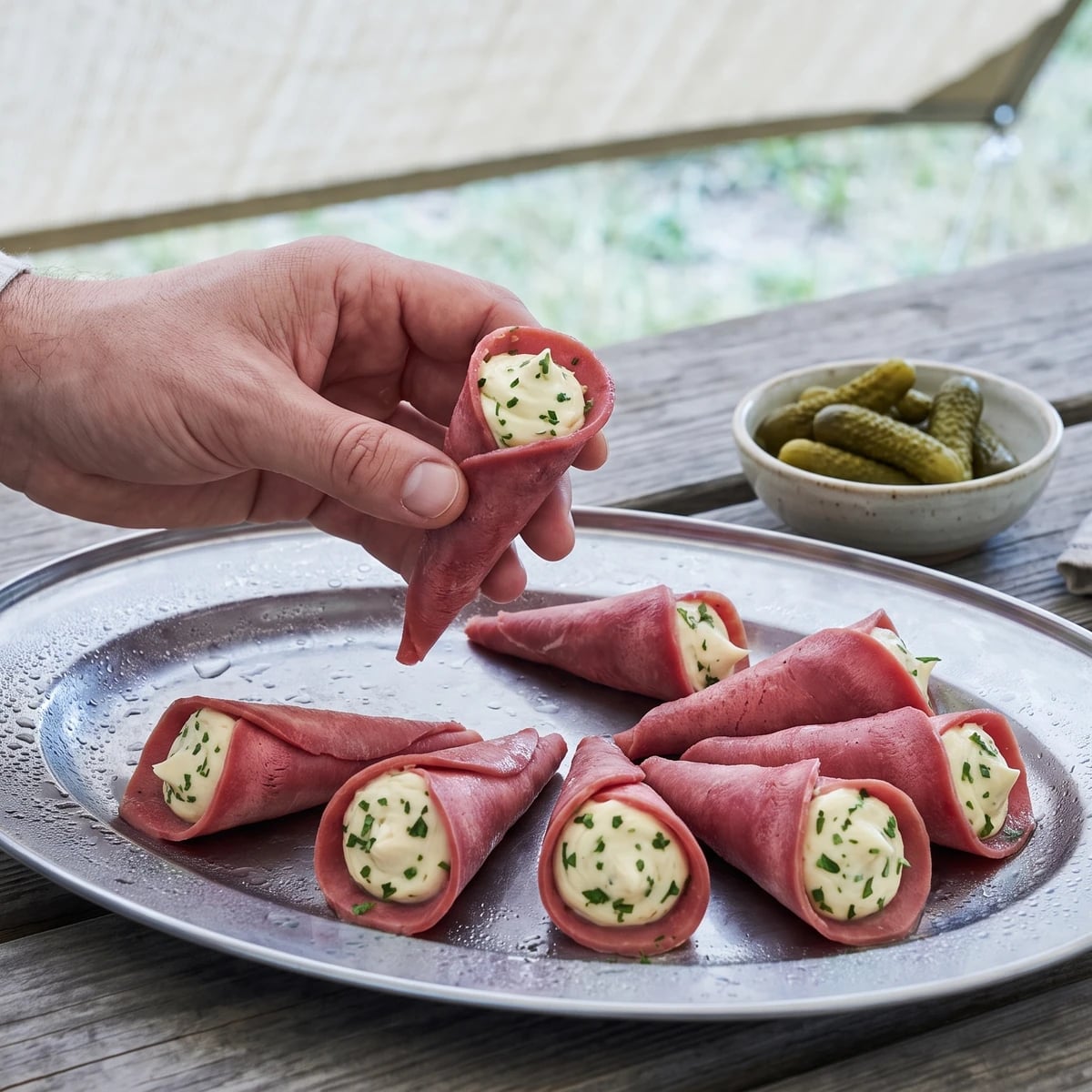
Paper thinness makes Cornets de Langue Écarlate: rosy red salted tongue curled around a mustard-bright butter, chilled just firm enough to hold, then set out for drinks, dinner, or the picnic basket.
Cornets de Langue Écarlate (red salted tongue cones) teach the small discipline of cold hors-d'oeuvre work: shape comes from the slice, not force. The thinner and colder the tongue, the more cleanly it curls; a thick slice buckles, and no piping bag can disguise it.
The original entry's brisk instruction, "Proceed as for York Cones," assumed a garde-manger with cooked tongue beside a slicing machine and bowls of prepared butter ready for service. No saucier, stockpot, or salamander belongs here. For one cook, the honest equivalent is eight deli-thin slices and a small bowl of beurre d'hors-d'oeuvre (seasoned appetizer butter), whipped by hand and piped from an ordinary bag. The brigade quantity and machinery were scaffolding; the paper-thin tongue, neat cone, and cool filling are the dish and must stay.
Once filled, the cornets are rosy, silky, salty, and mustard-bright, with the ivory butter holding each delicate roll in place. Have the tongue cut nearly translucent before you begin. That is the step that decides the dish.
Cornets de langue belong to the cold hors-d'oeuvre repertoire of Parisian hotel kitchens and bourgeois dining rooms, where the garde-manger shaped ham, smoked fish, and cured tongue into small bites for the opening table. Langue écarlate takes its name from the rosy-red appearance of cured cooked tongue, not from a peppery preparation. The reference to York Cones describes a shared method borrowed from ham cornets: thin slicing, rolling, and filling, with tongue substituted for the ham.
Quantity
8 paper-thin slices (about 8 oz / 225 g)
chilled and sliced about 1 mm thick
Quantity
1/2 cup (120 ml / 113 g)
softened but still cool
Quantity
2 teaspoons (10 ml / 10 g)
Quantity
1 teaspoon (5 ml / 5 g)
Quantity
1 tablespoon (15 ml / 4 g)
very finely chopped
Quantity
2 teaspoons (10 ml / 3 g)
very finely sliced
Quantity
1/8 teaspoon (0.6 ml / 0.3 g)
finely ground
| Ingredient | Quantity |
|---|---|
| cooked red salted beef tonguechilled and sliced about 1 mm thick | 8 paper-thin slices (about 8 oz / 225 g) |
| unsalted buttersoftened but still cool | 1/2 cup (120 ml / 113 g) |
| Dijon mustard | 2 teaspoons (10 ml / 10 g) |
| fresh lemon juice | 1 teaspoon (5 ml / 5 g) |
| flat-leaf parsleyvery finely chopped | 1 tablespoon (15 ml / 4 g) |
| chivesvery finely sliced | 2 teaspoons (10 ml / 3 g) |
| white pepperfinely ground | 1/8 teaspoon (0.6 ml / 0.3 g) |
Keep the tongue cold until you are ready to work. Lay the slices flat and blot away surface moisture with a clean towel; wet tongue slides apart instead of holding its fold. Each slice should be supple and nearly translucent, about 1 mm thick. Trim only a ragged edge that prevents a clean overlap. If a slice has torn, place the tear where the sides will overlap. Ça se rattrape, and the filling will reinforce it.
Beat the cool butter with a wooden spoon or hand mixer until pale, smooth, and pliable, but not oily. Work in the Dijon mustard, then add the lemon juice a few drops at a time. Fold in the parsley, chives, and white pepper. Taste before adding any salt; the tongue supplies plenty. If the butter looks greasy, chill it for 5 minutes and beat again. If it is stiff or the lemon beads on its surface, warm the outside of the bowl between your hands and keep beating until it comes together. Ça se rattrape.
Place a pea-sized dab of butter near one long edge of each tongue slice. Bring the two long sides together, overlapping them by about 1/2 inch (1.25 cm), while narrowing one end into a point and leaving the other end open. Press the overlap gently onto the dab of butter and set the cornet seam-side down. Do not squeeze the tongue or pull it tight; a cornet is folded into shape, not trussed into submission.
Transfer the remaining beurre d'hors-d'oeuvre to a piping bag fitted with a 1/2-inch (12 mm) plain or open-star tip. Pipe from the pointed end upward so no hollow pocket remains, stopping when the butter sits just proud of the open rim. If the pressure begins to split the tongue, the butter is too cold. Scrape it back into the bowl, soften it briefly with the spoon, and continue.
Arrange the cornets seam-side down on a chilled platter and refrigerate for 30 minutes, just long enough for the butter to hold the rolls securely. Take them from the cold 10 minutes before serving so the filling is cool and creamy rather than hard. Allow two per person, and keep them properly chilled if they travel to a picnic. Cooking well is not cooking fancy. À table!
1 serving (about 90g)
Culinary guides, cultural storytelling, and the editorial depth that makes cooking meaningful.
Discover Culinary Explorer
Chef Juliette
Beurres et crèmes d’hors-d’œuvre prove that cold-table finesse is mostly timing: smooth good dairy, cover it closely, hold it cool, then season only as you dish so every spoonful keeps a clean edge.

Chef Juliette
Beurre d’Anchois turns two ingredients into a silky, deeply savoury spread. Pounding makes them one, but the fine sieve finishes the work, removing every fibre and pin bone before the butter reaches bread.

Chef Juliette
Beurre de caviar turns two ingredients into a polished cold-table spread: keep the butter cool, pound until completely uniform, then pass it fine so every bite carries the roe's full salt-brine.

Chef Juliette
Whole shell-on shrimp, equal butter, and two patient passes make a rose-pink beurre de crevettes with remarkable delicacy: a small classical preparation whose silk depends entirely on the second straining.