
Chef Juliette
Butters and Creams
Beurres et crèmes d’hors-d’œuvre prove that cold-table finesse is mostly timing: smooth good dairy, cover it closely, hold it cool, then season only as you dish so every spoonful keeps a clean edge.
A cooking platform built around craft, culture, and the stories behind what we eat.
Created by Chef Juliette
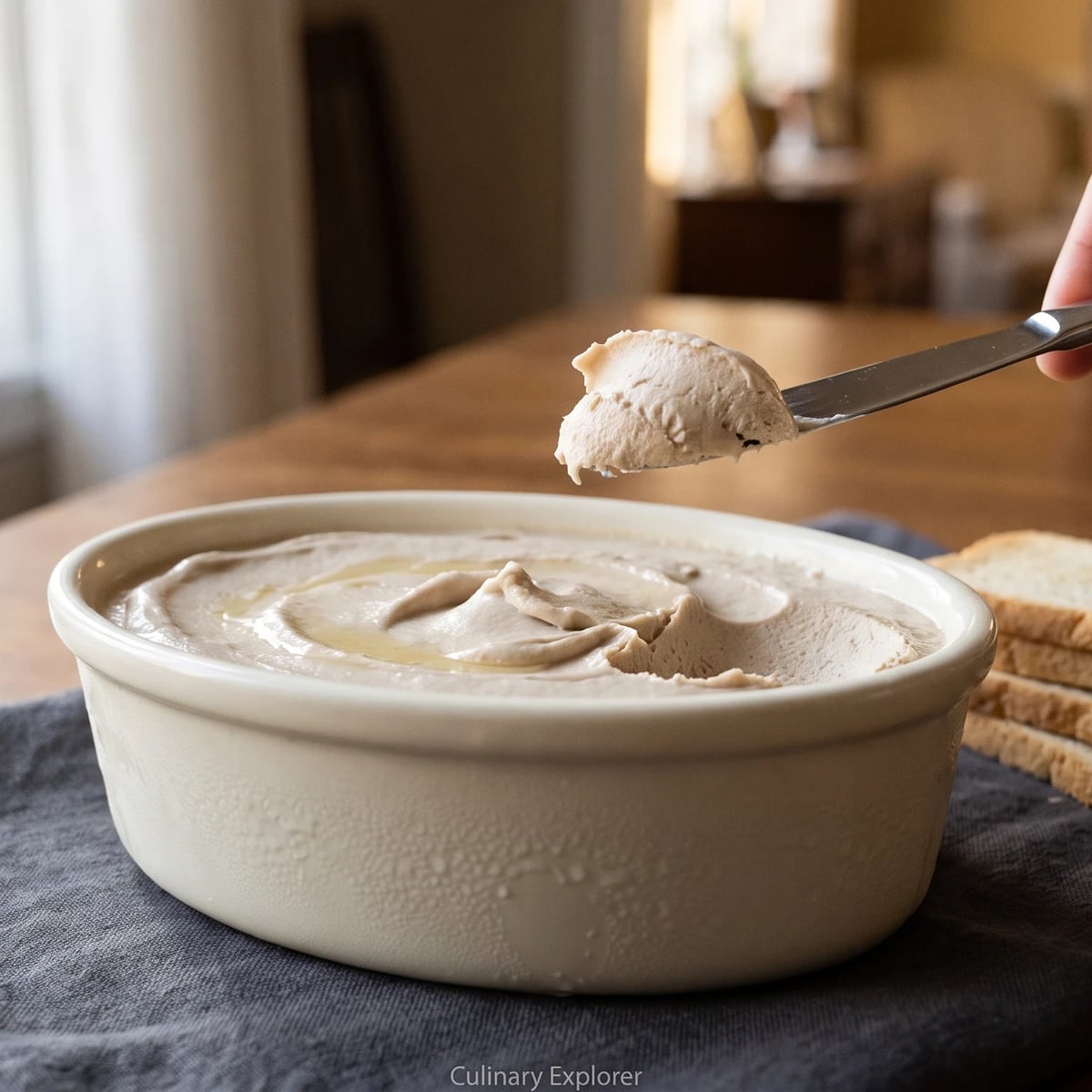
Crème de gibier turns a small piece of cold roast into a generous hors d'oeuvre: game worked with butter and cream, sieved to silk, then lightened for the first toast.
Crème de gibier teaches the double work of refinement: first make cooked game completely smooth, then give it back lightness with whipped cream. The one true thing is that the sieve is not decorative. It removes the last fibres a blade only shortens, and without it you have a pleasant pâté, not this crème.
The original assumed a mortar, a tamis (drum sieve), and brigade hands willing to pound four ounces of game until no fibre remained. A mini food processor now takes over the armwork, and a sturdy fine-mesh sieve replaces the tamis. That armwork was scaffolding and can go; the sieving and final fold are the dish and must stay. The source quantity is already suited to a home dinner party, yielding eight small portions, so its proportions remain untouched. One cook, one stove, one evening, with the stove left cold.
Keep the game and cream cold while the butter stays softly pliable, never melted or shiny. Whip the finishing cream only to soft peaks and fold without beating. That final fold decides whether the Crème de gibier reaches the table light and silken or merely dense.
Crème de gibier belongs to the garde-manger (cold station) of the classical French kitchen, particularly the cold hors d'oeuvre and buffet table where remnants of roasted grouse, partridge, pheasant, hare, or venison were carried into another service. It is not attached to one province; it grew from the national practice of turning a small quantity of cooked game into a refined first course, moving naturally between hunting households and grand kitchens. The name crème describes its sieved, butter-rich consistency here, not a soup, and its identity lies in pounding, sieving, and folding rather than any regional garnish.
Quantity
About ¾ cup (4 oz / 113 g)
stripped of skin, bone, gristle, sinew, and any shot traces
Quantity
3 tablespoons (45 ml / 45 g)
chilled, for pounding
Quantity
4 tablespoons (60 ml / 2 oz / 57 g)
softened but not greasy
Quantity
3 tablespoons (45 ml / 45 g)
very cold, for whipping
| Ingredient | Quantity |
|---|---|
| cold cooked game meatstripped of skin, bone, gristle, sinew, and any shot traces | About ¾ cup (4 oz / 113 g) |
| fresh heavy creamchilled, for pounding | 3 tablespoons (45 ml / 45 g) |
| unsalted buttersoftened but not greasy | 4 tablespoons (60 ml / 2 oz / 57 g) |
| fresh heavy creamvery cold, for whipping | 3 tablespoons (45 ml / 45 g) |
Chill a small narrow bowl and balloon whisk for 10 minutes, and keep the cream cold until needed. Let the butter soften only until a fingertip leaves a clean dent; it must remain matte, not shiny. Pick through the cooked game carefully, removing every scrap of skin, bone, gristle, sinew, and any trace of shot, then tear the meat into small pieces. Cold meat gives the softened butter enough resistance to form a smooth paste rather than an oily one.
Put the cold game, the first 3 tablespoons (45 ml / 45 g) cream, and the softened butter in a mini food processor. Pulse several times, scraping down the bowl, then process just until the mixture becomes a uniform, close paste, about 20 to 30 seconds. Do not let the motor warm it. If the paste begins to shine or show beads of butter, stop, chill the processor bowl for 10 minutes, then bring it together with three brief pulses.
Set a sturdy fine-mesh sieve over a clean bowl. Press the game paste through in small spoonfuls with a flexible scraper or the back of a metal spoon, working firmly against the mesh. Scrape every bit of the smooth paste from the underside and discard the dry fibres left above. A processor shortens fibres; the sieve removes them. If the butter firms before the paste has passed through, leave it at cool room temperature for 3 minutes, then continue rather than adding more cream and weakening the formula.
Whisk the final 3 tablespoons (45 ml / 45 g) cold cream in the chilled bowl until it holds soft, drooping peaks. If it begins to look grainy, stop at once. Ça se rattrape: stir a spoonful of the sieved game base gently into the cream until it smooths, then proceed. Work one-third of the whipped cream briskly into the game base to loosen it, then fold in the remainder with broad turns of the scraper, stopping as soon as no white streaks remain. The first cream makes the paste; the second gives it air.
Spoon the Crème de gibier into a small serving dish, leaving the surface in generous soft folds rather than packing it down. Cover tightly and chill for at least 2 hours so the butter sets the structure. Bring it out 10 to 15 minutes before serving; it should remain cool but yield easily to a spreading knife. Offer thin plain toast alongside. À table!
1 serving (about 33g)
Culinary guides, cultural storytelling, and the editorial depth that makes cooking meaningful.
Discover Culinary Explorer
Chef Juliette
Beurres et crèmes d’hors-d’œuvre prove that cold-table finesse is mostly timing: smooth good dairy, cover it closely, hold it cool, then season only as you dish so every spoonful keeps a clean edge.

Chef Juliette
Beurre d’Anchois turns two ingredients into a silky, deeply savoury spread. Pounding makes them one, but the fine sieve finishes the work, removing every fibre and pin bone before the butter reaches bread.

Chef Juliette
Beurre de caviar turns two ingredients into a polished cold-table spread: keep the butter cool, pound until completely uniform, then pass it fine so every bite carries the roe's full salt-brine.

Chef Juliette
Whole shell-on shrimp, equal butter, and two patient passes make a rose-pink beurre de crevettes with remarkable delicacy: a small classical preparation whose silk depends entirely on the second straining.