
Chef Juliette
Bombe Aboukir
Bombe Aboukir sets a pale pistachio ice shell around pralined pâte à bombe, cool, nutty, and cleanly sliceable, with chopped pistachios held in a centre as light as frozen mousse.
A cooking platform built around craft, culture, and the stories behind what we eat.
Created by Chef Juliette
Based on No. 2879, Bombe Miss Helyett, from Le Guide Culinaire (1907) by Auguste Escoffier
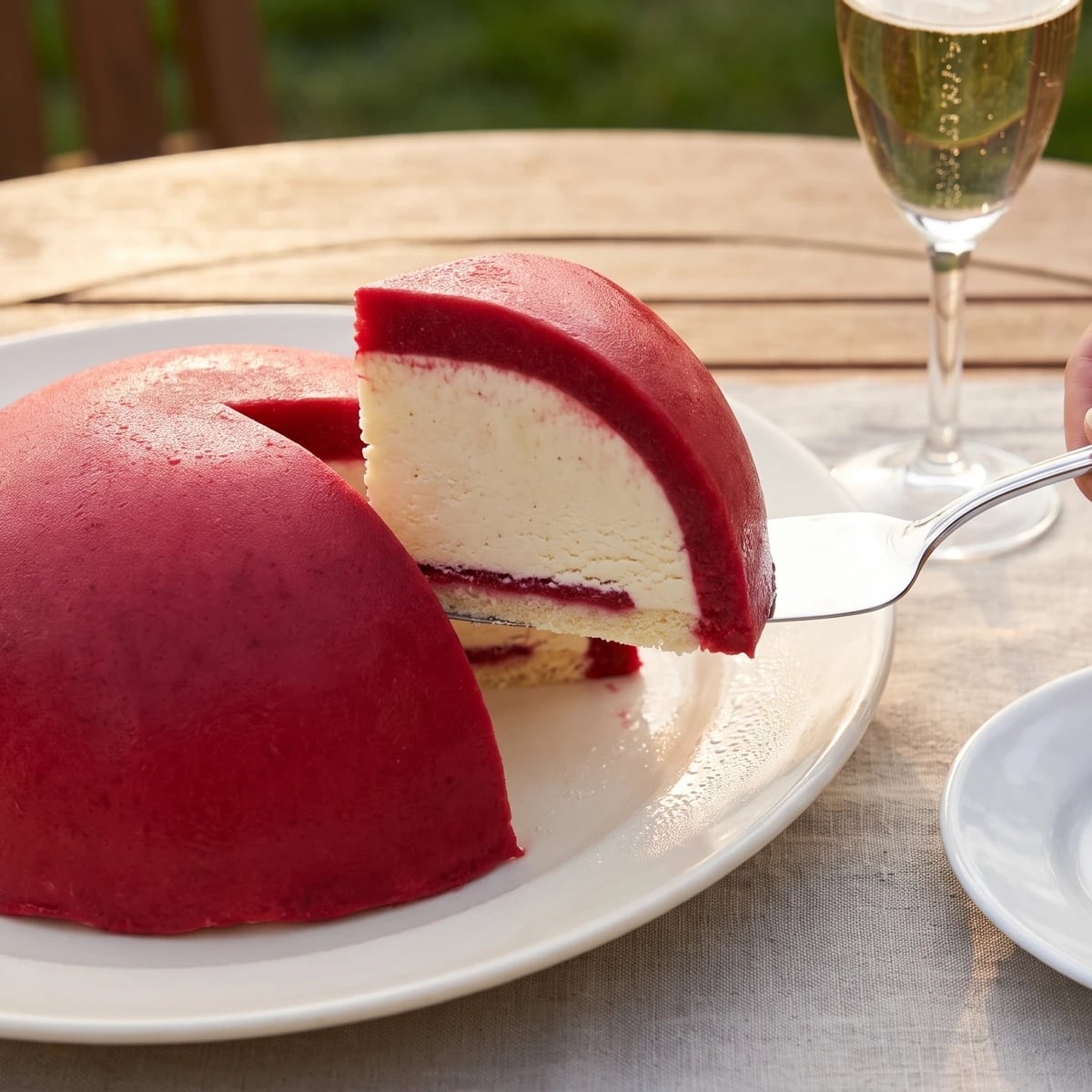
A scarlet shell of raspberry ice around a pale vanilla heart, spread thin, frozen firm, and sliced cleanly. This is the classical bombe brought down to one mould and one attentive cook.
Bombe Miss Helyett (a raspberry-sheathed vanilla frozen bombe) teaches the architecture of a bombe: cold shell first, light filling second. The one true thing is thickness. Make the raspberry shell thin and even, or every slice will eat in hard red blocks around a soft vanilla heart.
The original formula assumed a purpose-built bombe mould packed in salted ice, finished raspberry ice waiting at the pastry station, vanilla Bombe-preparation ready to fill it, and enough hands to keep both at exactly the right softness. A 5-cup metal bowl, a home freezer, and an electric whisk do the same work for eight servings. The brigade's holding and passing are scaffolding and can go; the raspberry ice and vanilla pâte à bombe are the dish, so both stay. One cook, one stove, one evening of making, then the freezer takes the night watch.
Chemiser, to clothe the mould, with the back of a cold spoon. Stop and inspect the shell before filling it. Thin, smooth, and firm is the whole standard, and those five attentive minutes decide the bombe.
Miss Helyett was the title heroine of a Parisian operetta, and her name entered the pastry repertoire through the grand-kitchen custom of naming composed ices after figures from the stage. The dessert belongs to the Parisian service table rather than any raspberry-growing region: its identity is architectural, a tart red outer ice enclosing a rich vanilla center. Its link to a sole aspic is technical, not culinary, because cold aspics and frozen bombes both depend on clothing a mould evenly before it is filled.
Quantity
3 cups (720 ml / 360 g)
thawed if frozen
Quantity
7 tablespoons (105 ml / 90 g)
Quantity
⅓ cup (80 ml / 80 g)
Quantity
6
Quantity
¾ cup (180 ml / 150 g)
Quantity
3 tablespoons (45 ml / 45 g)
Quantity
1
split and scraped
Quantity
1½ cups (360 ml / 360 g)
| Ingredient | Quantity |
|---|---|
| fresh or frozen raspberriesthawed if frozen | 3 cups (720 ml / 360 g) |
| granulated sugar, for the raspberry ice | 7 tablespoons (105 ml / 90 g) |
| water, for the raspberry ice | ⅓ cup (80 ml / 80 g) |
| large egg yolks | 6 |
| granulated sugar, for the vanilla pâte à bombe | ¾ cup (180 ml / 150 g) |
| water, for the vanilla pâte à bombe | 3 tablespoons (45 ml / 45 g) |
| vanilla beansplit and scraped | 1 |
| cold heavy cream | 1½ cups (360 ml / 360 g) |
Put a 5-cup (1.25-liter) metal bombe mould or deep stainless-steel bowl in the freezer for at least 30 minutes. Chill a large metal spoon beside it, along with the platter you will use for unmoulding. Metal takes the cold quickly and releases cleanly; a thick glass bowl is slower to freeze and risks cracking when warmed for unmoulding.
Combine the 7 tablespoons sugar and ⅓ cup water in a small saucepan. Warm gently until the sugar dissolves, then boil for 1 minute and cool for 5 minutes. Blend the raspberries with the syrup until completely smooth, then press the mixture through a fine sieve without grinding the seeds against the mesh. Set the strained base over an ice bath and stir until thoroughly cold. Keeping the fruit away from prolonged heat preserves its sharp flavor and clear scarlet color.
Churn the raspberry base in an ice-cream maker until it holds a furrow like soft clay but remains easy to spread. Without a machine, pour it into a shallow metal tray, freeze until firm around the edges, and beat it vigorously every 30 minutes; once evenly slushy, process it briefly until smooth. Do not freeze it solid before coating the mould. Hard ice tears into ridges instead of lying flat.
Use the coating principle preserved in Another Method of Preparing Aspics de Filets de Soles (No. 916): fix a thin, even layer against a thoroughly cold mould. For Bombe Miss Helyett, the coating is raspberry ice, never jelly. Reserve roughly one quarter of the ice for sealing the base, then spread the remainder over the bottom and sides with the back of the cold spoon, aiming for an even ¼-inch (6 mm) shell. Turn the mould as you work instead of digging at one spot. If the shell becomes lumpy or thick at the crown, scrape that patch back into the bowl, soften it for a few minutes, and spread again. Ça se rattrape. Freeze the coated mould for 45 minutes, until hard.
While the shell hardens, put the ¾ cup sugar and 3 tablespoons water in a clean small saucepan. Warm gently until clear, then bring to a boil without stirring and cook to 244°F (118°C). If crystals appear around the edge, cover the pan for 2 minutes so condensation washes them down, then uncover and continue. Do not scrape crystallized sugar from the sides into the syrup.
Put the egg yolks and vanilla seeds in the mixer bowl and begin whisking when the syrup reaches about 230°F (110°C). At 244°F (118°C), remove the syrup from the heat and pour it in a fine stream down the inside of the bowl while whisking steadily, keeping it away from the moving beaters. This makes pâte à bombe, a hot-syrup yolk foam. The mixture should reach at least 160°F (71°C); if it does not, whisk the bowl over barely simmering water until it does. Beat for 7 to 10 minutes, until pale, thick enough to fall in a ribbon, and no warmer than 79°F (26°C). If it remains warm, set the bowl over ice and keep whisking. Warm pâte à bombe melts the cream and gives a heavy center.
Whip the cold cream to soft peaks that bend at their tips. Stir one third into the cooled pâte à bombe to lighten it, then fold in the remainder in two additions, turning the bowl and cutting through the center with the spatula. Stop as soon as no white streaks remain. If the mixture loosens because the base was still warm, set it over ice for 10 minutes and fold gently until it holds a soft mound again.
Check that the raspberry shell is completely hard. Spoon in the vanilla mixture gradually, pressing it gently against the curves so no hollow pockets remain, and stop about ¼ inch (6 mm) below the rim. Freeze for 30 minutes to steady the filling. Soften the reserved raspberry ice just enough to spread, cover the exposed vanilla in a thin, level layer, and return the bombe to the freezer. Cover once firm and freeze for at least 6 hours, preferably overnight.
Dip the mould to just below its rim in warm water for 5 to 8 seconds, wipe it dry, invert the chilled platter over it, and turn both together. Lift the mould straight up. If the bombe refuses to release, repeat the warm-water dip for 2 seconds; patience, not hotter water. If the raspberry surface becomes soft or glossy, return the unmoulded bombe to the freezer for 15 minutes. Let it stand for 5 minutes before cutting with a hot, dry knife, wiping the blade between slices. À table!
1 serving (about 145g)
Culinary guides, cultural storytelling, and the editorial depth that makes cooking meaningful.
Discover Culinary Explorer
Chef Juliette
Bombe Aboukir sets a pale pistachio ice shell around pralined pâte à bombe, cool, nutty, and cleanly sliceable, with chopped pistachios held in a centre as light as frozen mousse.

Chef Juliette
A thin dark chocolate chemise gives way to golden apricot pâte à bombe, a frozen dinner-party dessert whose elegance depends on spreading the shell evenly before it firms.

Chef Juliette
Apricot ice holds a Kirsch-scented pâte à bombe and ribbons of stewed fruit, frozen into a gleaming dome whose clean layers depend on cold components and thoroughly drained apricots.

Chef Juliette
Strawberry ice forms a bright, clean shell around a satin Kirsch pâte à bombe, a frozen dessert that teaches precise layering, restrained alcohol, and the patience to let each layer set.