
Chef Juliette
Various Almond Preparations
Five almond preparations, one discipline: remove the skins cleanly, dry every kernel through, then cut, toast, or cloak it in pale caramel without letting its fragrant oils escape.
A cooking platform built around craft, culture, and the stories behind what we eat.
Created by Chef Juliette
Based on No. 2845, Bombe Colombia, from Le Guide Culinaire (1907) by Auguste Escoffier
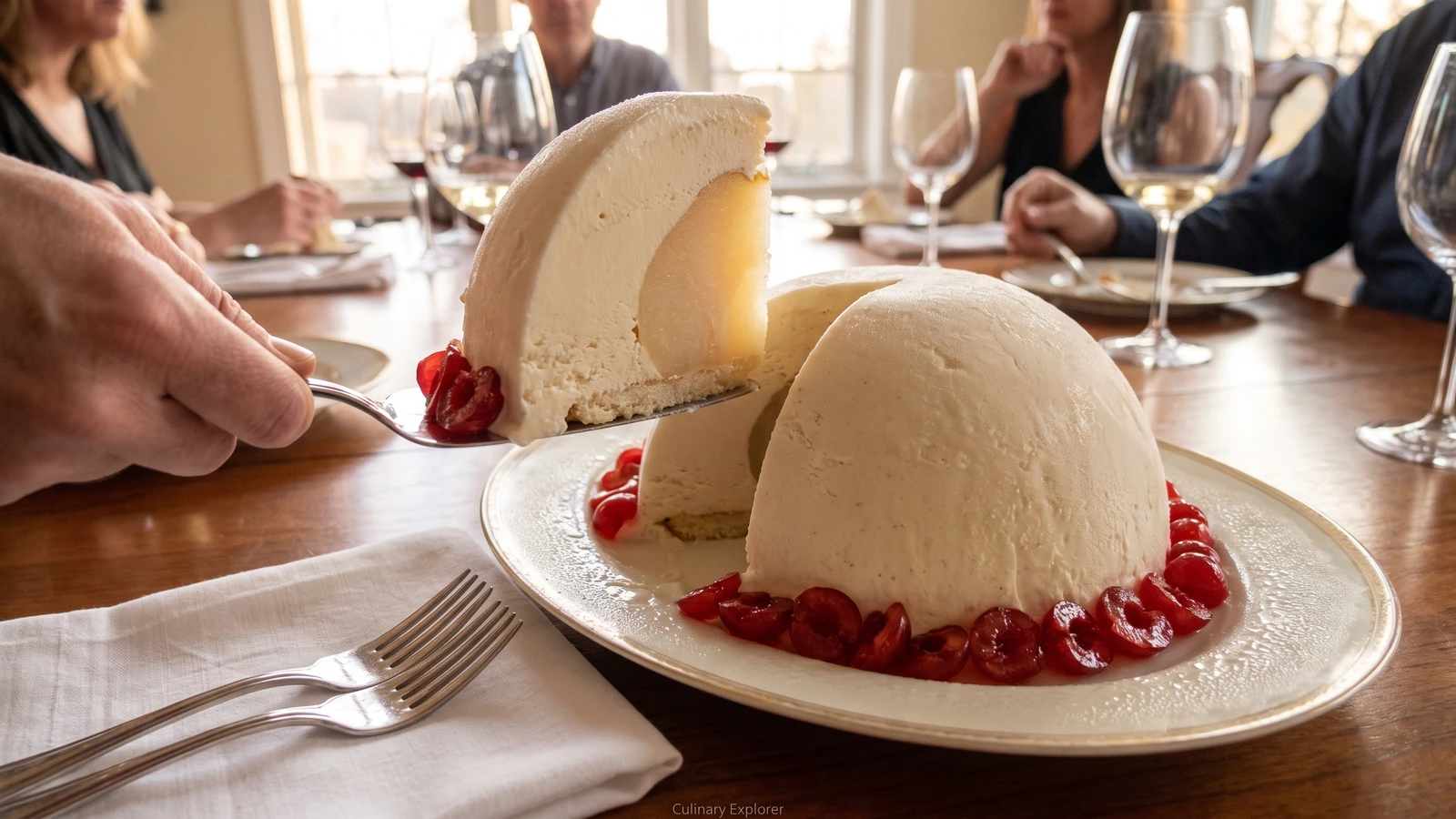
Bombe Colombia (Kirsch-lined pear frozen bombe) sets a bright cherry-spirit ice around a satin pear pâte à bombe, then rings the cold dome with candied cherries for a celebration dessert made ahead.
Bombe Colombia (Kirsch-lined pear frozen bombe) teaches one true thing about frozen fruit desserts: cold silences flavour, so the pears must be ripe enough to perfume the room before you touch a pan. Cook and sieve them until their flavour is concentrated, then fold that purée through pâte à bombe (a hot-syrup egg-yolk foam) and cream. The finished dome gives you a bright Kirsch shell, a soft ivory pear centre, and little red flashes of candied cherry around its base.
The original formula assumed a glacier tending salted ice, a dedicated metal bombe mould, prepared ices waiting in quantity, and several hands to assemble them. At home, a small ice cream machine or a shallow freezer tray replaces the hand-cranked sorbetière, an ordinary stainless-steel bowl replaces the special mould, and the quantities become one 1.5 litre bombe for eight. The separate ice station was brigade scaffolding and can go. The Kirsch shell, the cooked and sieved pears, and the pâte à bombe are the dish, so they stay. One cook, one stove, one evening of work, then the freezer keeps watch.
The step that decides everything is temperature. The pear purée and pâte à bombe must be cold before the whipped cream joins them, or the filling loses its air and freezes heavy. Chill each component fully, and the centre will cut like satin rather than ice.
The bombe glacée belongs to the grand confectionery repertoire of Paris, where layered ices were packed into rounded metal moulds and held in salted ice until service. Its name comes from that domed mould, while individual formulas received elaborate catalog titles according to their fillings and decoration. In Bombe Colombia, the formula itself settles any geographical confusion: this is a pear and Kirsch composition finished with candied cherries, not a claim to Colombian ingredients.
Quantity
1¼ cups (300 ml / 300 g)
for the Kirsch ice
Quantity
⅔ cup (160 ml / 135 g)
for the Kirsch ice
Quantity
3 tablespoons (45 ml / 42 g)
Quantity
4 medium (about 1½ pounds / 680 g whole)
peeled, cored, and diced
Quantity
2 tablespoons (30 ml / 25 g)
for the pears
Quantity
1 tablespoon (15 ml / 15 g)
Quantity
4 large
Quantity
½ cup (120 ml / 100 g)
for the pâte à bombe
Quantity
3 tablespoons (45 ml / 45 g)
for the pâte à bombe
Quantity
1¼ cups (300 ml / 300 g)
Quantity
12 (about ⅓ cup / 70 g)
halved
Quantity
1 technique reference (for clothing the mould only; no fish preparation added)
| Ingredient | Quantity |
|---|---|
| waterfor the Kirsch ice | 1¼ cups (300 ml / 300 g) |
| granulated sugarfor the Kirsch ice | ⅔ cup (160 ml / 135 g) |
| Kirsch | 3 tablespoons (45 ml / 42 g) |
| very ripe Bartlett or Comice pearspeeled, cored, and diced | 4 medium (about 1½ pounds / 680 g whole) |
| granulated sugarfor the pears | 2 tablespoons (30 ml / 25 g) |
| fresh lemon juice | 1 tablespoon (15 ml / 15 g) |
| pasteurized egg yolks | 4 large |
| granulated sugarfor the pâte à bombe | ½ cup (120 ml / 100 g) |
| waterfor the pâte à bombe | 3 tablespoons (45 ml / 45 g) |
| cold heavy cream | 1¼ cups (300 ml / 300 g) |
| red candied cherrieshalved | 12 (about ⅓ cup / 70 g) |
| Another Method of Preparing Aspics de Filets de Soles (No. 916) | 1 technique reference (for clothing the mould only; no fish preparation added) |
Combine the 1¼ cups water and ⅔ cup sugar in a small saucepan. Bring to a simmer, stirring only until the sugar dissolves, then simmer for 1 minute and remove from the heat. Cool completely before stirring in the Kirsch, so its fragrance stays bright. Churn in an ice cream machine until it resembles soft, finely packed snow. Without a machine, freeze it in a shallow metal tray, scrape it thoroughly every 30 minutes, then process the nearly frozen crystals until smooth. Measure the Kirsch, don't splash it freely: excess alcohol prevents a firm shell. If the ice remains loose after a proper chill, ça se rattrape. Blend in 2 tablespoons of cold water and freeze again.
Put the diced pears, 2 tablespoons sugar, and lemon juice into a covered saucepan. Cook over gentle heat for 8 to 12 minutes, stirring occasionally, until the fruit collapses under the spoon and smells strongly of pear. Remove the lid and cook away any loose juice, then purée and press the fruit through a fine sieve. You want about 1⅓ cups (330 ml / 340 g) of thick purée. If it runs from the spoon like juice, return it to the clean pan and reduce it gently; watery purée freezes into crystals. Cover and chill completely.
Use the clothing-the-mould operation preserved in Another Method of Preparing Aspics de Filets de Soles (No. 916), translated from jelly to ice. Pack the soft Kirsch ice against the bottom and sides of the frozen 1.5 litre mould, turning it as you work and smoothing the ice into an even layer about ¼ inch (6 mm) thick. The book's rocking over broken ice was brigade scaffolding; a prechilled metal mould and the back of a cold spoon give the same continuous lining at home. If the coating slides or exposes metal, return both mould and ice to the freezer for 10 minutes, then patch the thin place. Freeze the clothed mould until hard, at least 1 hour.
Begin beating the yolks at medium speed until they are pale and lightly thickened. Meanwhile, combine the ½ cup sugar and 3 tablespoons water in a small saucepan and cook without stirring to 244°F (118°C). If crystals form before the syrup reaches temperature, add 1 tablespoon water, cover the pan for 30 seconds so condensation washes the sides, and continue. Ça se rattrape. With the mixer running, pour the hot syrup in a thin stream down the inside of the bowl, never onto the moving whisk. Keep beating until the pâte à bombe is thick, holds a ribbon, and has cooled to room temperature, about 6 to 8 minutes. Hot sugar burns fiercely, so keep the bowl steady and don't touch or taste the syrup.
Whisk the cold cream to soft peaks, stopping while its surface remains smooth and supple. Fold the chilled pear purée into the cooled pâte à bombe, then fold in the cream in three additions, turning the bowl and lifting from underneath so the air stays in the mixture. If the filling loosens because one component was too warm, set the bowl over ice and continue folding slowly until it regains body. If the cream looks grainy from overwhipping, fold 1 tablespoon of unwhipped cream into it before combining.
Spoon the pear filling into the hard Kirsch-lined mould a little at a time, pressing each addition gently against the lining to prevent hollow pockets without crushing out all the air. Level the top, cover it directly with parchment and then wrap the mould well. Freeze on a level shelf until solid throughout, at least 6 hours and preferably overnight.
Chill the serving platter. Remove the wrapping and dip the outside of the mould in warm water for 5 to 8 seconds, keeping water away from the dessert. Dry it, invert it onto the platter, and lift straight upward. If it refuses to release, repeat the dip for only 2 seconds; patience, not a long bath, protects the Kirsch shell. If an edge softens, return the unmoulded bombe to the freezer for 15 minutes. Arrange the halved candied cherries in a generous ring around the base, let the bombe stand for 5 minutes so the centre cuts cleanly, and serve with a knife warmed and dried between slices. À table!
1 serving (about 200g)
Culinary guides, cultural storytelling, and the editorial depth that makes cooking meaningful.
Discover Culinary ExplorerChef Juliette
Five almond preparations, one discipline: remove the skins cleanly, dry every kernel through, then cut, toast, or cloak it in pale caramel without letting its fragrant oils escape.

Chef Juliette
A pastry pantry lesson in one tray: filberts warmed only until their red skins release, rubbed clean, cooled, and chopped into a fragrant mise-en-place for cakes, creams, pralines, and petits fours.

Chef Juliette
The smallest pâtisserie discipline decides whether a cake leaves its mould intact: clarified butter in every corner, followed by the lightest veil of dry flour or fécule.

Chef Juliette
Four whites, one spotless bowl, and a patient change of speed: whisk gently until loosened, then briskly to glossy stiffness, with powdered sugar waiting if the foam begins to granulate.